
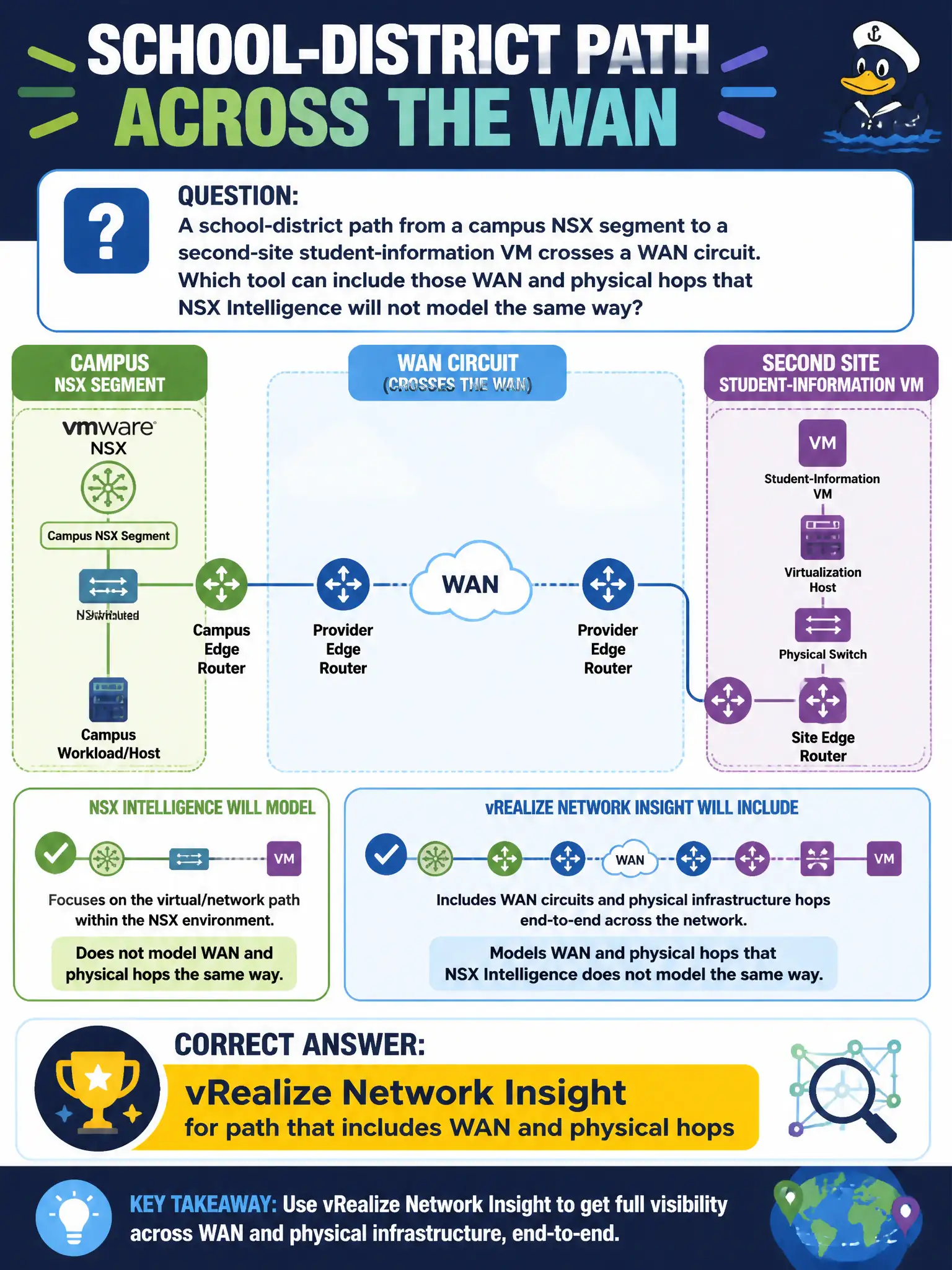
A school-district path from a campus NSX segment to a second-site student-information VM crosses a WAN circuit. Which tool can include those WAN and physical hops that NSX Intelligence will not model the same way?
Select an answer to reveal the explanation.
Short Explanation
Once the packet leaves NSX and rides a school WAN, Intelligence is looking at the wrong floor. vRNI can still draw WAN and physical hops. That broader path is why vRNI wins here.
Full Explanation
A school-district path from a campus NSX segment to a second-site student-information VM that crosses a WAN circuit needs vRealize Network Insight for path that includes WAN and physical hops. Once the packet leaves the NSX overlay and rides district WAN and physical infrastructure, Intelligence no longer models those hops the same way; vRNI still can draw the end-to-end path including WAN and metal. That broader path view is what multi-site student-information troubleshooting requires. NSX Intelligence alone, because it traces every WAN hop, fails by concept because Intelligence is NSX-centric overlay security visibility and does not replace WAN and physical hop analytics across sites. Carbon Black Cloud Enterprise EDR on the student-information VM fails by concept because EDR investigates endpoint behavior, not WAN-inclusive network path. Workspace ONE Tunnel as a substitute for WAN path analytics fails by concept because Tunnel provides managed per-app or device VPN connectivity, not underlay-plus-WAN path tracing. Exam caveat: when the path leaves NSX onto WAN and physical hops, choose vRNI; do not claim Intelligence, CBC, or Tunnel reconstruct that multi-site path. Operational check: run vRNI path from the campus segment to the second-site SIS VM, identify the failing WAN or physical hop, coordinate with WAN and LAN owners, retest overlay reachability, and archive the path in the school-district incident record for civic education IT governance.