
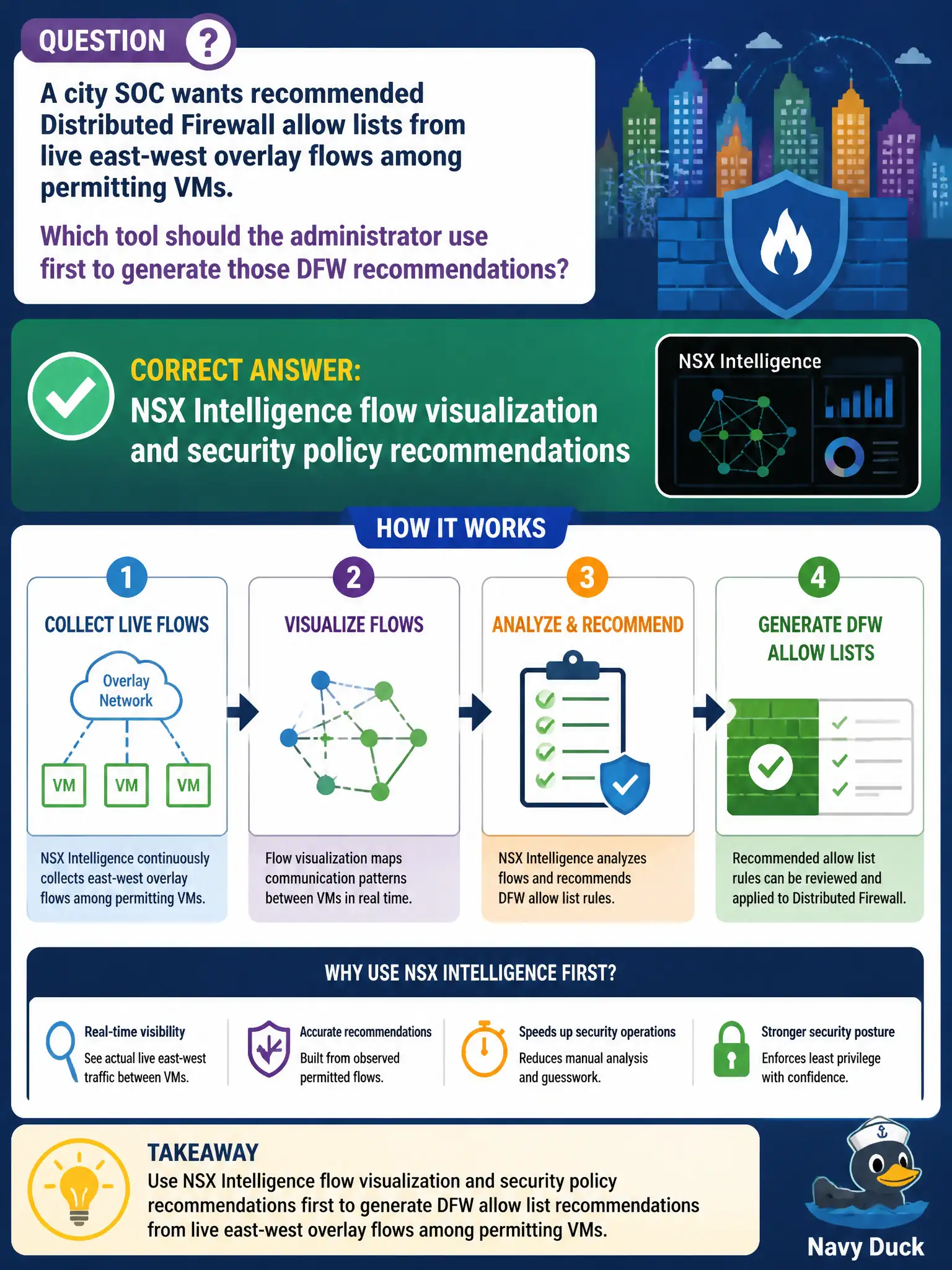
A city SOC wants recommended Distributed Firewall allow lists from live east-west overlay flows among permitting VMs. Which tool should the administrator use first to generate those DFW recommendations?
Select an answer to reveal the explanation.
Short Explanation
Think of Intelligence as a traffic camera already sitting on the NSX overlay that can draft the who-talks-to-whom list. vRNI is the bigger physical-plus-virtual map, not the first DFW recommendation engine. Start in Intelligence, then review the suggested allow list in policy.
Full Explanation
A city SOC that needs a first-pass Distributed Firewall allow list from live east-west overlay flows among permitting VMs should start with NSX Intelligence flow visualization and security policy recommendations. Intelligence sits on the NSX overlay, observes who talked to whom among those workloads, and drafts recommended DFW policy that micro-segmentation teams can review before publish. That is the civic security-operations path from observed permitting traffic to an allow-list draft without inventing rules from memory. vRealize Network Insight as the first engine that creates NSX DFW policy fails by concept because vRNI is the broader underlay-plus-overlay visibility and path product, not the NSX-native DFW recommendation engine Intelligence provides. Workspace ONE Access reports of SSO sessions to the permitting portal fail by concept because Access proves who authenticated to an application, not which overlay VMs exchanged east-west packets for DFW. Carbon Black Cloud process trees on the permitting endpoints fail by concept because endpoint process lineage is host prevention telemetry, not NSX overlay flow-to-policy recommendation. Exam caveat: for NSX-native DFW recommendations from overlay flows, Intelligence is first; do not equate vRNI path analytics, Access SSO, or Carbon Black process data with DFW allow-list generation. Operational check: open NSX Intelligence flow visualization for the permitting VM groups, generate recommendations, review suggested allow rules against civic least-privilege, publish only after peer review, and confirm hit counts on a pilot segment. Keep the recommendation export with the municipal micro-segmentation runbook so audits can prove the control was derived from observed civic traffic.