
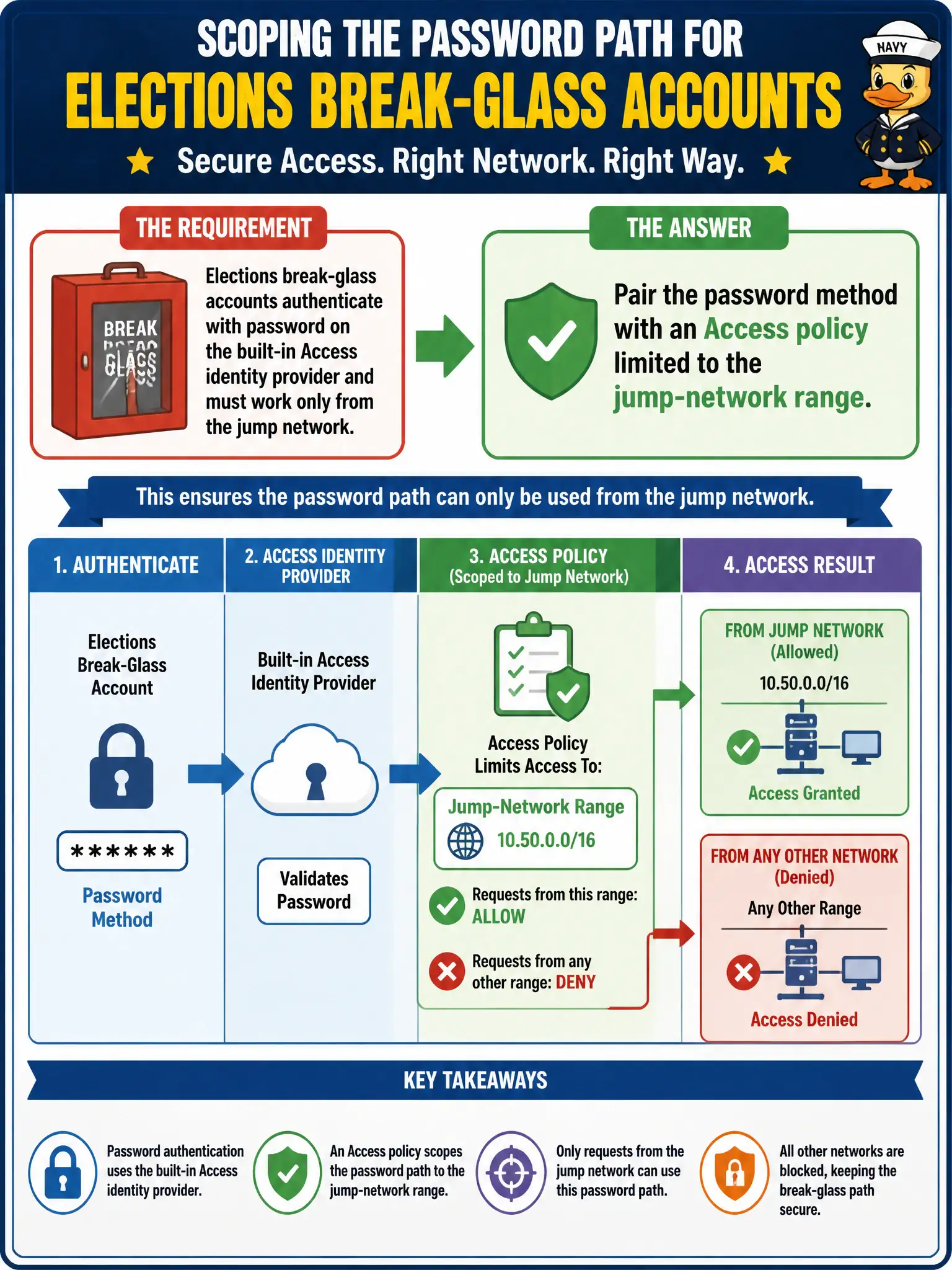
Elections break-glass accounts authenticate with password on the built-in Access identity provider and must work only from the jump network. How should that password path be scoped?
Select an answer to reveal the explanation.
Short Explanation
A break-glass password is a master key—you still keep it in a locked cabinet. Leave password on the built-in IdP, but only from the jump-network range on that Access policy, not from the open internet.
Full Explanation
Pair the password method for elections break-glass accounts on the built-in Access identity provider with an Access policy limited to the jump-network range so those powerful local passwords only work from the approved recovery network. Break-glass password paths need network conditioning to reduce remote abuse while remaining available on the jump segment during enterprise IdP failures. Enabling password for those accounts from any network expands the blast radius and contradicts jump-network scoping for elections recovery. Moving the password method into Carbon Black drops Access policy controls that actually gate Hub authentication and misplaces the control. Replacing the network-range condition with an NSX overlay segment that has no Access policy abandons Access conditional access for a network construct that does not enforce Hub password method scope. Exam caveat: Access network-range conditions on policies are the correct lever for source-network limits on authentication methods. Operational check: set the jump-network range on the break-glass policy, confirm success from jump hosts and failure elsewhere, inventory break-glass accounts, and record ranges in the elections contingency runbook so civic election-support recovery stays tightly controlled.