
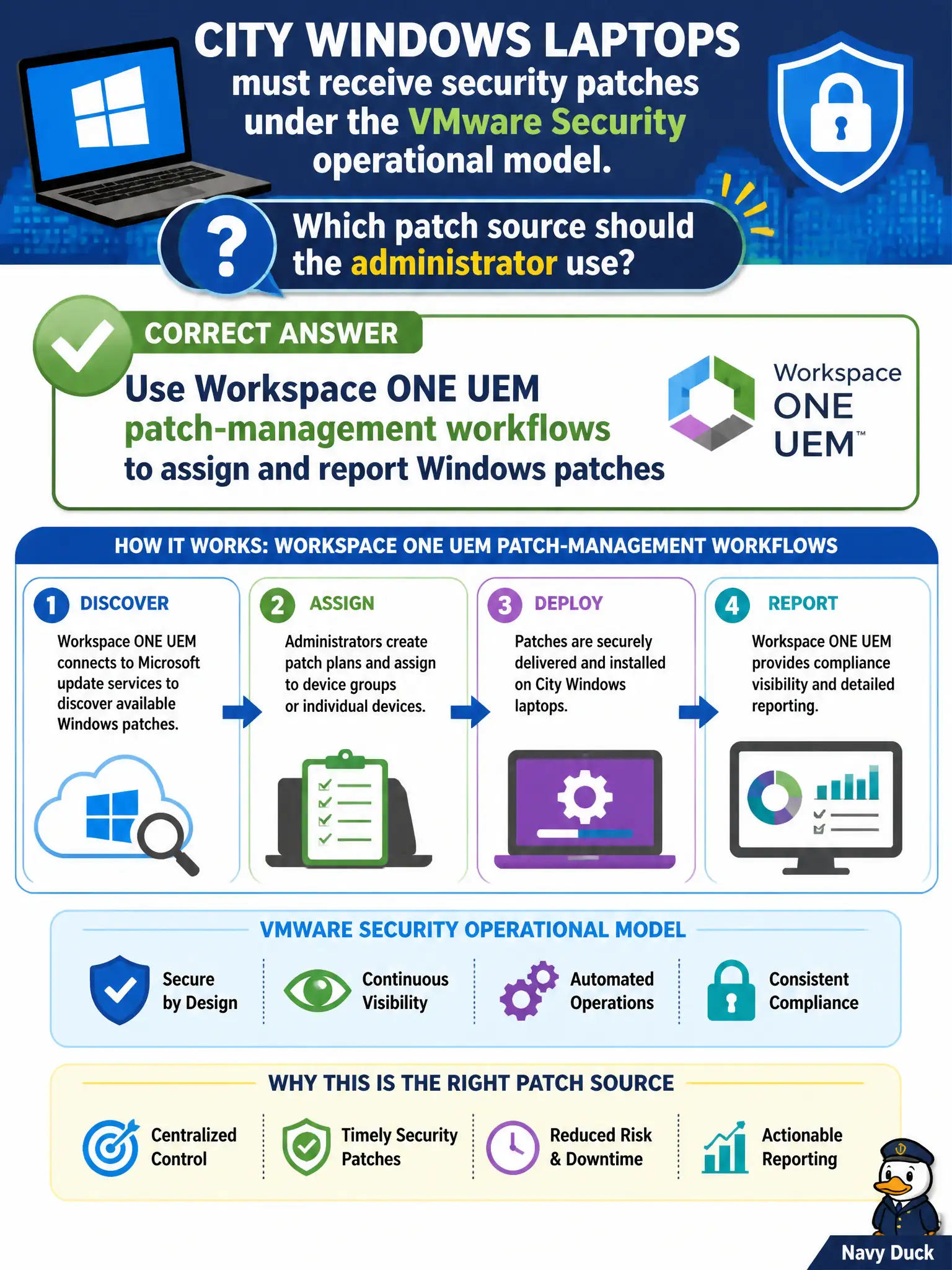
City Windows laptops must receive security patches under the VMware Security operational model. Which patch source should the administrator use?
Select an answer to reveal the explanation.
Short Explanation
Patching city laptops is a Workspace ONE job, not an NSX plumbing trick. Use UEM patch workflows so assignment and reporting live in the same console as the devices.
Full Explanation
City Windows laptops must receive security patches under the VMware Security operational model by using Workspace ONE UEM patch-management workflows to assign and report Windows patches. Treat UEM patch workflows as the city fleet garage that both installs the update and proves it landed on the laptop roster. Publishing Windows updates only through an unmanaged WSUS that UEM cannot report fails by concept because unmanaged WSUS without UEM reporting breaks the operational visibility the model requires. Pushing OS patches with NSX-T Service Insertion because it sits on the hypervisor fails because Service Insertion is for network security services, not Windows KB distribution to laptops. Waiting for Carbon Black Cloud to install Microsoft KBs as part of sensor updates fails because CBC sensor updates are not the Windows patch-management source. Exam caveat: Windows security patching in this stack is Workspace ONE UEM patch management with assign-and-report workflows; unmanaged WSUS-only, Service Insertion, and CBC sensor updates are not the patch source. Operational check: assign a test KB via UEM to a city laptop smart group, confirm install and compliance reporting, remediate failures from the patch dashboard, and document UEM as the patch source of record.