
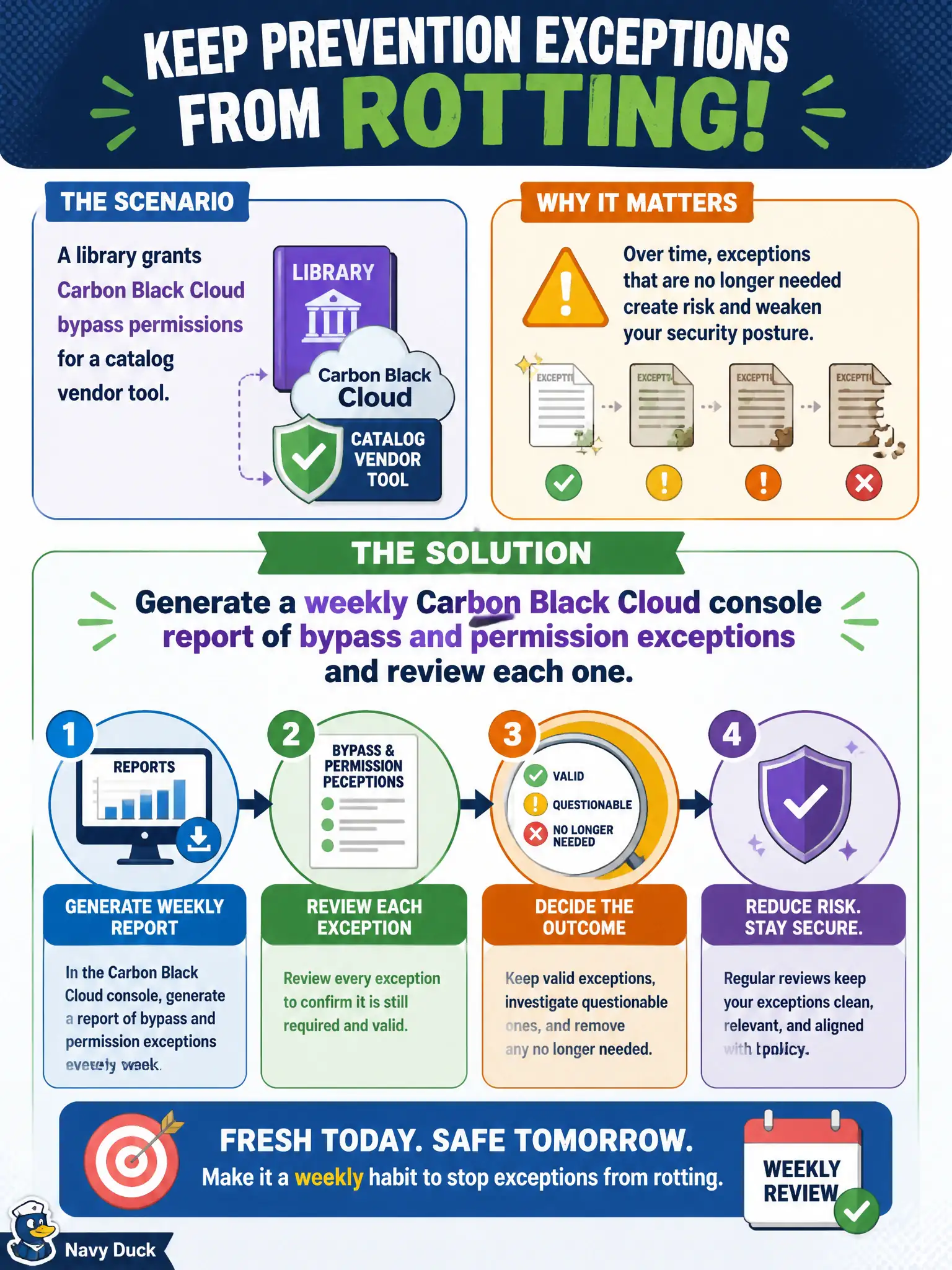
A library grants Carbon Black Cloud bypass permissions for a catalog vendor tool. How should the administrator keep those prevention exceptions from rotting?
Select an answer to reveal the explanation.
Short Explanation
A bypass is a library after-hours key. If nobody checks the key ring, it lives forever. Run the weekly Carbon Black Cloud exception report and take back keys the vendor no longer needs.
Full Explanation
When a library grants Carbon Black Cloud bypass permissions for a catalog vendor tool, the administrator keeps those prevention exceptions from rotting by generating a weekly Carbon Black Cloud console report of bypass and permission exceptions and reviewing each one. Treat bypass as temporary library loading-dock passes that must be re-checked every week or they accumulate into permanent open doors. Disabling all Carbon Black Cloud prevention so exceptions never appear fails by concept because turning prevention off eliminates the control rather than managing exceptions. Treating bypass as a permanent NSX-T exclusion with no Carbon Black Cloud reporting fails because NSX exclusion is a different plane and does not inventory CBC bypass permissions. Filing the original change ticket and never reopening the Carbon Black Cloud console fails because a closed ticket is not continuous exception hygiene. Exam caveat: CBC bypass and permission exceptions weaken prevention and require recurring console reporting and review; disabling prevention, silent NSX exclusion, or ticket archival alone lets exceptions rot. Operational check: schedule a weekly CBC bypass and permissions report, revoke unused vendor exceptions, keep only justified scoped bypass with owners and expiry, and attach the review log to the library endpoint exception register.