
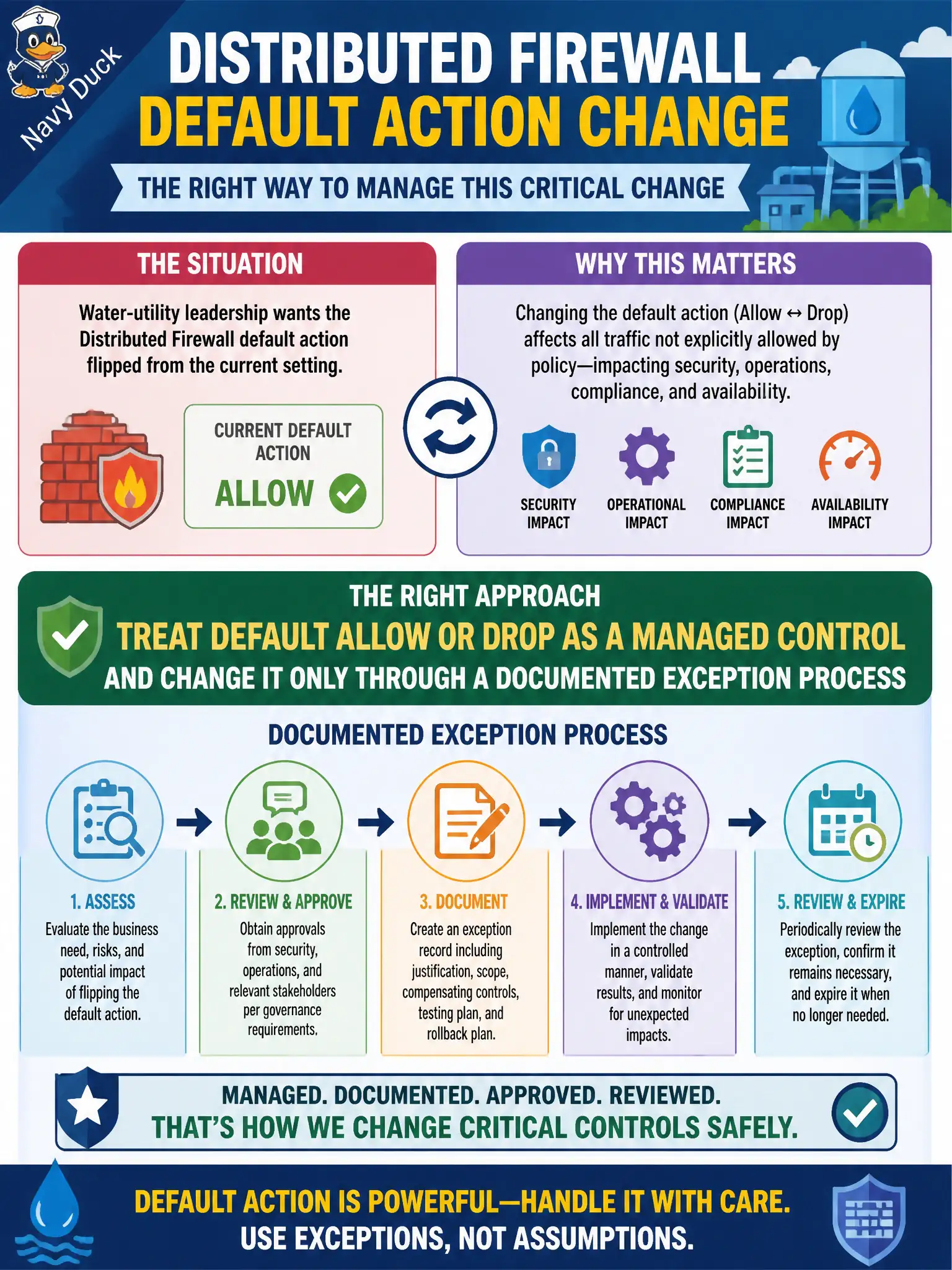
Water-utility leadership wants the Distributed Firewall default action flipped from the current setting. How should the administrator treat that change?
Select an answer to reveal the explanation.
Short Explanation
The default action is the last door in the plant. Leave it open or slam it shut only with a signed exception, not a casual toggle.
Full Explanation
When water-utility leadership wants the Distributed Firewall default action flipped, the administrator must treat default allow or drop as a managed control and change it only through a documented exception process. Treat the default action as the last gate at the end of every utility hallway: flipping it is a data-center-wide decision, not a casual toggle. Changing it in production immediately because default action is not a real control fails by concept because unmatched traffic follows that default and the change has estate-wide effect. Allowing developers to toggle default action from a guest script fails because guests must not control the NSX Distributed Firewall default and scripts bypass change control. Encoding default action as a Workspace ONE UEM compliance rule fails because UEM compliance governs endpoint posture, not the NSX-T Distributed Firewall default rule. Exam caveat: the DFW default rule is an operational control changed only under documented exception; guest scripts and UEM compliance are not the change path. Operational check: record the current production default action, open a documented exception if a flip is required, apply only after peer review and rollback planning, verify unmatched traffic behavior, and archive the change record for auditors.