
A county highway department plans to solicit bids for a roadway resurfacing and sub-base repair project where engineers know the surface lane-miles but cannot determine exact cubic yards of deteriorated sub-base until milling begins. Which contract pricing structure should the buyer select during pre-solicitation planning?
Select an answer to reveal the explanation.
Short Explanation
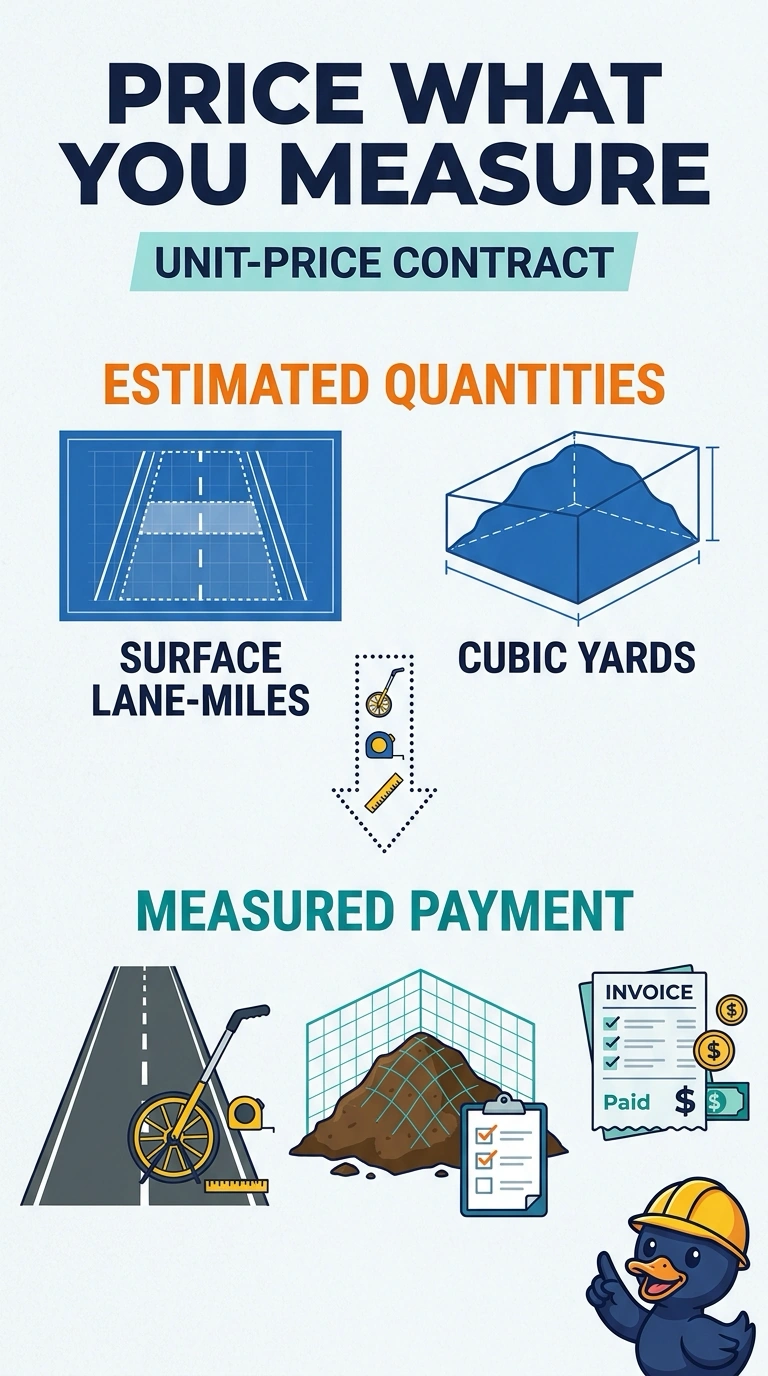
When you know the price per scoop of dirt you need, just not how many scoops are hiding under the pavement, unit pricing keeps both sides honest. The trap is forcing a lump-sum bid onto unknown underground conditions, which pushes contractors to pad their prices heavily against worst-case surprises.
Full Explanation
A unit-price contract based on estimated quantities with measured payment allocates quantity risk fairly when the type of work is well defined but final field quantities remain uncertain until excavation or milling occurs. Bidders compete on fixed unit rates applied to good-faith estimated quantities, and the agency pays only for verified, measured work performed. A lump-sum firm-fixed-price contract based on the engineers' estimate of sub-base quantities still forces a single total price despite uncertain hidden conditions, forcing bidders to include large contingency markups or driving contentious change-order disputes once actual damage exceeds the estimate. A cost-plus-percentage-of-cost contract reimbursing actual expenses plus a fixed markup rate is generally prohibited in public procurement because it rewards higher contractor spending rather than cost control. A blanket purchase agreement priced from the contractor's catalog discounts is designed for repetitive small supply orders at catalog pricing, not major capital roadway construction requiring firm competitive pricing, defined scope, and bonding. One caveat is that unit-price estimates must be realistic to prevent materially unbalanced bidding across line items. As an operational check, confirm that engineering estimates include clear measurement and payment clauses specifying how field quantities will be verified.
Prefer to study offline? Printable PDF study book + test engine ($7.50, unofficial). These questions stay free here.