
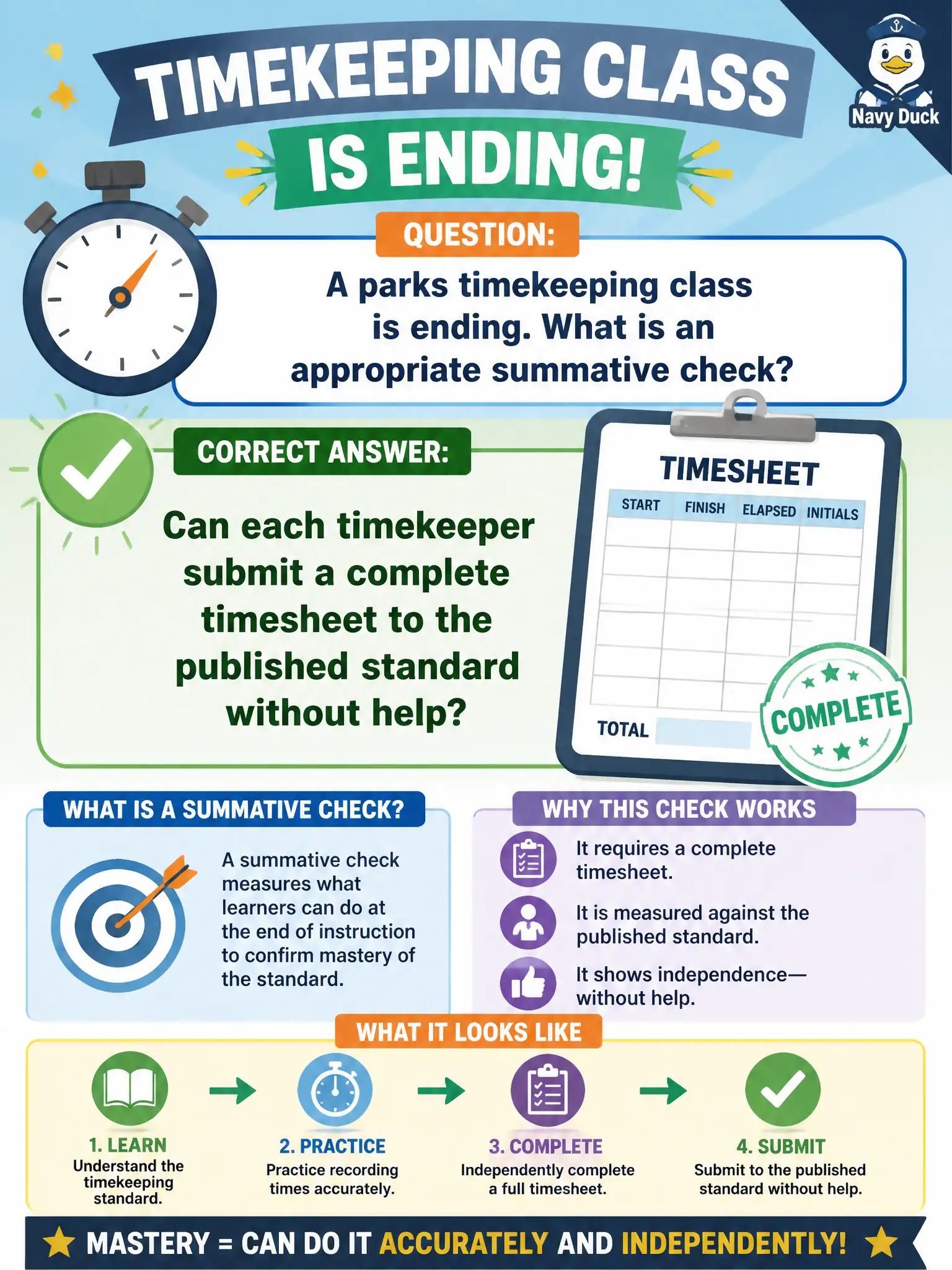
A parks timekeeping class is ending. What is an appropriate summative check?
Select an answer to reveal the explanation.
Short Explanation
Summative is the last mile: can they file a complete timesheet on their own? Coffee ratings and leftover slides are not the finish line.
Full Explanation
As a parks timekeeping class ends, an appropriate summative check asks whether each timekeeper can submit a complete timesheet to the published standard without help. Summative evaluation measures end-of-event achievement against the objective, not hospitality or instructor convenience. Asking whether learners enjoyed coffee and jokes fails validity; reaction is not timesheet competence. Tracking who left early for softball fails to measure the skill objective. Asking whether the instructor can finish leftover slides after close measures instructor pacing, not learner performance. Exam caveat: summative questions target the published performance, independently demonstrated. Operational check: have each timekeeper submit a complete timesheet in the system or on the official form without coaching, score against the completeness standard, record results, and remediate any missing fields before signing the class closed. Parks payroll depends on complete timesheets submitted to standard; a summative that asks whether each timekeeper can finish that task without help answers the city’s question, while coffee ratings and softball departures do not. Keep the civic standard visible on the rubric so every rater and learner sees what "met" means.