
Two election trainers will score poll-worker mock precincts. What keeps evaluation standards uniform?
Select an answer to reveal the explanation.
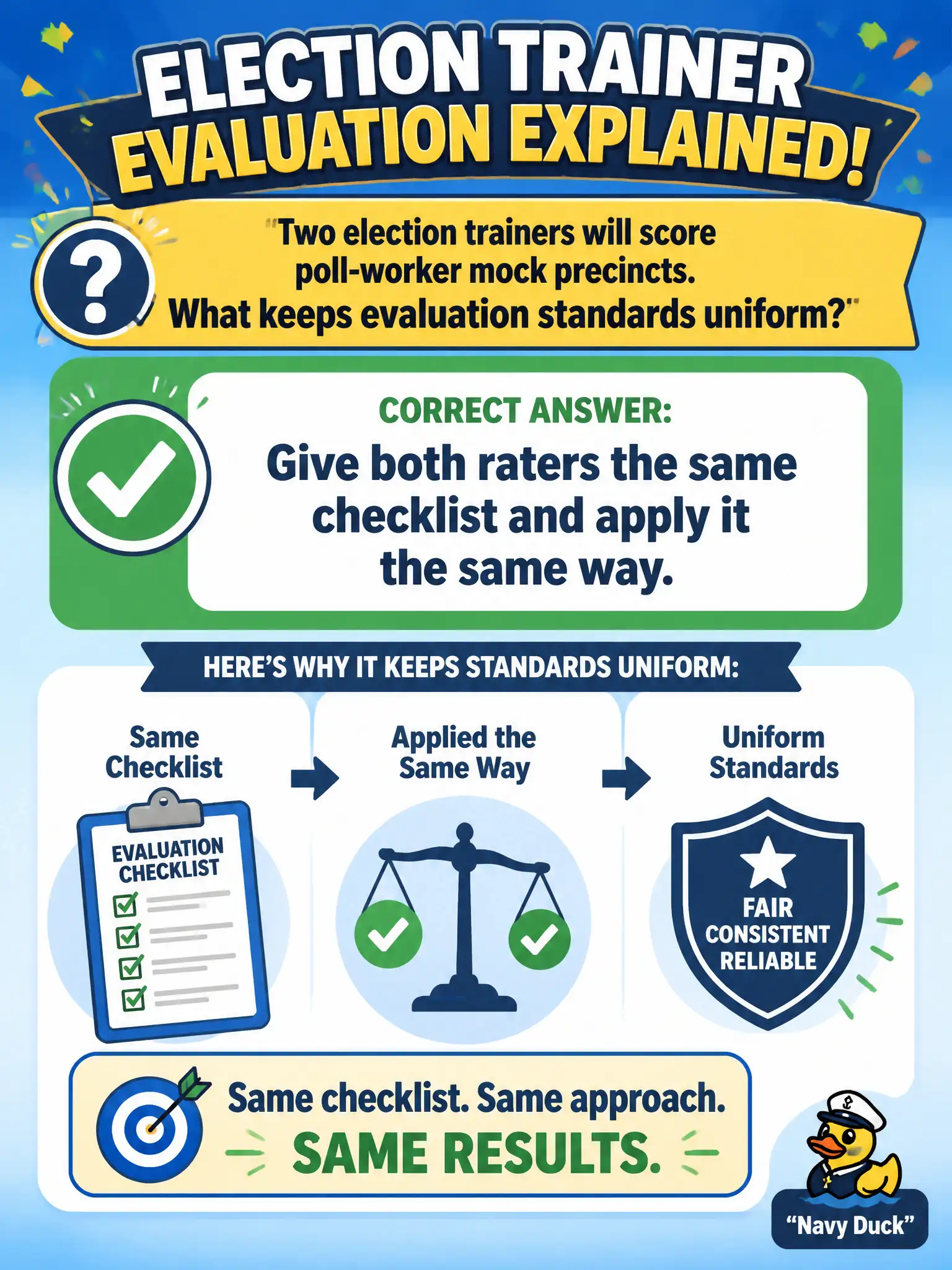
Short Explanation
Two judges, one scorecard. If each trainer grades by feel, the same precinct walk-through gets two different verdicts. Hand them the same checklist and use it.
Full Explanation
When two election trainers will score poll-worker mock precincts, uniform evaluation requires giving both raters the same checklist and applying it the same way. Shared instruments and shared application prevent drift that would certify some poll workers on courtesy while others are judged on speed for the same civic task. Letting each rater invent a personal scoring style fails standardization. Having only the more senior rater score favorite learners fails fairness and introduces bias. Scoring the first shift on courtesy and the second on speed fails construct consistency across the event. Exam caveat: identical checklists plus calibrated application keep municipal evaluation standards uniform. Operational check: train both raters on the checklist with sample videos or live pilots, compare scores on a common mock precinct until agreement is acceptable, then score live mock precincts with the same tool and document any remaining discrepancies for adjudication. Poll-worker mock precincts certify civic election readiness; when two trainers share one checklist and apply it the same way, voters are protected from uneven standards that would otherwise vary by rater personality or shift preference.