
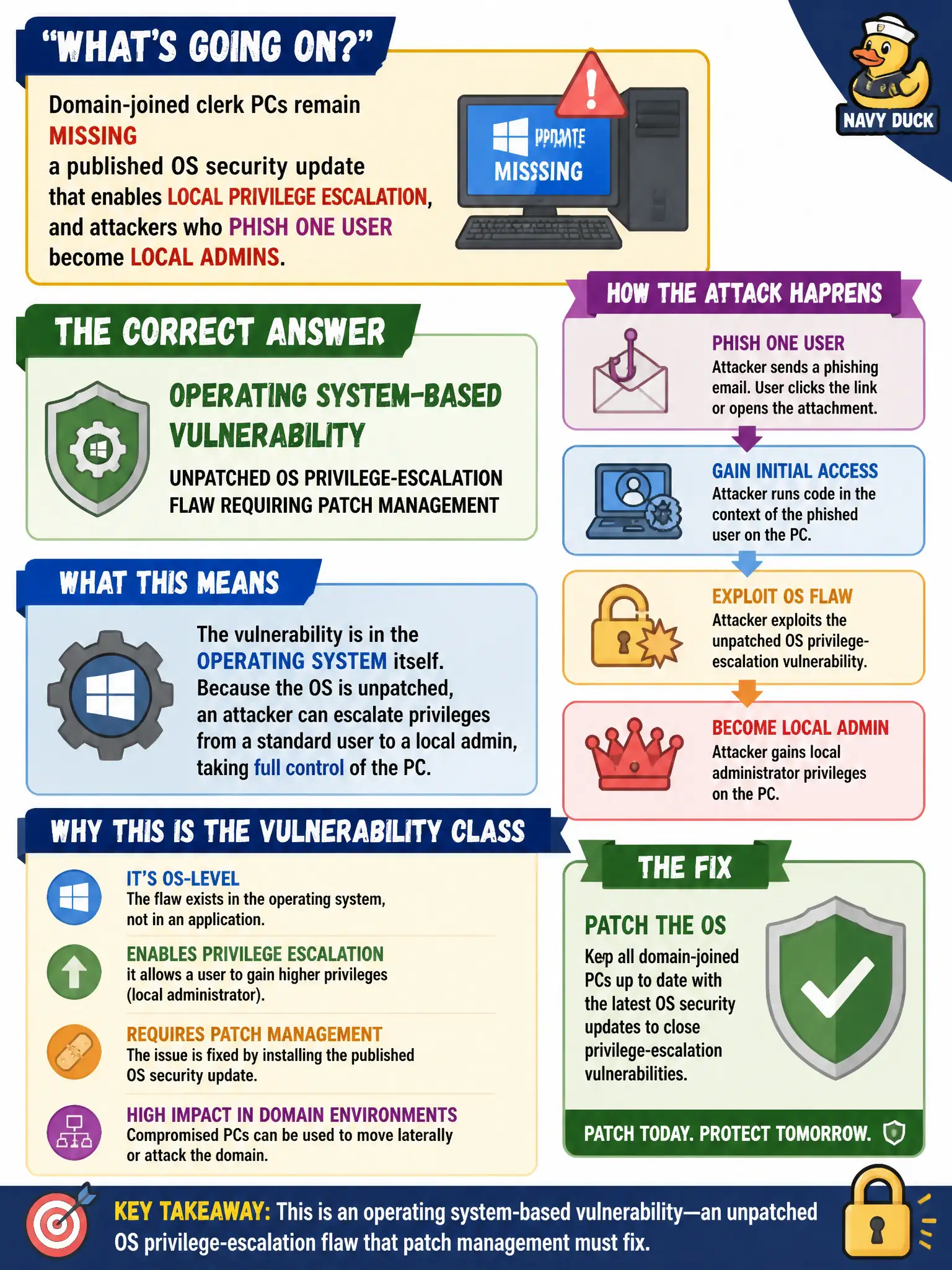
Domain-joined clerk PCs remain missing a published OS security update that enables local privilege escalation, and attackers who phish one user become local admins. Which vulnerability class best describes the missing fix?
Select an answer to reveal the explanation.
Short Explanation
Missing the OS privilege-escalation patch means the operating system itself is the soft spot — classic OS-based vulnerability. Patch management is the cure, not blaming a public bucket or a map image. Keep clerk fleets current so phishing does not equal instant admin.
Full Explanation
Operating system-based vulnerability refers to flaws in the OS itself—here a published privilege-escalation bug on domain-joined clerk PCs that remains unpatched. Attackers who phish a standard user can then elevate to local admin using the missing fix, turning a single credential compromise into durable host control. Patch management is the primary control; the vulnerability class is the OS flaw, amplified by delayed remediation.
Cloud storage misconfiguration leaving a bucket publicly readable exposes objects via cloud ACLs. It is not an unpatched OS privilege-escalation on clerk endpoints.
Image-based delivery of malware through a GIS map file is a media/delivery vector. The class asked here is the missing OS security update enabling elevation after phishing.
MSP remote-support tooling used as a supply-chain entry point abuses trusted vendor access channels. The stem focuses on absent OS patches enabling local privilege escalation after user compromise.
Exam caveat: OS-based vulnerabilities are patched via OS updates, distinct from application, firmware, and cloud-config classes. Privilege escalation after phishing is a common exam chain: initial access via social engineering, impact magnified by missing OS patches. Do not blame only phishing when the question asks for the vulnerability class of the missing fix.
Operational check: enforce rapid deployment of privilege-escalation patches to clerk fleets, use ringed rollouts with quick enterprise-wide follow-through, verify patch compliance in inventory, enable attack-surface reduction and least privilege so users are not local admins by default, and assume phished sessions will attempt elevation. Municipal SOC playbooks should correlate phishing incidents with endpoints missing critical OS updates.