
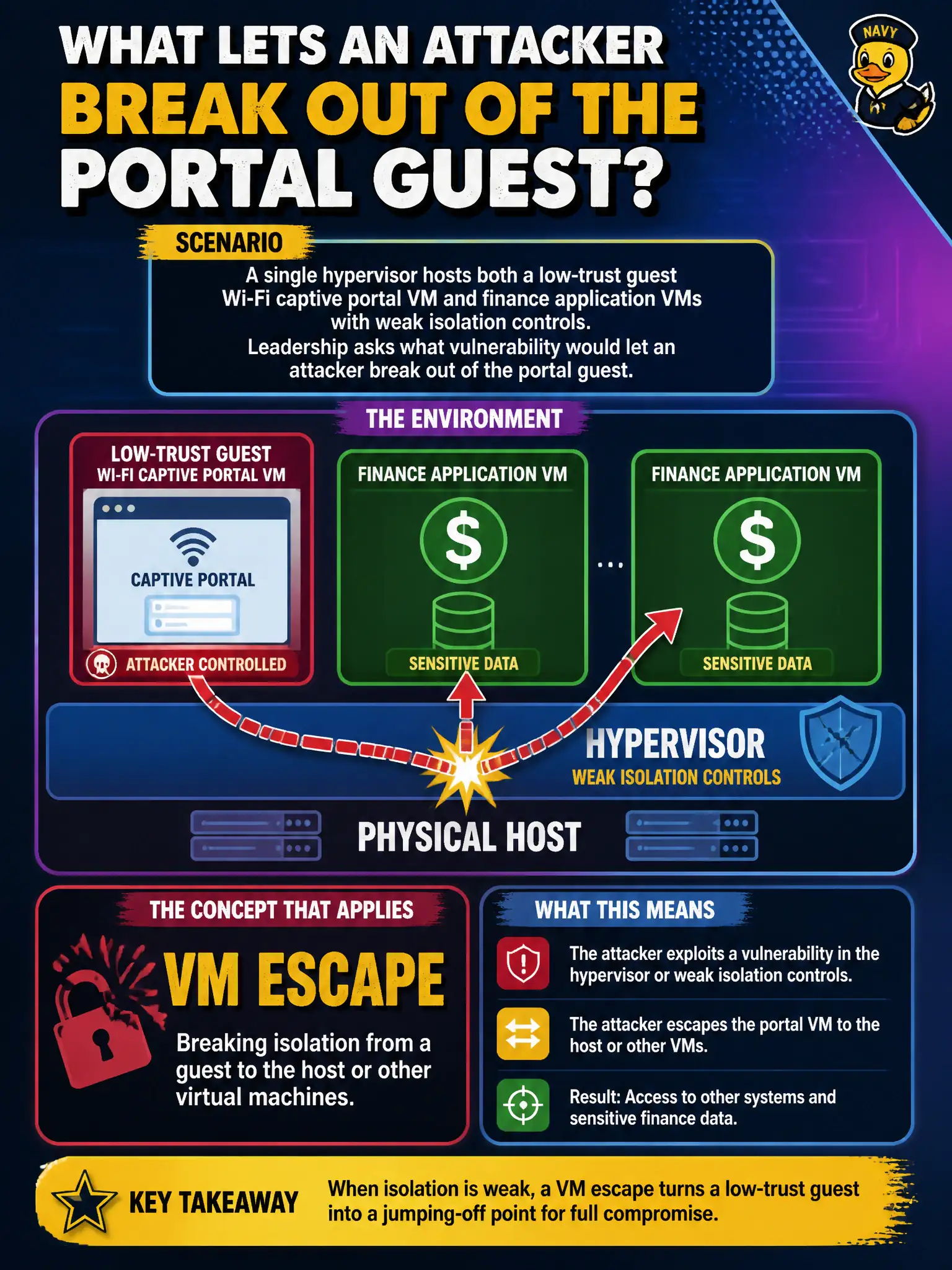
A single hypervisor hosts both a low-trust guest Wi-Fi captive portal VM and finance application VMs with weak isolation controls. Leadership asks what vulnerability would let an attacker break out of the portal guest. Which concept applies?
Select an answer to reveal the explanation.
Short Explanation
If malware in the guest Wi-Fi portal can climb into the hypervisor or next-door finance VMs, that is VM escape — isolation just failed. Keep low-trust and high-trust workloads apart; SMS phishing and public buckets are different headaches. Hypervisor patching and segregation matter for civic mixed tenancy.
Full Explanation
VM escape is breaking isolation from a guest virtual machine to the hypervisor or to other virtual machines on the same host. Hosting a low-trust guest Wi-Fi captive portal VM beside finance application VMs with weak isolation creates a path where compromise of the portal guest could threaten higher-trust workloads. The vulnerability concept is failed virtualization boundary enforcement—not the guest Wi-Fi business function itself.
Smishing delivers social engineering only over SMS. It does not describe hypervisor or inter-VM breakout.
Typosquatting a vendor domain to redirect ACH is BEC/payment fraud. Co-location risk on a hypervisor is a virtualization isolation topic.
Leaving public object storage readable without authentication is cloud misconfiguration. It is unrelated to escaping a portal VM on a municipal hypervisor.
Exam caveat: VM escape questions hinge on guest-to-host or guest-to-guest isolation failure. Mixing trust levels on one hypervisor without strong controls is the operational setup that makes escape impactful. Distinguish from simple network VLAN issues unless the stem explicitly centers virtualization breakout.
Operational check: do not co-host low-trust captive portals with finance VMs; use separate clusters or hosts, keep hypervisors patched, enable isolation features, restrict VM console and management plane access, and monitor for anomalous hypervisor activity. Treat guest Wi-Fi infrastructure as hostile when designing municipal virtualization layouts.