
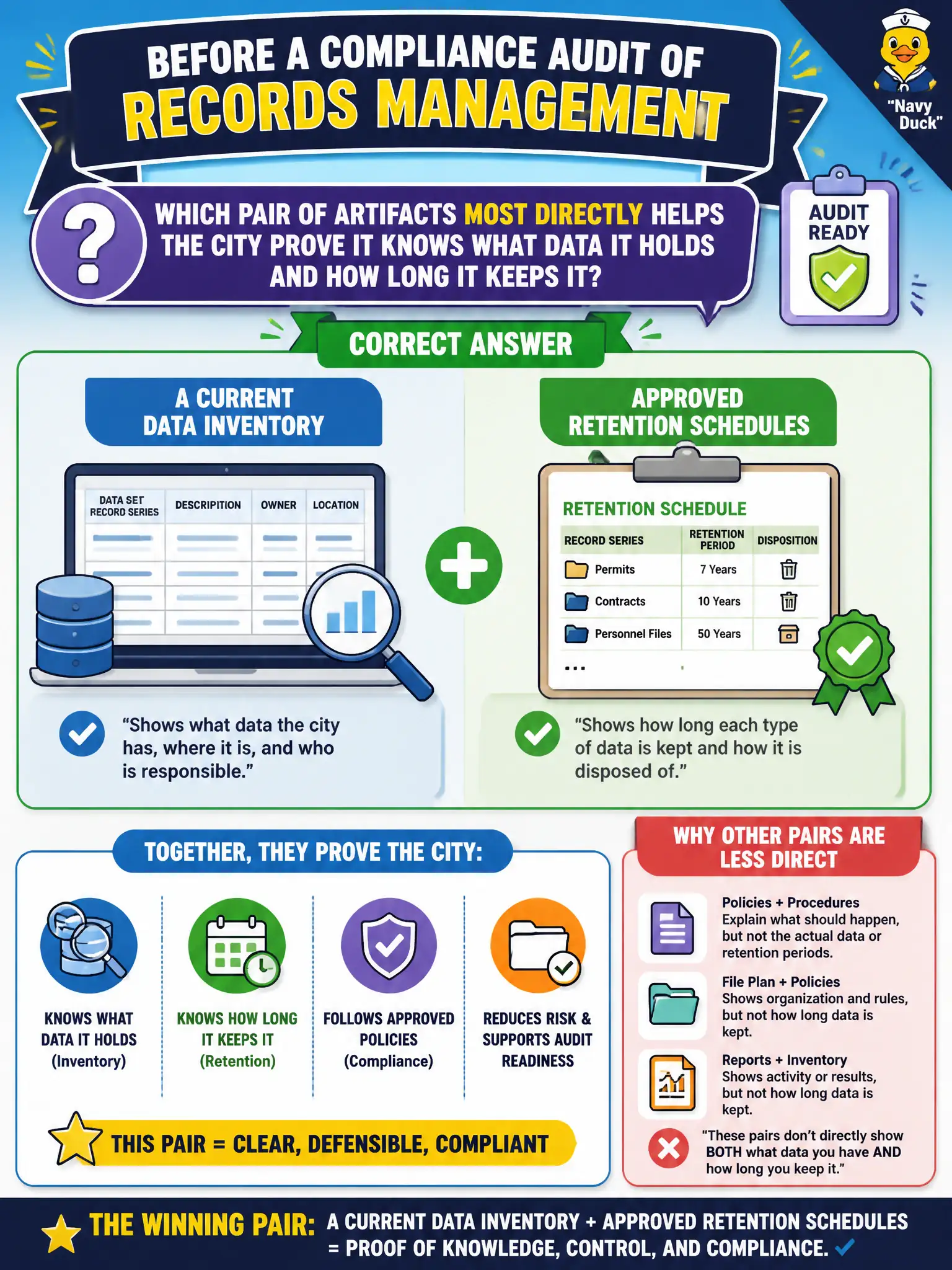
Before a compliance audit of records management, which pair of artifacts most directly helps the city prove it knows what data it holds and how long it keeps it?
Select an answer to reveal the explanation.
Short Explanation
Auditors love maps and calendars for data: what you’ve got and when it leaves. Inventory plus retention schedules beat a pile of mystery folders every time.
Full Explanation
Proving records-management compliance starts with knowing what you hold and how long you keep it. A current data inventory paired with approved retention schedules gives auditors a map of systems, data categories, owners, and disposal or archival timelines. That pair directly answers the foundational questions of inventory and lifecycle control for municipal records that mix resident case files, operational logs, and public archives.
Marketing slogans and an untracked shared drive of old posters demonstrate neither inventory currency nor authorized retention. CEO calendar notes from a council retreat are anecdotal leadership artifacts, not a controlled data map. A physical visitor log with no link to systems or retention rules may be one operational record, but alone it does not prove enterprise knowledge of holdings or disposal rules.
Exam caveat: SY0-701 compliance and data-governance questions often pair data inventory with retention schedules as the core evidence set. Decorative or incomplete artifacts are distractors.
Operational check: maintain an inventory that lists applications, data types, stewards, storage locations, and classification. Link each category to a retention schedule approved through records management or counsel. Sample quarterly for orphan shares and systems missing schedule mappings; remediate before external audit fieldwork begins.