
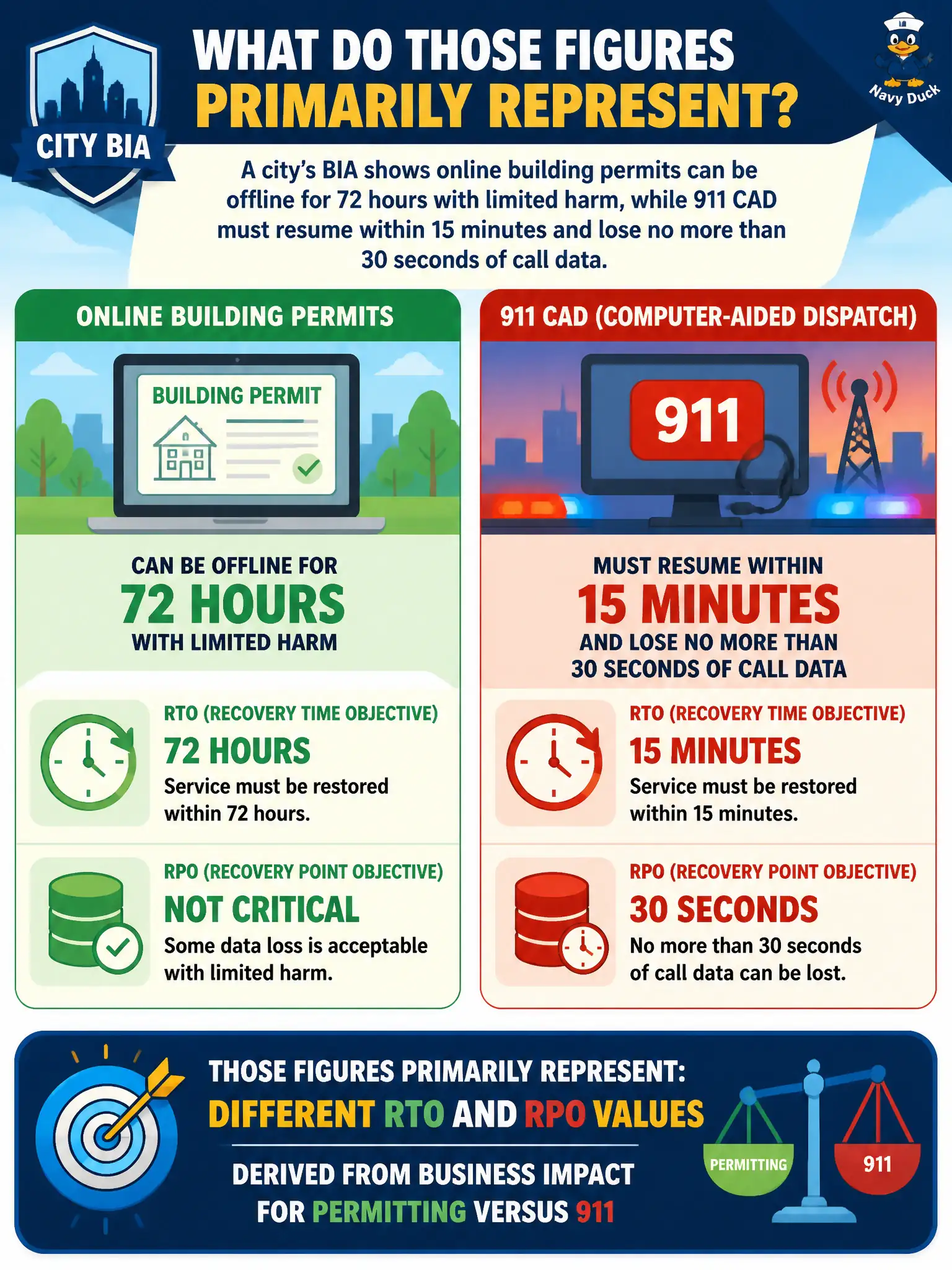
A city's BIA shows online building permits can be offline for 72 hours with limited harm, while 911 CAD must resume within 15 minutes and lose no more than 30 seconds of call data. What do those figures primarily represent?
Select an answer to reveal the explanation.
Short Explanation
BIA is asking each city service how long it can be down and how much data it can lose before citizens get hurt. Permitting can nap for days; 911 needs a near-instant wake-up with almost no forgotten calls—that's RTO and RPO talking.
Full Explanation
Business impact analysis derives recovery time objectives and recovery point objectives from how long processes can be down and how much data loss is tolerable before the organization suffers unacceptable harm. Online building permits that can be offline for 72 hours with limited harm receive a relatively relaxed RTO, while 911 CAD that must resume within 15 minutes and lose no more than 30 seconds of call data receives aggressive RTO and RPO values. Those figures are different by design because impact differs across municipal services. Identical RTO and RPO values forced to be the same for every city system contradict BIA practice. Uniform objectives either overspend on low-impact services or under-protect life-safety systems; the exam expects differentiation from impact analysis. Only MTBF numbers for hard-disk mean life address component reliability statistics, not process-level recovery objectives from a BIA. MTBF may inform availability design but is not what the 72-hour versus 15-minute figures primarily represent. Vendor SLA credits unrelated to continuity needs are commercial remedies for service shortfalls. Credits do not define the city's internal RTO/RPO requirements derived from citizen and safety impact. Exam caveat: BIA outputs RTO and RPO tailored to each process's impact. When a stem contrasts permitting versus 911 timing and data-loss limits, recognize differentiated recovery objectives, not one global number or unrelated metrics. Operational check: Trace permitting and 911 objectives back to BIA worksheets, ensure DR designs and contracts can meet the tighter 911 RTO/RPO, and avoid applying the 72-hour permitting RTO to emergency systems.