
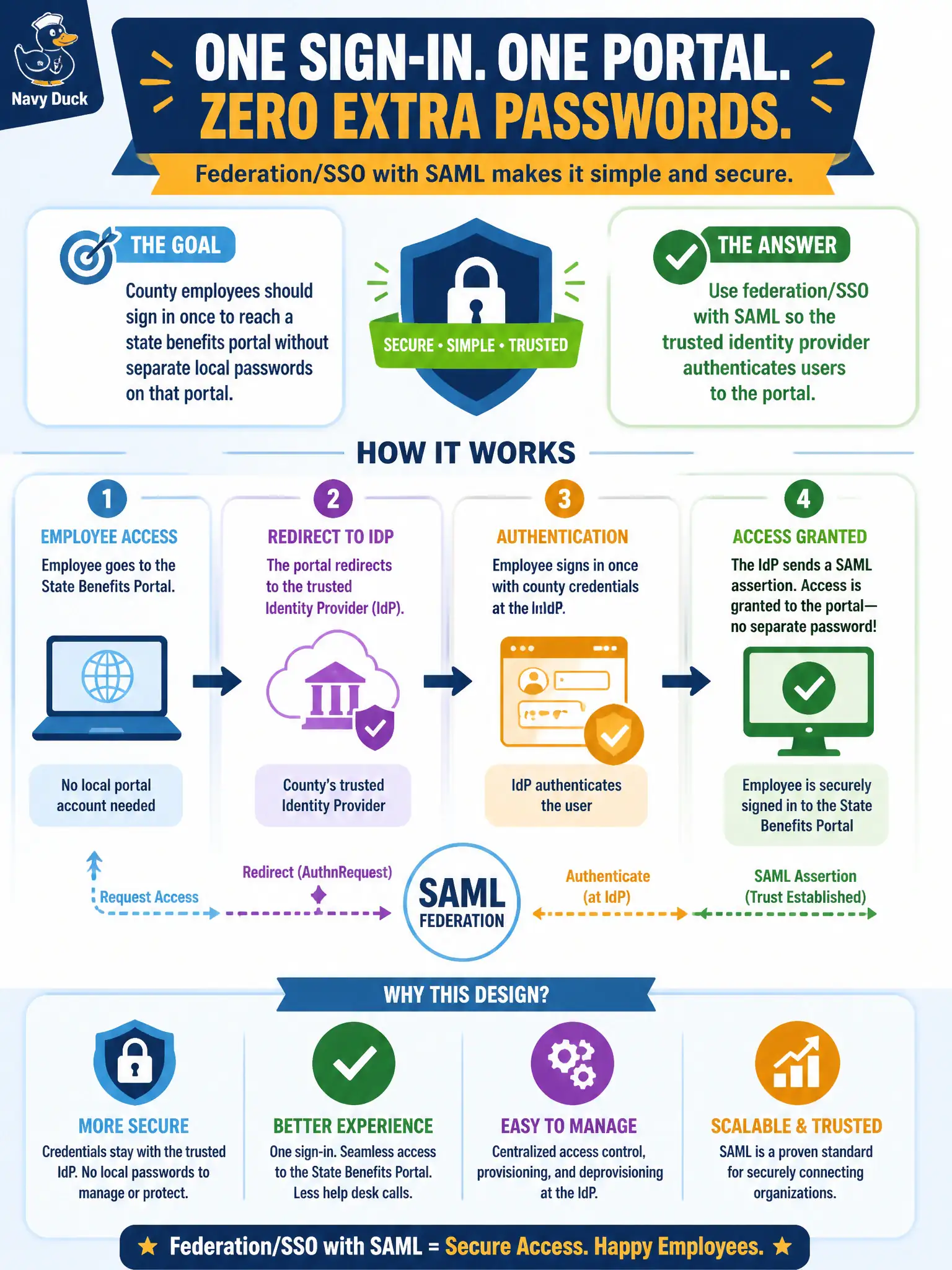
County employees should sign in once to reach a state benefits portal without separate local passwords on that portal. Which approach best describes this design?
Select an answer to reveal the explanation.
Short Explanation
Federation with SAML is the county ID badge that the state portal also accepts—you prove who you are once at the trusted desk, then walk through without inventing another password.
Full Explanation
County employees reaching a state benefits portal should authenticate once through a trusted identity provider rather than maintaining a separate local password on that portal. Federation and single sign-on using SAML (or comparable federation protocols) let the county IdP assert the user's identity to the relying party portal, so authentication happens at the trusted desk and the portal consumes a signed assertion instead of storing yet another password database. That design reduces password sprawl, centralizes MFA and disablement for municipal staff, and matches how inter-agency portals commonly integrate.
Storing every portal password in a shared spreadsheet concentrates secrets in a high-value, weakly controlled file and destroys individual accountability. Disabling authentication on the benefits portal for convenience exposes citizen and employee benefits data to anyone who can reach the site. Forcing a new unique portal password that never syncs with county identity recreates password-fatigue risk and leaves termination lag when county accounts are disabled but portal locals remain.
Exam caveat: federation trusts the IdP—compromise or misconfiguration of federation metadata, certificates, or assertion validation can become a systemic SSO risk. SAML describes the assertion exchange; it does not by itself authorize fine-grained app permissions inside the portal.
Operational check: validate SAML trust (entity IDs, certificates, ACS URLs) between county IdP and the state portal, confirm MFA is enforced at the IdP, and test that disabling a county account immediately blocks portal access without leftover local portal credentials.