
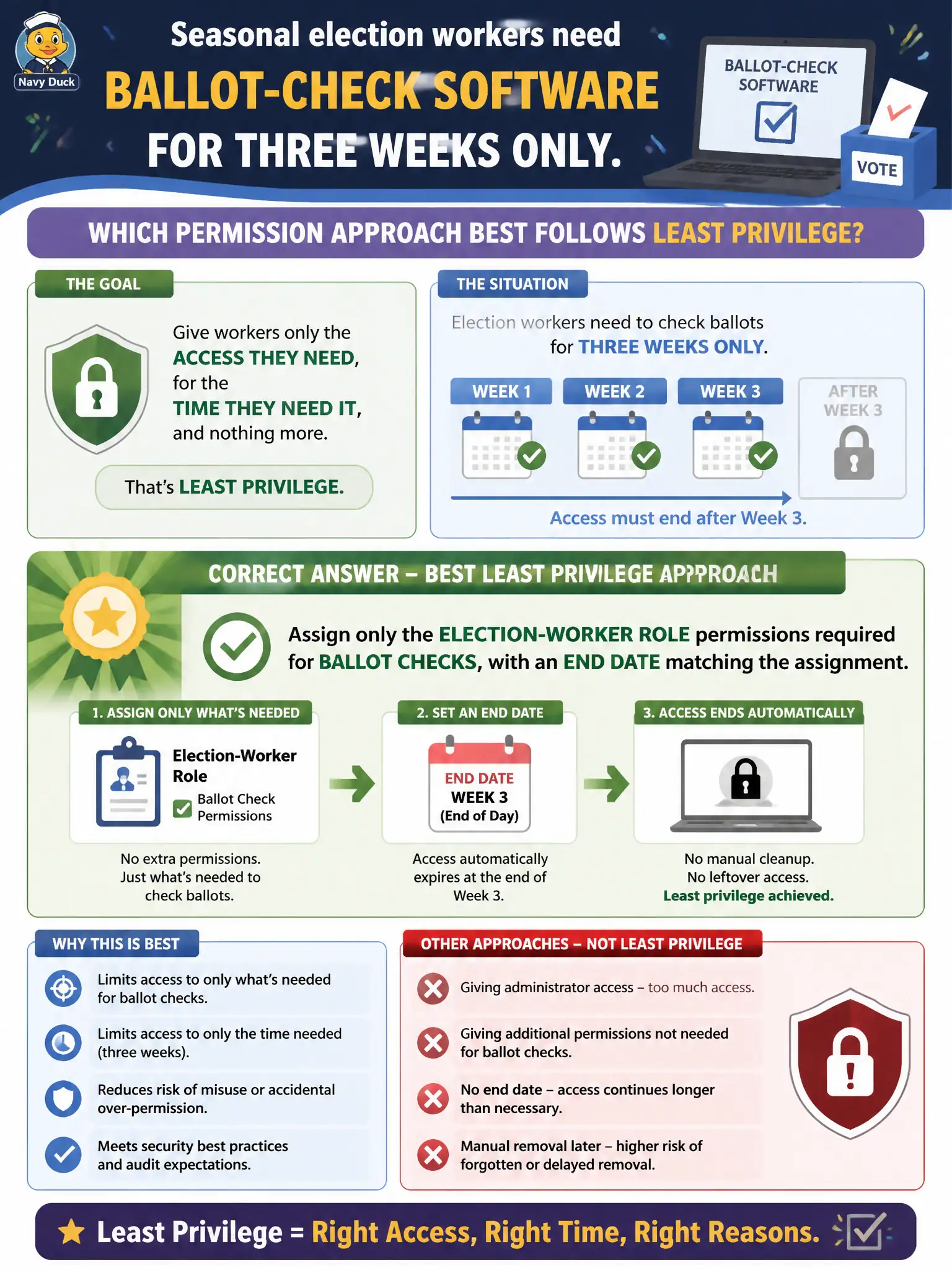
Seasonal election workers need ballot-check software for three weeks only. Which permission approach best follows least privilege?
Select an answer to reveal the explanation.
Short Explanation
Least privilege is handing election temps the one key to the ballot desk drawer—not the master key to city hall—and taking it back when early voting wraps.
Full Explanation
Least privilege for seasonal election workers means granting only the role permissions required for ballot-check software and binding that access to the three-week assignment window with an explicit end date. Time-bounded role assignment prevents early-voting helpers from retaining write paths into election tools—or worse, unrelated county systems—long after the canvass ends. Municipal election operations are high-scrutiny environments; scoped, expiring entitlements reduce both insider misuse and the blast radius if a seasonal credential is phished.
Adding every seasonal worker to Domain Admins for convenience is the opposite of least privilege and endangers the entire county directory during a politically sensitive period. Permanent write access to all county file shares including HR and finance expands election-temp reach far beyond ballot checks. Disabling MFA for seasonal accounts to 'speed login lines' weakens authentication precisely when temporary staff and crowded sites increase credential-risk exposure.
Exam caveat: role assignment should come from approved election-worker roles in IAM, not ad-hoc local admin on the ballot PCs. Expiration must actually revoke access automatically—calendar reminders alone are not controls.
Operational check: verify election-worker group membership lists only required application rights, confirm end dates align with the assignment, test that access fails after expiration, and ensure MFA remains enforced on those accounts throughout early voting.