
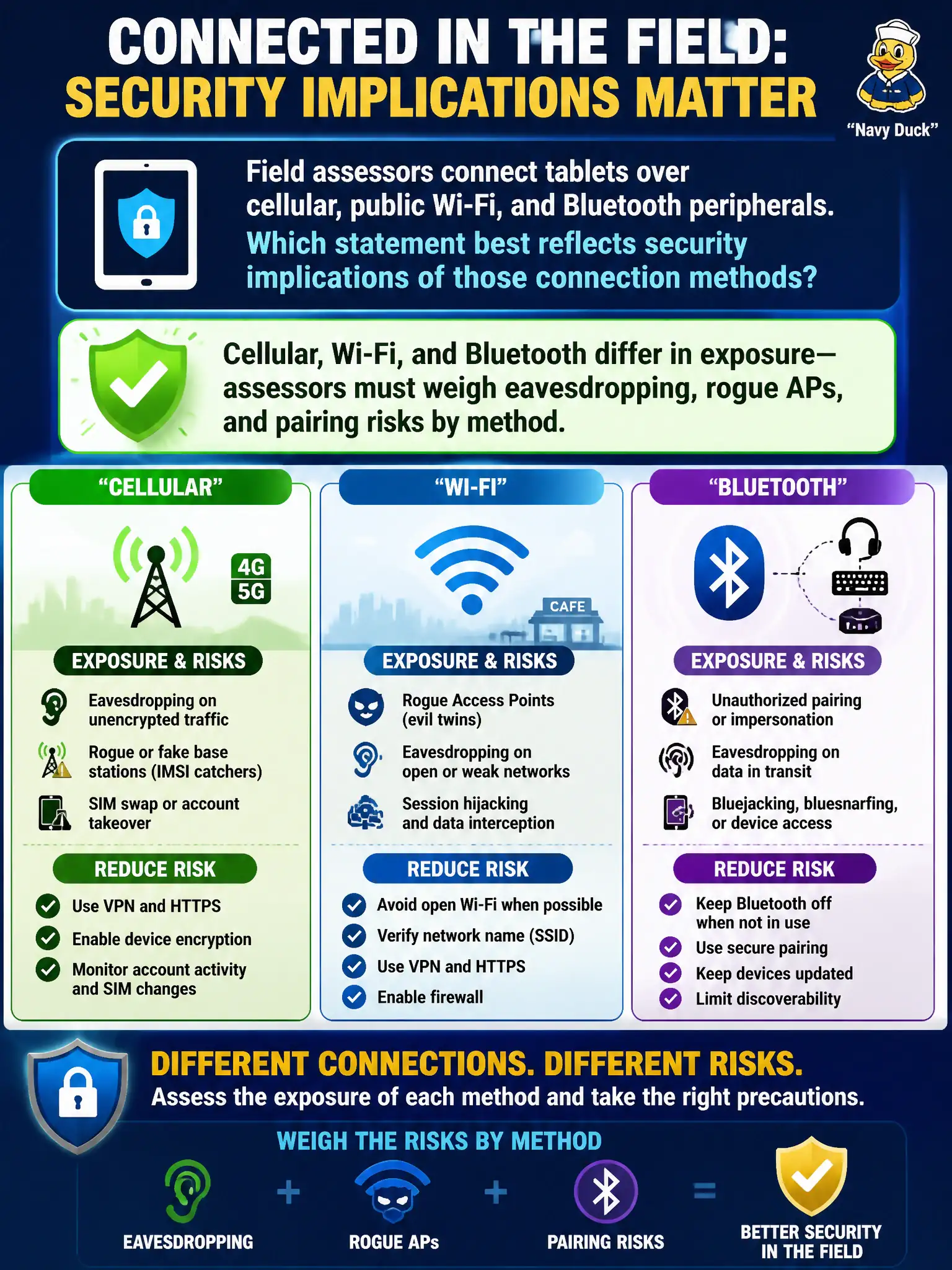
Field assessors connect tablets over cellular, public Wi-Fi, and Bluetooth peripherals. Which statement best reflects security implications of those connection methods?
Select an answer to reveal the explanation.
Short Explanation
Not every radio is the same seatbelt. Cellular, café Wi-Fi, and Bluetooth each bring different eavesdropping and pairing headaches in the field. Pretending they are identical—or that only one matters—misses how assessors actually connect.
Full Explanation
Field mobility for inspectors and first-line staff uses radios that do not share identical threat models. Cellular typically rides carrier-managed networks with different eavesdropping and rogue-infrastructure profiles than open café Wi-Fi, where evil twin APs and unencrypted paths are routine concerns. Bluetooth adds pairing, unauthorized accessory, and proximity attack considerations that neither cellular nor Wi-Fi fully mirror. Risk assessors must weigh eavesdropping, rogue access points, and pairing risks by medium rather than treating every radio as interchangeable. Claiming cellular, Wi-Fi, and Bluetooth present identical risk erases operational differences the scenario asks you to recognize. Asserting that public Wi-Fi and Bluetooth never introduce eavesdropping or pairing risks denies well-documented field threats. Focusing only on Bluetooth while ignoring cellular and Wi-Fi leaves large portions of the mobile attack surface unreviewed. Exam caveat: mobile connection questions often test differentiation of risk by medium—not a single universal ranking that one distractor invents. Operational check: for each field workflow, document which radios are required, apply VPN and hardened Wi-Fi profiles where public networks are unavoidable, disable unused Bluetooth, and include medium-specific threats in the mobile risk assessment.