
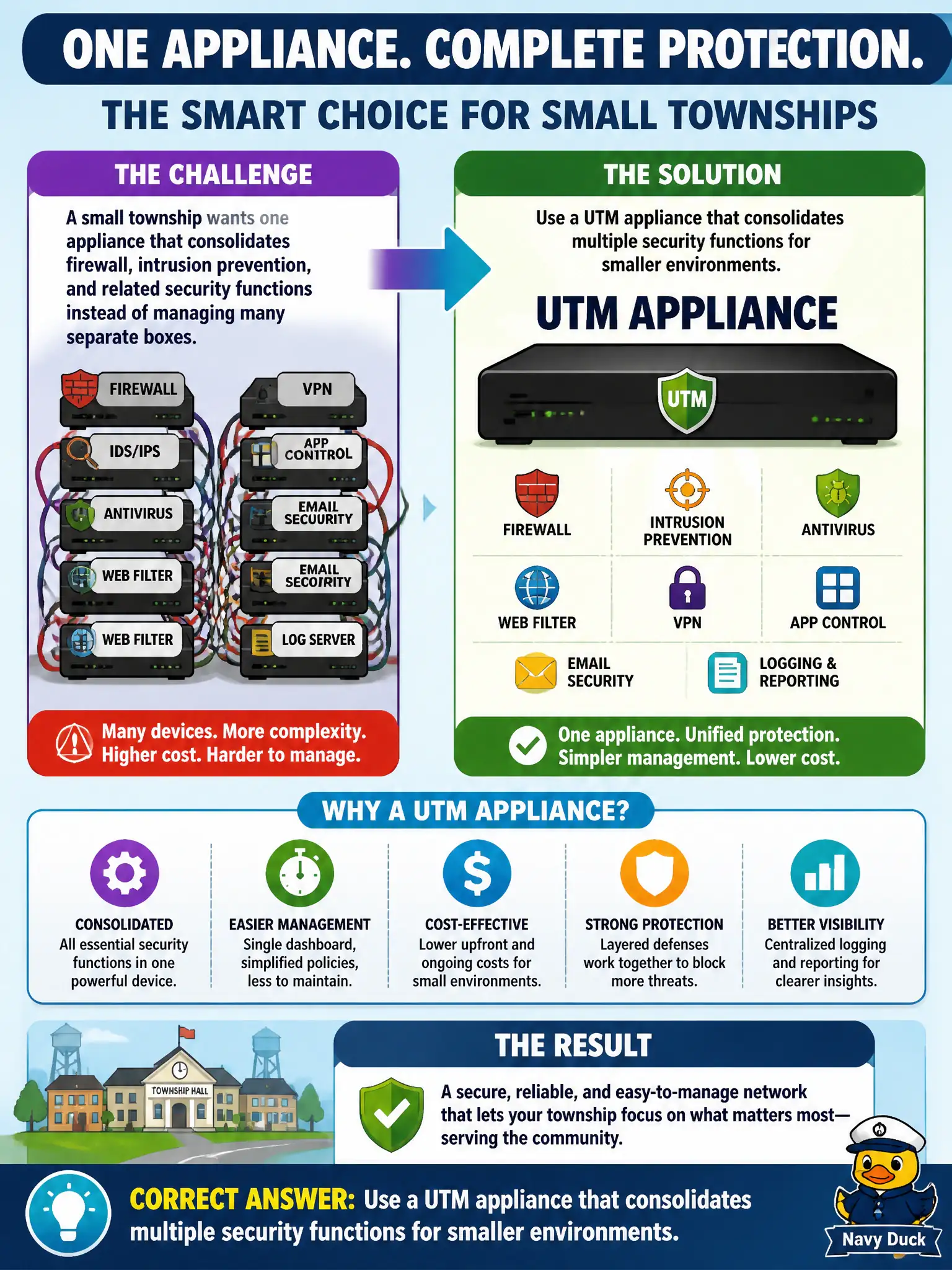
A small township wants one appliance that consolidates firewall, intrusion prevention, and related security functions instead of managing many separate boxes. Which solution fits that need?
Select an answer to reveal the explanation.
Short Explanation
Small townships often need a Swiss Army knife, not a whole knife drawer. UTM packs firewall, IPS, and friends into one manageable box. A gaming router wearing an enterprise name tag still isn’t that.
Full Explanation
A unified threat management appliance consolidates firewall, intrusion prevention, URL filtering, antivirus gateway functions, and related controls into one manageable platform. For a small township or branch office with limited staff, that consolidation reduces appliance sprawl, licensing complexity, and the number of consoles operators must master while still delivering layered perimeter protection.
Unmanaged Layer 2 switches provide connectivity without stateful inspection or threat services. A consumer gaming router may market similar buzzwords but lacks enterprise policy depth, support, logging, and lifecycle expectations suitable for government use. Operating a separate standalone box for every function can be correct in large enterprises, yet the scenario of a smaller environment makes deliberate consolidation the better architectural match when budget and staffing constrain specialization.
Exam caveat: UTM trades some best-of-breed depth and scalability for simplicity. Large campuses may still prefer discrete NGFW, dedicated IPS, and separate web gateways. Do not equate “one box” with “no need for updates, segmentation, or monitoring.”
Operational check: confirm the UTM license covers the needed feature set, that signatures and firmware stay current, that high-availability or spare strategy exists for the single appliance, and that logs still feed the municipal SIEM so consolidation does not create a visibility dead end.