
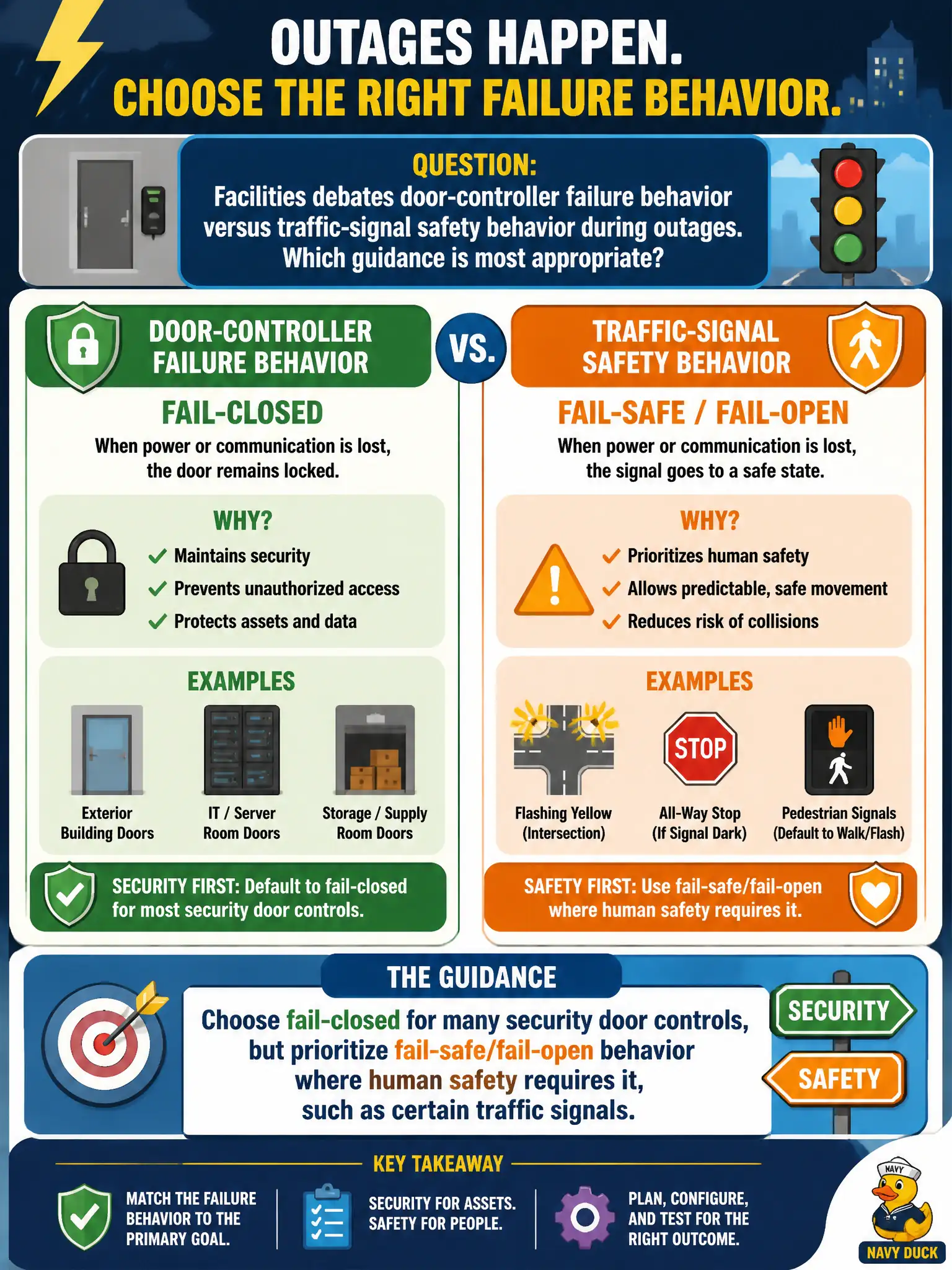
Facilities debates door-controller failure behavior versus traffic-signal safety behavior during outages. Which guidance is most appropriate?
Select an answer to reveal the explanation.
Short Explanation
Locks and stoplights do not share one magic failure setting. Security doors often fail closed; life-safety gear may need to fail open or fail safe so people are not trapped or stuck. Match the mode to the risk—security versus safety.
Full Explanation
Failure mode must match the harm you are preventing. Many physical security door controllers are designed to fail-closed so that power or system loss does not leave sensitive rooms unlocked. Life-safety systems such as certain traffic signals or egress paths may need fail-safe or fail-open behavior so outages do not trap people or create dangerous intersection states. Facilities and security architects therefore choose per-system failure behavior—security confidentiality/integrity of spaces versus human safety—rather than applying one universal setting to every controller in the city.
Always failing open every security and safety system prioritizes convenience and can leave vaults and server rooms unprotected during outages. Always failing closed every system, including safety-critical traffic signals that must clear intersections, can create life-safety hazards. Declaring failure mode irrelevant because outages never affect electronic controls ignores real power and controller fault scenarios.
Exam caveat: Security+ and related safety topics distinguish fail-closed security from fail-safe life safety; "always" answers are usually wrong. Operationally, document the required fail state per door, gate, and signal type; test failover during maintenance windows; coordinate with fire and traffic engineering codes; and ensure monitoring still alerts when controllers enter degraded modes so staff do not assume a silent fail-open is intentional.