
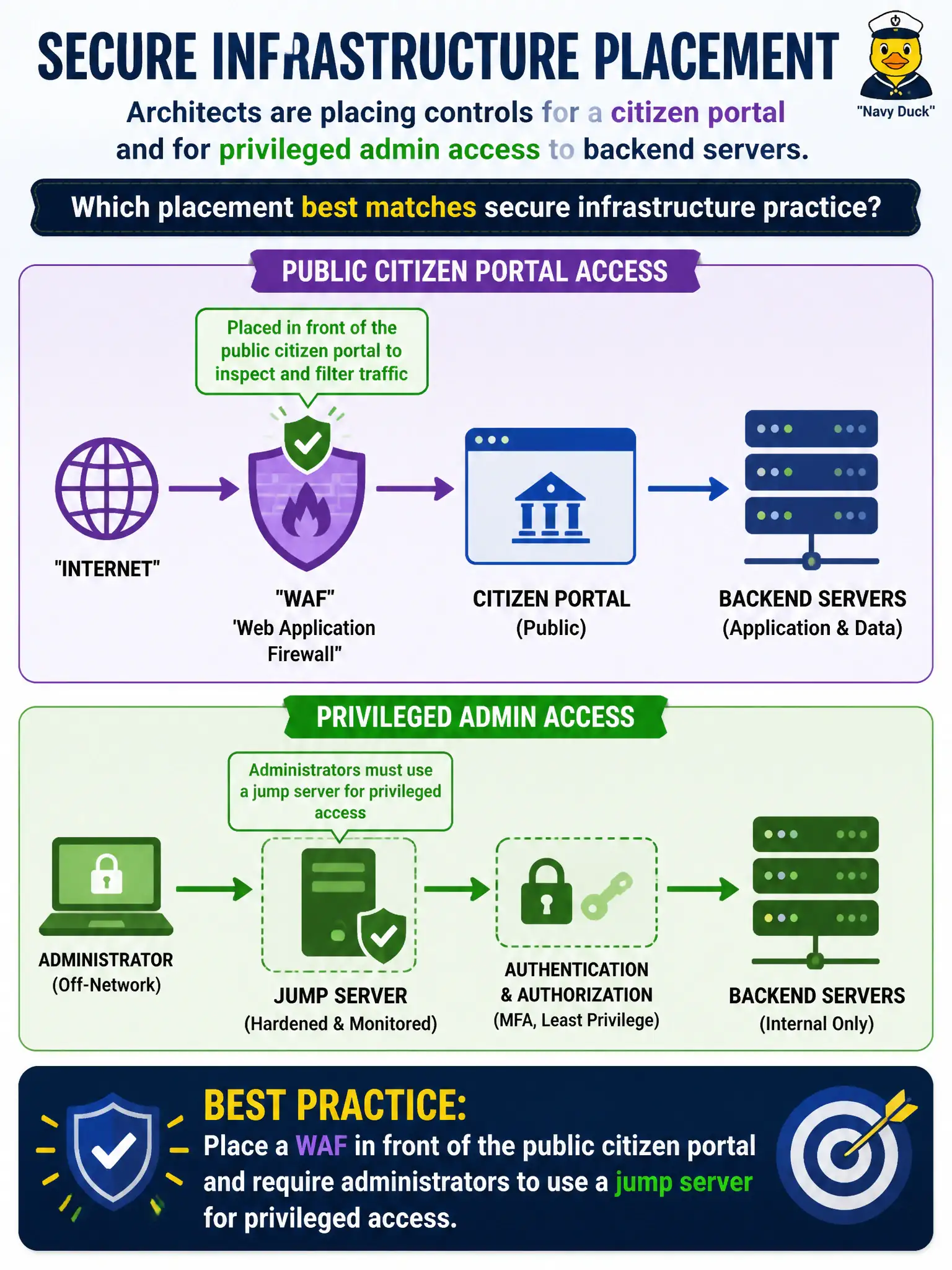
Architects are placing controls for a citizen portal and for privileged admin access to backend servers. Which placement best matches secure infrastructure practice?
Select an answer to reveal the explanation.
Short Explanation
Public web gets a web bodyguard out front; admins walk through a guarded side door, not the lobby. WAF for the portal, jump server for privileged reach. Direct Internet RDP to everything is the wrong map.
Full Explanation
Secure infrastructure design places controls where threats and trust boundaries meet. A public citizen portal that accepts Internet HTTP(S) traffic benefits from a web application firewall in front to inspect and mitigate application-layer abuse, while privileged administrative access to backend servers should traverse a jump server (bastion) with strong authentication, session logging, and reduced direct exposure. That pairing matches least privilege and defense-in-depth: citizens hit a hardened application edge; administrators do not RDP or SSH from the open Internet to every host.
Putting a WAF only on internal file shares while allowing direct Internet RDP to every admin server misplaces both controls—WAF belongs on web apps, and direct Internet admin protocols are a perennial compromise path. Disabling WAF and jump hosts because TLS alone stops application and admin abuse overstates transport encryption; TLS does not stop authenticated injection or stolen-admin sessions by itself. Exposing management interfaces on the same public VIP as the citizen portal conflates user and admin planes for convenience and widens blast radius.
Exam caveat: placement questions reward WAF for public web and jump/bastion for privileged admin—not TLS-only or Internet-exposed RDP. Operationally, terminate citizen traffic through WAF-protected reverse proxies, require MFA into the jump tier, record admin sessions, deny direct management from untrusted networks, and periodically scan for accidental public exposure of admin ports.