
City leadership debates a centralized SOC with shared tooling versus letting each department run its own security stack. Which tradeoff is most accurate?
Select an answer to reveal the explanation.
Short Explanation
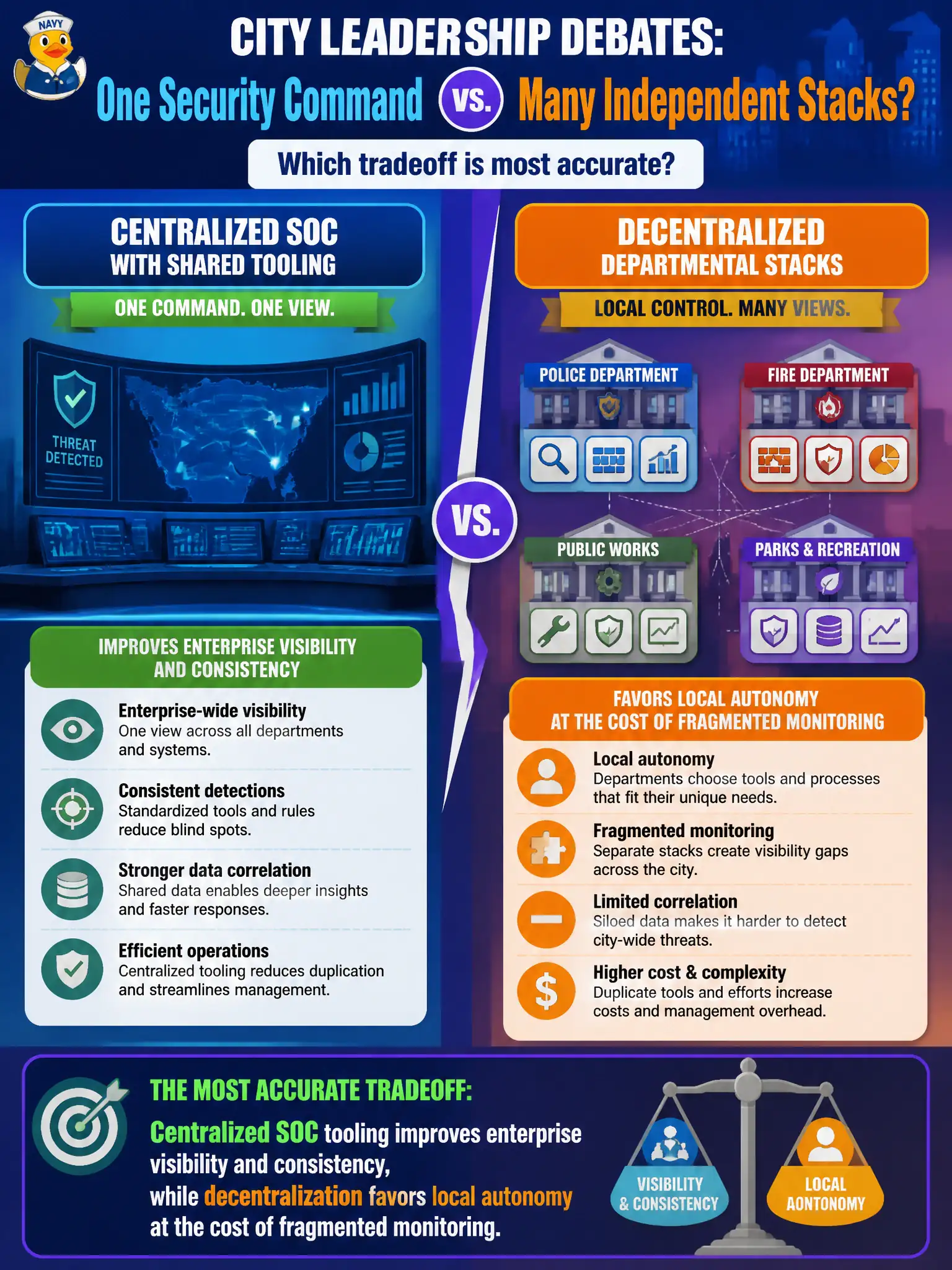
One big security glass pane shows more of the city; many little panes keep local control but miss the panorama. Centralized SOC tooling buys visibility and consistency; department silos buy autonomy and fragmentation. Pick with eyes open.
Full Explanation
A centralized SOC with shared tooling improves enterprise-wide visibility, correlation, playbook consistency, and staffing efficiency across city departments that would otherwise operate in silos. Decentralized stacks favor local autonomy and tailored tooling but typically fragment monitoring, dilute detection coverage, and complicate cross-department incident response. Security architecture tradeoffs are therefore about visibility versus autonomy—not a claim that one model erases all local needs or that placement of tooling never matters. For municipal leadership, the accurate framing is that centralization strengthens consistent detection and response, while decentralization trades that coherence for departmental independence.
Asserting centralization always removes all local operational needs ignores that facilities still need on-site responders, business owners, and context experts during incidents. Claiming decentralization always provides better enterprise-wide visibility contradicts how fragmented logs and consoles reduce correlation. Saying architecture choice does not matter because tooling placement never affects detection coverage dismisses a core design decision for Security Operations.
Exam caveat: look for balanced tradeoff language—central visibility/consistency versus local autonomy/fragmentation—rather than absolute "always" claims. Operationally, if centralizing, define log onboarding standards, shared detection content, and clear escalation paths back to departments; if remaining hybrid, require minimum telemetry into the enterprise SIEM so autonomy does not create blind zones for citywide threats.