
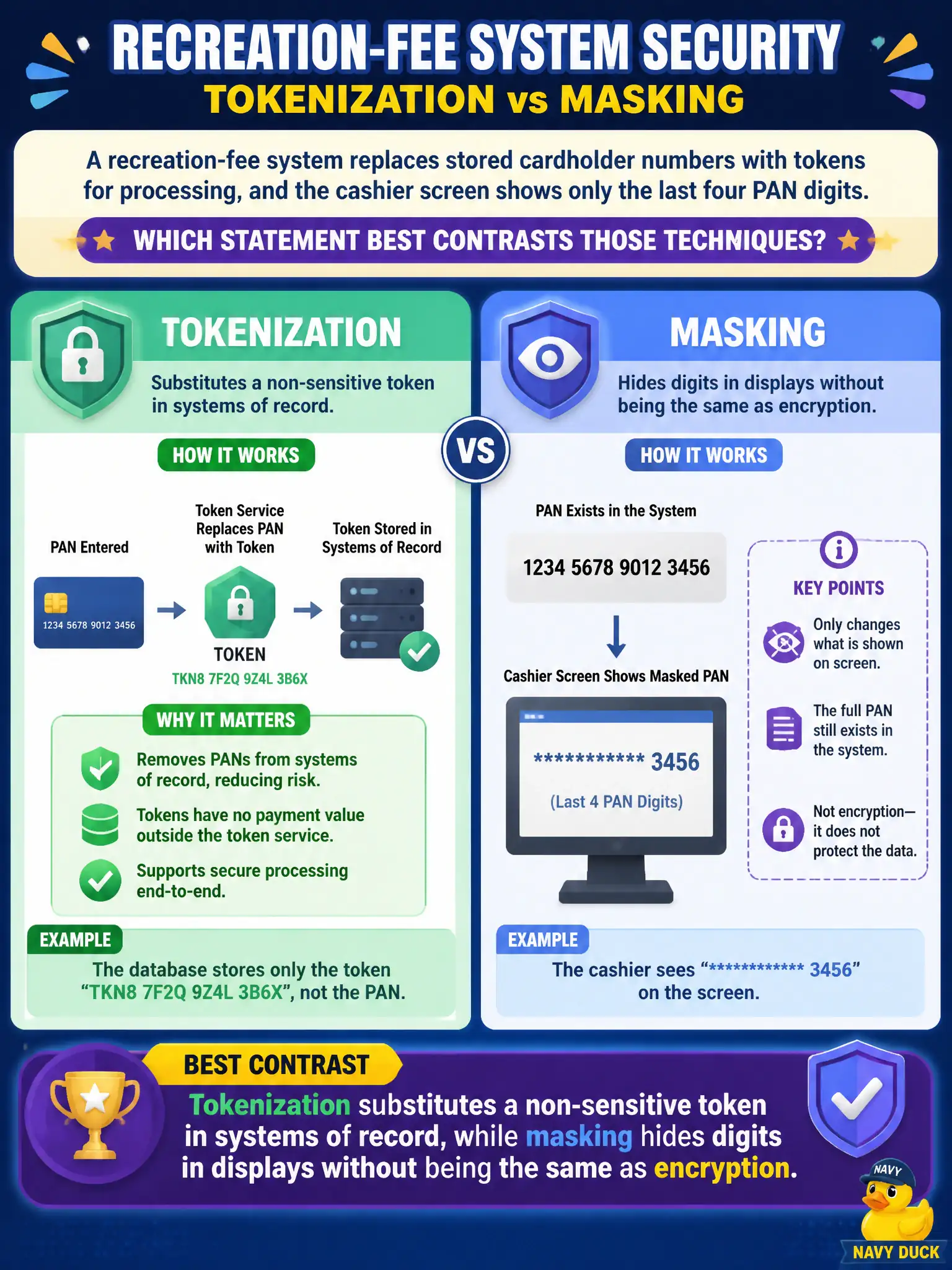
A recreation-fee system replaces stored cardholder numbers with tokens for processing, and the cashier screen shows only the last four PAN digits. Which statement best contrasts those techniques?
Select an answer to reveal the explanation.
Short Explanation
Tokenization swaps the real card number for a stand-in chip in the back-end systems; masking is the black marker on the screen that leaves only ****1234. Neither one is 'encrypt the whole laptop disk,' and masking alone is not a crypto lockbox.
Full Explanation
In a recreation-fee payment flow, tokenization replaces the primary account number in systems of record with a surrogate token that has limited or no value outside the tokenization domain. Applications, databases, and logs can process payments using the token while the real PAN stays in a tighter vault boundary, shrinking PCI scope and breach blast radius. Masking, by contrast, is primarily a presentation control: the cashier screen shows only trailing digits so shoulder-surfing and casual screen capture reveal less, without itself being the same mechanism as encryption of stored values.
Masking does not permanently destroy the original PAN in the payment processor; destruction would break legitimate refunds and settlement that still need controlled access to real card data or token mappings. Calling tokenization and masking forms of full-disk encryption confuses application-layer data protection patterns with endpoint volume encryption of the cashier workstation. Claiming masking creates reversible public-key ciphertext any kiosk can decrypt offline misstates masking entirely—masking is display obfuscation, not asymmetric encryption.
Exam caveat: tokenization substitutes stored sensitive values; masking obscures displays; neither automatically equals encryption. Operational check: verify municipal fee systems store tokens rather than PANs where possible, restrict detokenization, apply masking on UI and reports, and keep workstation FDE as a separate endpoint control rather than a substitute for PAN tokenization.