
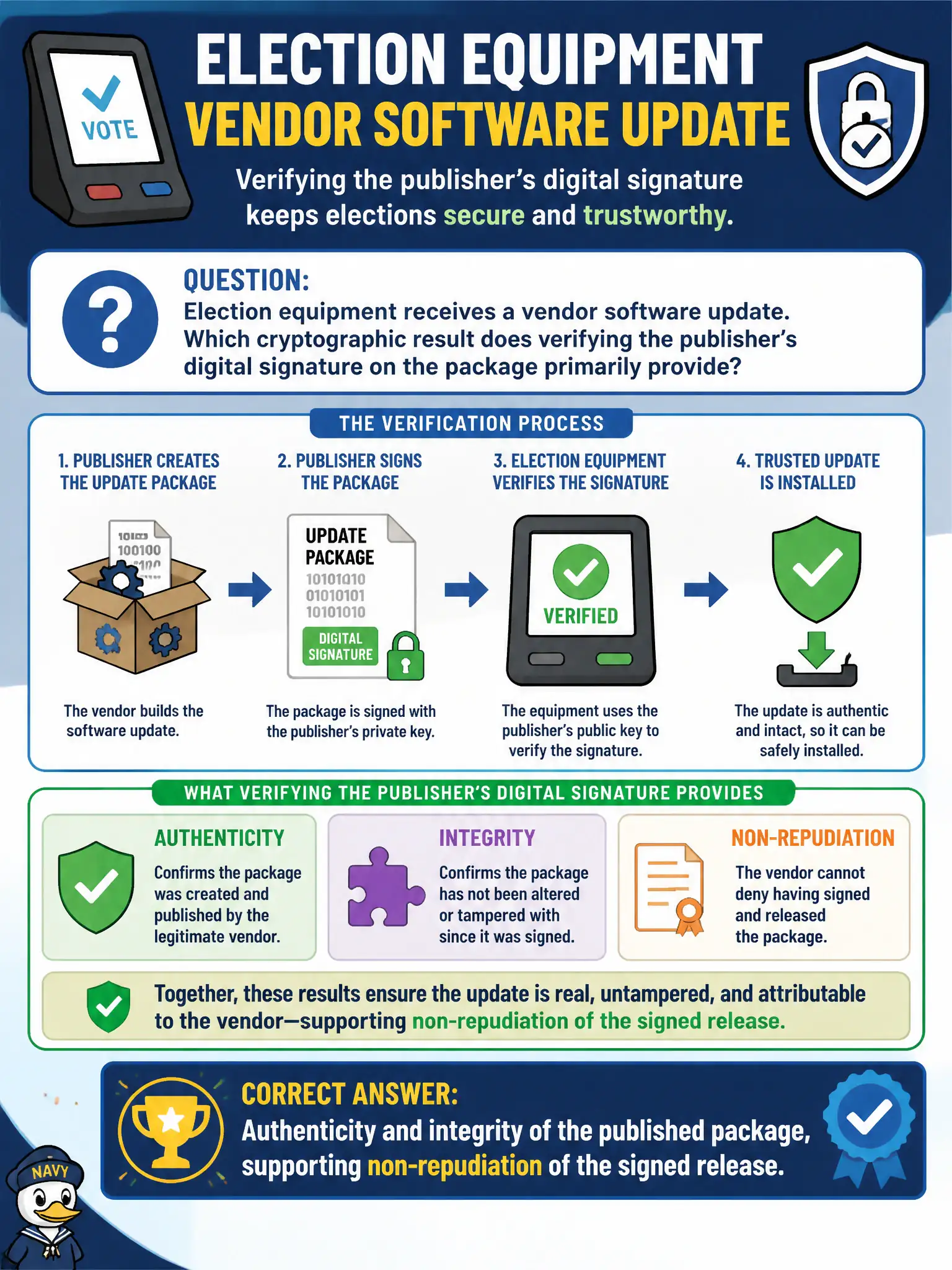
Election equipment receives a vendor software update. Which cryptographic result does verifying the publisher's digital signature on the package primarily provide?
Select an answer to reveal the explanation.
Short Explanation
A digital signature is the vendor's tamper-evident wax seal: if the seal verifies, you know who published the package and that nobody swapped bits on the way. It is not encryption for secrecy and it does not keep the download site online.
Full Explanation
Verifying a vendor digital signature on election-equipment software confirms two core properties: authenticity of the publisher (the signature verifies under the vendor's public key or trusted chain) and integrity of the package (the signed digest matches the bytes presented). Together those properties support non-repudiation of the signed release: the vendor cannot easily deny having signed that exact package if private-key control and certificate practices hold. Precinct systems gain assurance that the update was not swapped or silently altered on a mirror.
A signature does not provide confidentiality of update bytes sitting on a download mirror; encryption would be required to hide contents from observers. Signature verification also does not guarantee availability of the vendor portal during election week—availability is an operational and infrastructure concern separate from cryptographic proof of origin. Compression of the package is an engineering packaging choice unrelated to what a signature proves cryptographically.
Exam caveat: digital signatures primarily deliver authenticity, integrity, and non-repudiation—not secrecy or uptime. Operational check: before installing municipal election updates, validate publisher certificates against trusted roots, check revocation status, verify signatures on every package, compare published hashes when provided, and refuse unsigned or signature-failing builds even under schedule pressure.