
Before cutting over the city's online payment portal, which change-management practice best reduces security and business-process risk?
Select an answer to reveal the explanation.
Short Explanation
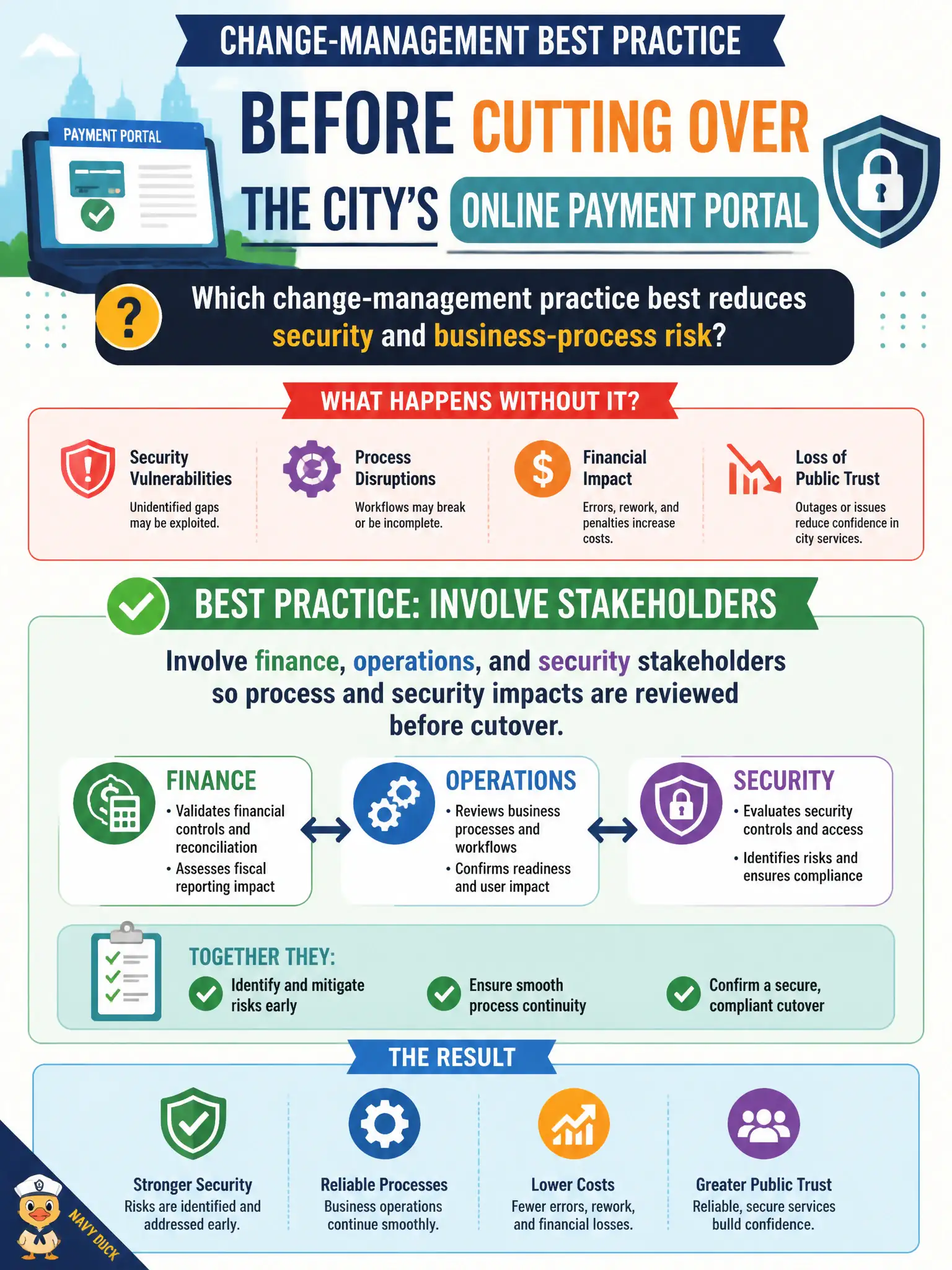
Think of a payment-portal cutover like opening a new bridge lane without telling traffic control or toll booths. Finance, ops, and security need a seat at the table before go-live so nobody discovers broken refunds or missing controls after citizens start paying.
Full Explanation
Effective change management for citizen-facing payment systems treats cutover as a controlled risk event, not a developer-only milestone. Involving finance, operations, and security before traffic switches ensures reconciliation workflows, refund handling, availability expectations, logging and monitoring coverage, access reviews, and payment-card control obligations are evaluated while there is still time to fix gaps. Stakeholder review surfaces process impacts that pure technical checklists miss, such as how nightly settlement jobs or PCI-scoped network segments change when the portal moves.
Relying only on a developer's informal go-live checklist fails because informal engineering readiness does not equal organizational change control; security and business owners never formally accept residual risk. Documenting the change only after production traffic has already switched inverts the control: records become post-incident paperwork instead of an approved decision path, and rollback criteria are unclear when something breaks. Disabling logging to shorten the window removes the primary forensic and operational signal needed during the highest-risk period, masking authentication failures, payment errors, or abuse.
Exam caveat: CompTIA expects change management to include stakeholder identification and impact analysis for security-affecting systems; speed or convenience does not override that process. Operational check: before municipal payment cutover, confirm a recorded change ticket, named business and security approvers, monitoring enabled end-to-end, and a tested rollback that preserves audit trails for citizen transactions.