
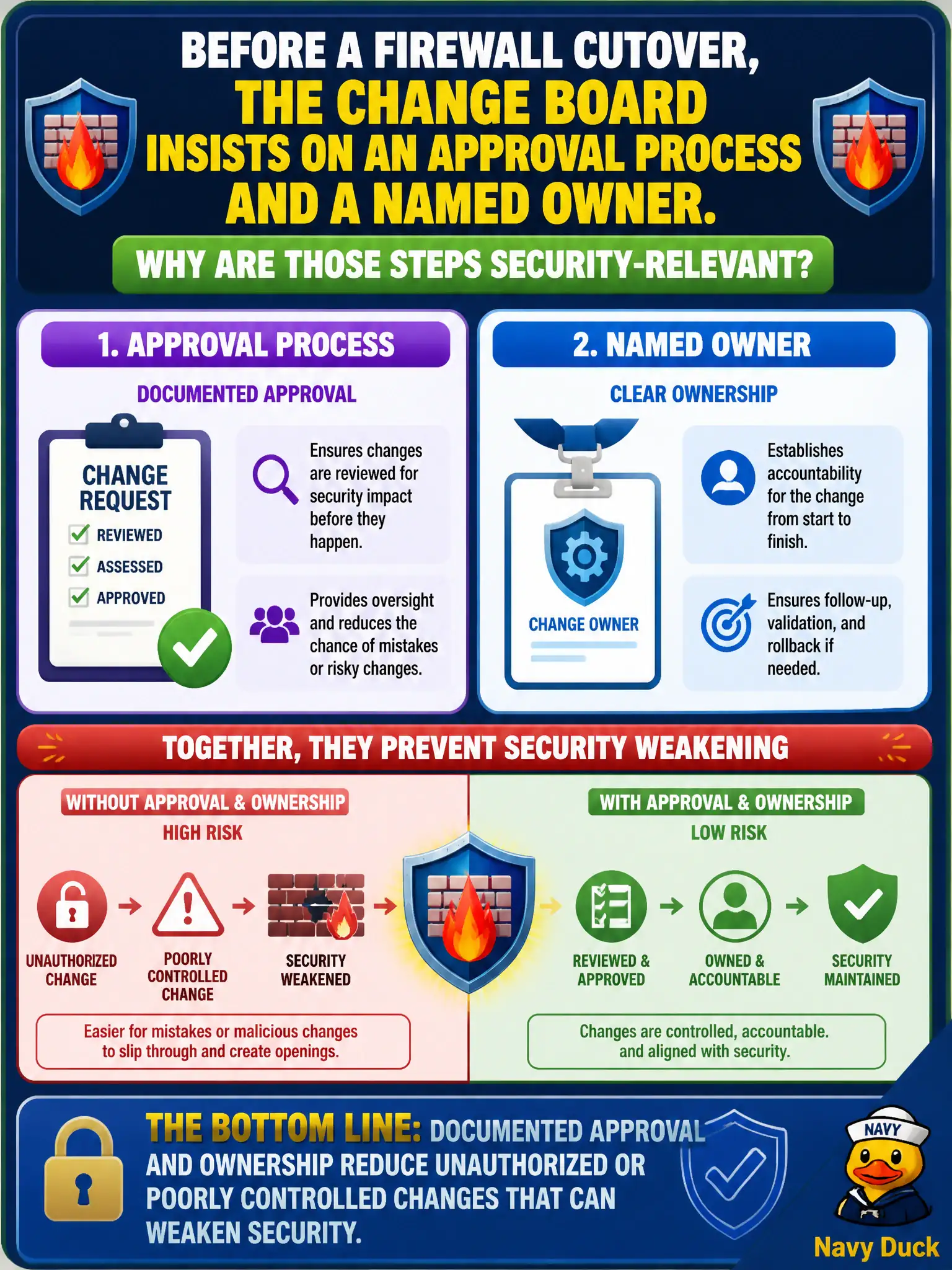
Before a firewall cutover, the change board insists on an approval process and a named owner. Why are those steps security-relevant?
Select an answer to reveal the explanation.
Short Explanation
Change approval is the 'who signed off and who owns the mess if it breaks' sticker. Skipping it is how surprise holes appear in the firewall. It is not red tape theater — it is security hygiene.
Full Explanation
Change management uses formal approval and clear ownership before security-impacting changes so modifications are intentional, reviewed, and accountable. Before a firewall cutover, an approval process and a named owner reduce unauthorized or poorly controlled changes that can open holes, break nat rules, or violate policy. Approval gates catch risky designs; ownership assigns who executes, communicates, and follows through if the cutover misbehaves.
Saying approvals eliminate the need for backout plans and impact analysis forever is false—those artifacts remain required parts of sound change practice. Saying named owners replace the requirement to test firewall rules invents a substitution; ownership does not remove validation in a lab or maintenance window. Saying change boards exist only for budgeting and have no security impact ignores how uncontrolled network changes are a common root cause of municipal outages and exposures.
Exam caveat: SY0-701 ties approval and ownership to protecting security posture, not mere bureaucracy. Know that change control supports confidentiality, integrity, and availability by reducing surprise modifications.
Operational check: for city firewall cutovers, require ticketed approval, named implementer and backup, peer review of rule diffs, impact analysis, tested backout, and post-change verification. Reject "emergency" changes that skip ownership unless true incident conditions apply—and still document them after the fact.