
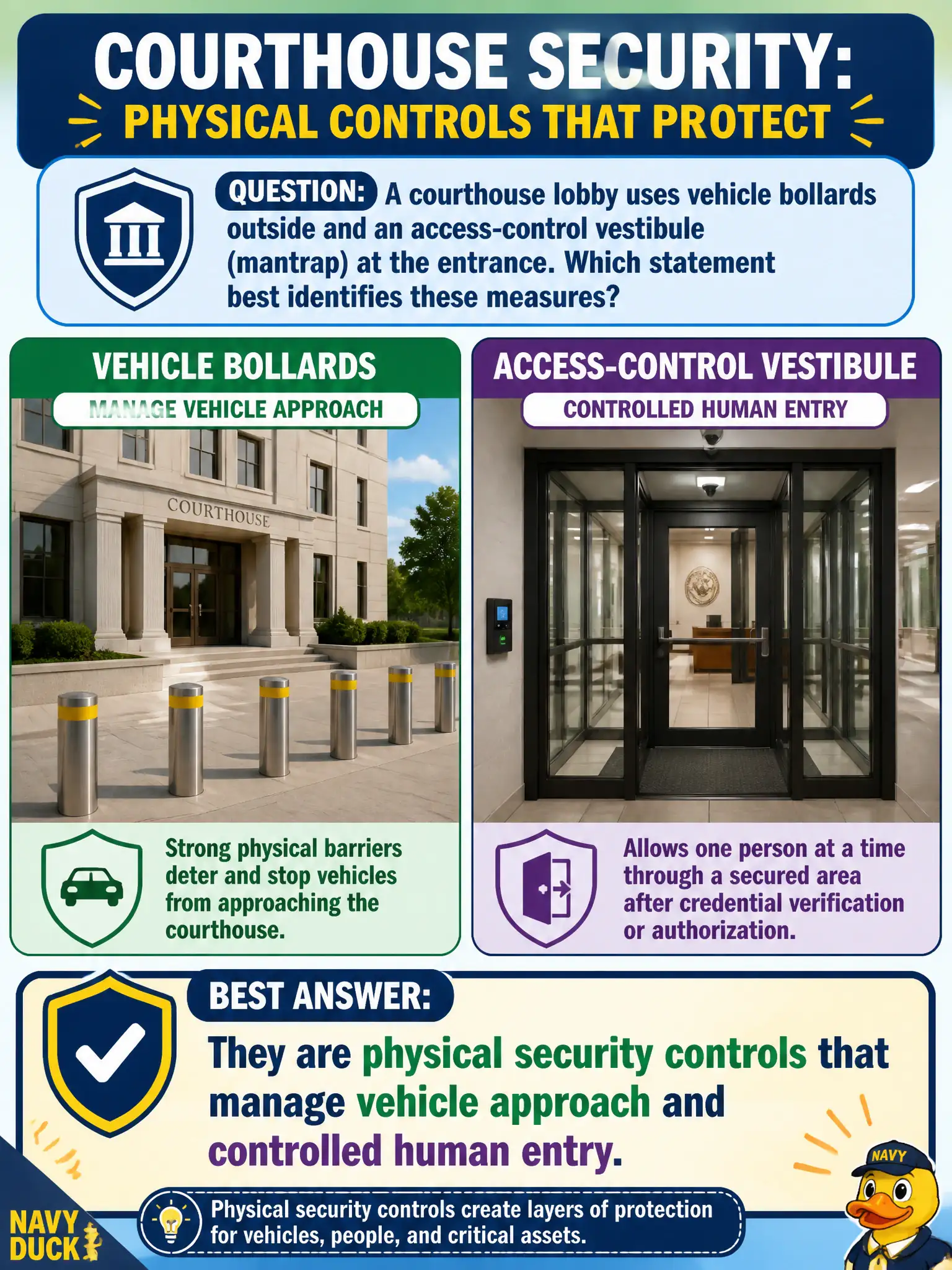
A courthouse lobby uses vehicle bollards outside and an access-control vestibule (mantrap) at the entrance. Which statement best identifies these measures?
Select an answer to reveal the explanation.
Short Explanation
Bollards stop trucks; a mantrap stages people one door at a time — classic physical security, like airport queues with concrete teeth. Do not rebrand them as SIEM rules or crypto just to sound fancy.
Full Explanation
Physical security under fundamental Security+ concepts includes barriers and entry controls such as vehicle bollards and access-control vestibules (often called mantraps). Bollards limit vehicle approach and ramming risk outside a courthouse lobby; a vestibule sequences and controls human passage between doors so tailgating and uncontrolled entry are harder. Together they are physical measures that manage vehicle approach and controlled human entry.
Calling them purely managerial policies with no physical security role ignores the concrete barriers and chambers themselves; a policy may require bollards, but the installed controls are physical. Labeling them technical SIEM rules that only parse badge syslog confuses log analytics with facility hardware—SIEM content is technical/detective tooling, not bollards or vestibules. Calling them compensating cryptographic controls that replace MFA invents a crypto substitution; physical entry controls do not replace strong authentication for logical systems and are not compensating cryptography.
Exam caveat: SY0-701 explicitly expects recognition of listed physical controls—bollards, vestibules/mantraps, fencing, lighting, and similar. Do not rebrand them as technical merely because badge readers or cameras integrate with IT.
Operational check: for courthouse and city-hall perimeters, maintain bollard ratings and spacing appropriate to vehicle threats, test vestibule interlocks and emergency egress compliance, coordinate with badge systems without assuming physical controls alone secure applications, and include these assets in physical security inspections and after-action reviews.