
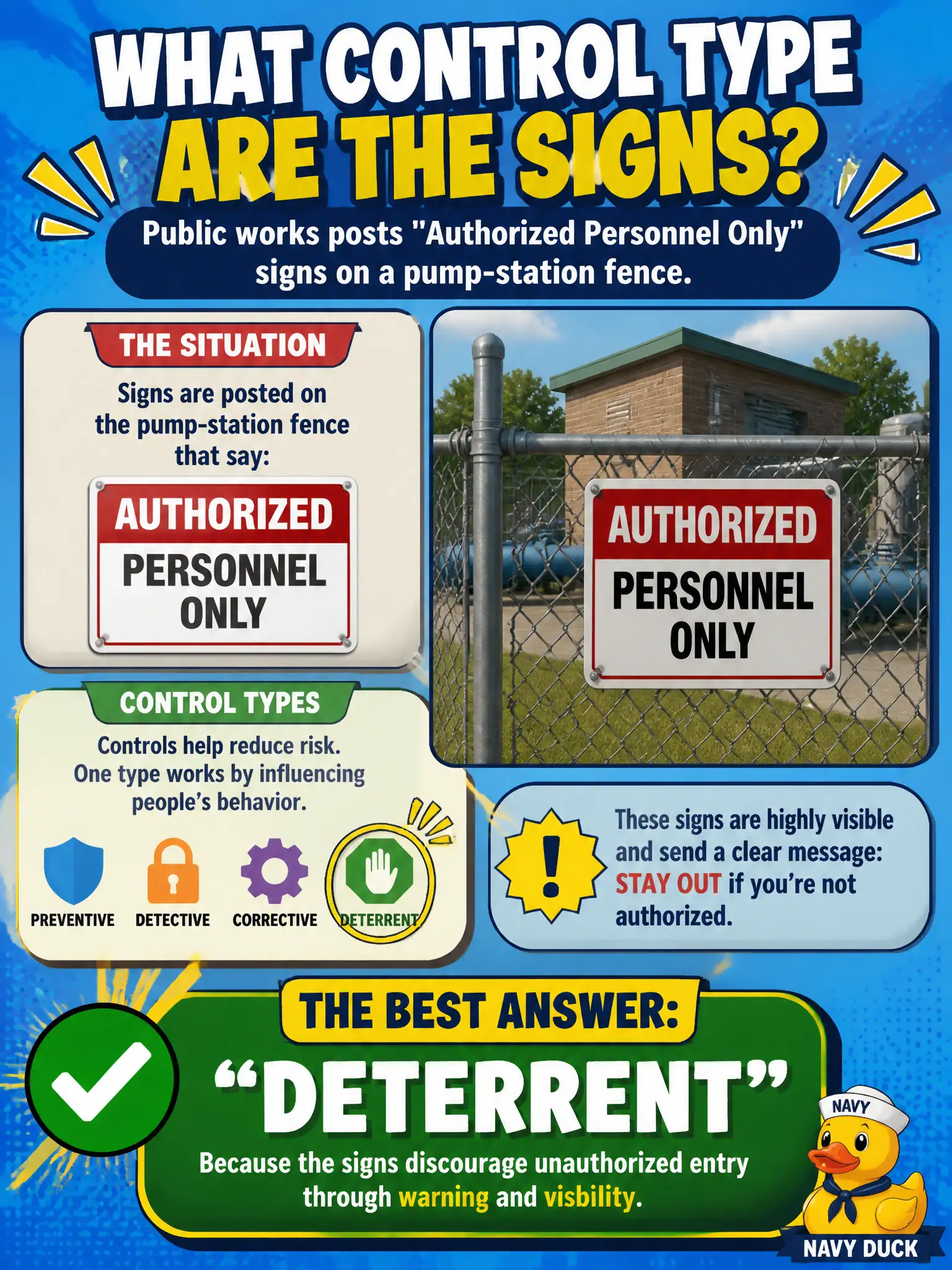
Public works posts 'Authorized Personnel Only' signs on a pump-station fence. Which control type best describes the signs by themselves?
Select an answer to reveal the explanation.
Short Explanation
A 'Keep Out' sign is more like a scarecrow than a padlock — it tries to talk people out of trying, but it does not actually bar the gate. That is deterrent territory. Pair signs with real locks and cameras when you need prevention and detection too.
Full Explanation
Deterrent controls discourage unwanted behavior through warning, visibility, or the appearance of consequences without necessarily stopping the action themselves. "Authorized Personnel Only" signs on a public-works pump-station fence are a classic deterrent: they communicate restricted access and raise the social and legal cost of trespass, which may reduce attempts by casual intruders. By themselves, signs do not latch the gate, log climbers, or repair cut fencing.
Calling the signs preventive because they "physically lock the gate" fails: prevention requires a control that actually impedes the action—locks, fences that bar passage when closed, access readers that deny entry. Signage alone does none of that. Labeling them detective because they "record who climbs" is incorrect; detection needs sensors, cameras, alarms, or logs that observe and report activity. Signs do not capture events. Framing them as corrective because they "repair damage after trespass" mismatches corrective controls, which restore or remediate after an incident (patch, rebuild, replace cut locks).
Exam caveat: SY0-701 distinguishes deterrent from preventive even when both reduce risk. A scarecrow-style warning is deterrent; a bolted gate is preventive. Cameras can be both detective and somewhat deterrent, but posted notices without sensing or blocking remain deterrent.
Operational check: for pump stations and other civic industrial sites, combine deterrent signage with real preventive barriers and detective monitoring (locks, fencing integrity checks, cameras, intrusion alarms). Inventory signs as deterrent, then verify that physical prevention and detection are not assumed to be covered by the placard alone.