
A USB drive left in the library parking lot is plugged into a catalog PC. What is the attack vector?
Select an answer to reveal the explanation.
Short Explanation
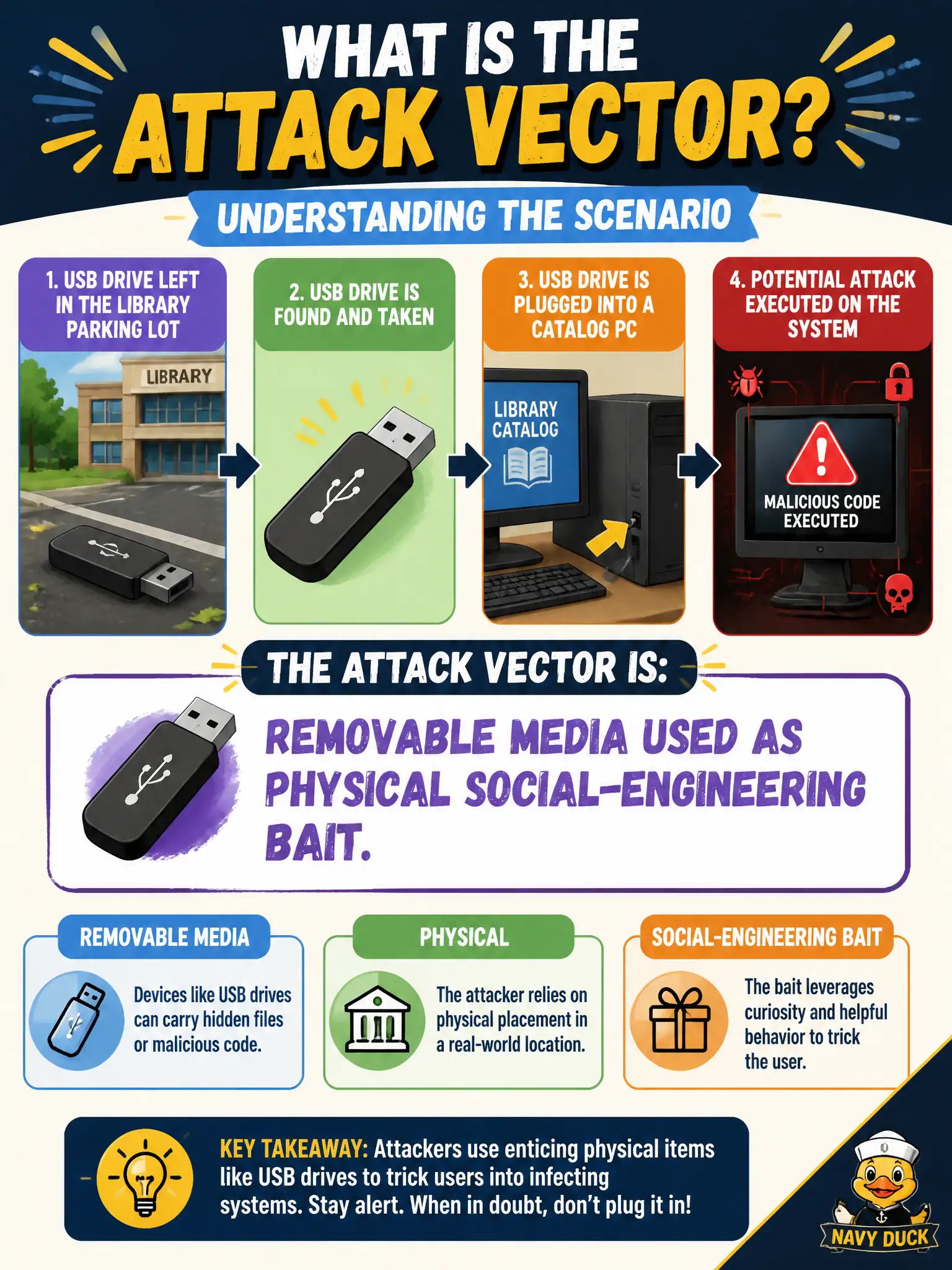
Someone left candy in the parking lot and a catalog PC ate it. A planted USB is removable-media baiting—physical social engineering—not a website, VPN spray, or API injection. The stick is the vector.
Full Explanation
A USB drive left in the library parking lot and plugged into a catalog PC is removable media used as physical social-engineering bait. Someone left candy in the lot and a catalog workstation ate it, which is a classic baiting pattern against curious civic staff. Public libraries see this vector because open PCs and helpful employees collide; the stick itself is the delivery path. Classification should stay on removable-media baiting rather than inventing a website, VPN spray, or API injection story the stem never supports.
Calling it a compromised parks-events website watering hole fails by concept: no trusted web page delivery is described—the medium is a found USB. Calling it brute-force against the library SSL-VPN fails by concept: authentication flooding against remote access is not present in the stem. Calling it SQL injection against the catalog search API fails by concept: the introduction medium is physical USB media, not crafted API input against a search endpoint.
Exam caveat: Planted USB equals removable-media baiting or physical social engineering—always match the physical medium named in the stem.
Operational check: Isolate the catalog PC, collect the USB as evidence under chain of custody, scan with controlled tooling, review autorun and process telemetry in Enterprise Security, and reinforce staff policy never to mount found media on production library systems.