
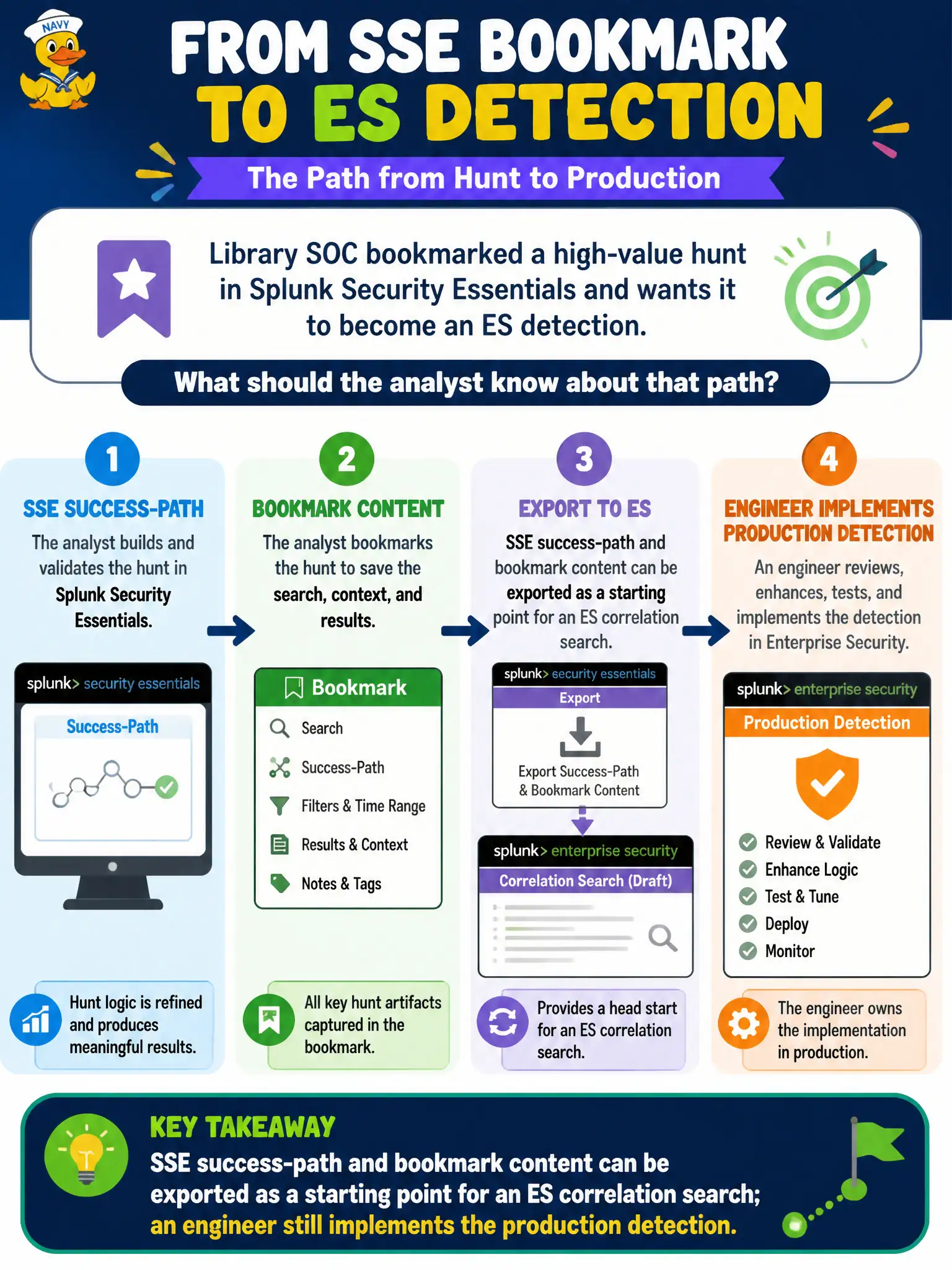
Library SOC bookmarked a high-value hunt in Splunk Security Essentials and wants it to become an ES detection. What should the analyst know about that path?
Select an answer to reveal the explanation.
Short Explanation
SSE bookmarks are seeds, not a magic Enable button. The library analyst should know the content can be exported as a correlation-search starting point, and that an engineer still lands it in ES. Python playbooks and CIM rebuilds are the wrong path.
Full Explanation
Splunk Security Essentials success-path and bookmark content can be exported as a starting point for an Enterprise Security correlation search, which is the promotion path a library SOC should understand when a high-value hunt needs to become a lasting detection. The analyst's role is to recognize that SSE content is seed material: an engineer or detection owner still lands, tunes, and enables the production ES search against library telemetry and Asset and Identity context. Bookmarking alone does not automatically author or enable a live ES correlation search with no further engineering, so treating the bookmark as a finished detection leaves Incident Review empty. Claiming SSE content cannot enter ES and that the only path is writing Python in SOAR confuses detection promotion with SOAR playbook development and skips the SSE-to-ES route the objective names. Requiring a full CIM rebuild from an ES admin install lab before any promotion is sibling-exam platform work, not the content-promotion skill under test. Exam caveat: SPLK-5001 expects awareness of the SSE-to-ES starting-point path, not that bookmarks silently become production detections or that analysts must author SOAR Python to move content. Operational check: bookmark a high-value library hunt in SSE, export or follow the documented success-path handoff into an ES correlation-search draft, confirm the draft references library sourcetypes and CIM fields, and leave enablement and tuning as an explicit engineering step before relying on it in Incident Review.