
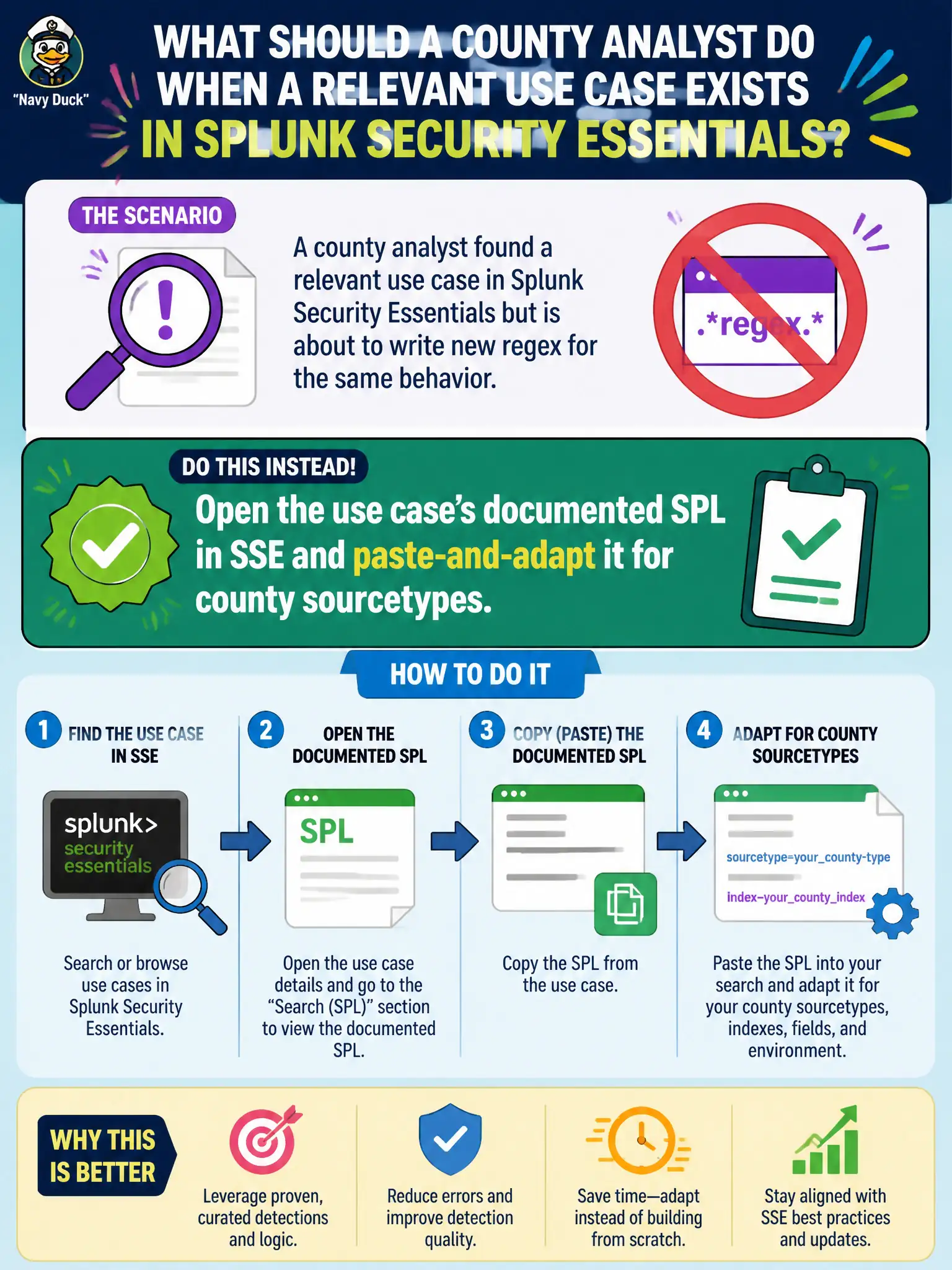
A county analyst found a relevant use case in Splunk Security Essentials but is about to write new regex for the same behavior. What should they do instead?
Select an answer to reveal the explanation.
Short Explanation
SSE is not a teaser trailer. It shows the actual SPL so a county analyst can paste and adapt. Inventing regex from scratch when the use case is already documented is unpaid overtime.
Full Explanation
Splunk Security Essentials documents the SPL for its use cases so a county analyst should open that documented search and paste-and-adapt it for local sourcetypes rather than inventing new regex for the same behavior. Reusing supported content is the Domain 5.3 habit: start from SSE, then adjust indexes and field names to county telemetry. Inventing rex from raw XML because of a mistaken belief that SSE never shows search strings wastes time and drifts from tested logic. Exporting Sysmon to Wireshark to rebuild the detection leaves the SIEM workflow entirely. Asking for a new indexer cluster before reusing a search confuses capacity work with content reuse. Exam caveat: paste-and-adapt still requires validation on local data—SSE examples may assume TA field names your county has not mapped yet. Operational check: open the SSE use case SPL, adapt sourcetype and index to county Sysmon, compare results to a known-good event, and only then consider custom regex for truly local gaps. Document the revised approach in the civic SOC runbook so the next on-call analyst inherits the correct pattern rather than the anti-pattern. Retain Job Inspector evidence with the change ticket for municipal audit readiness.