
A PSAP dashboard counts 911 SIP errors in one-minute buckets, and the current minute always looks artificially low while events are still arriving. What should the analyst change?
Select an answer to reveal the explanation.
Short Explanation
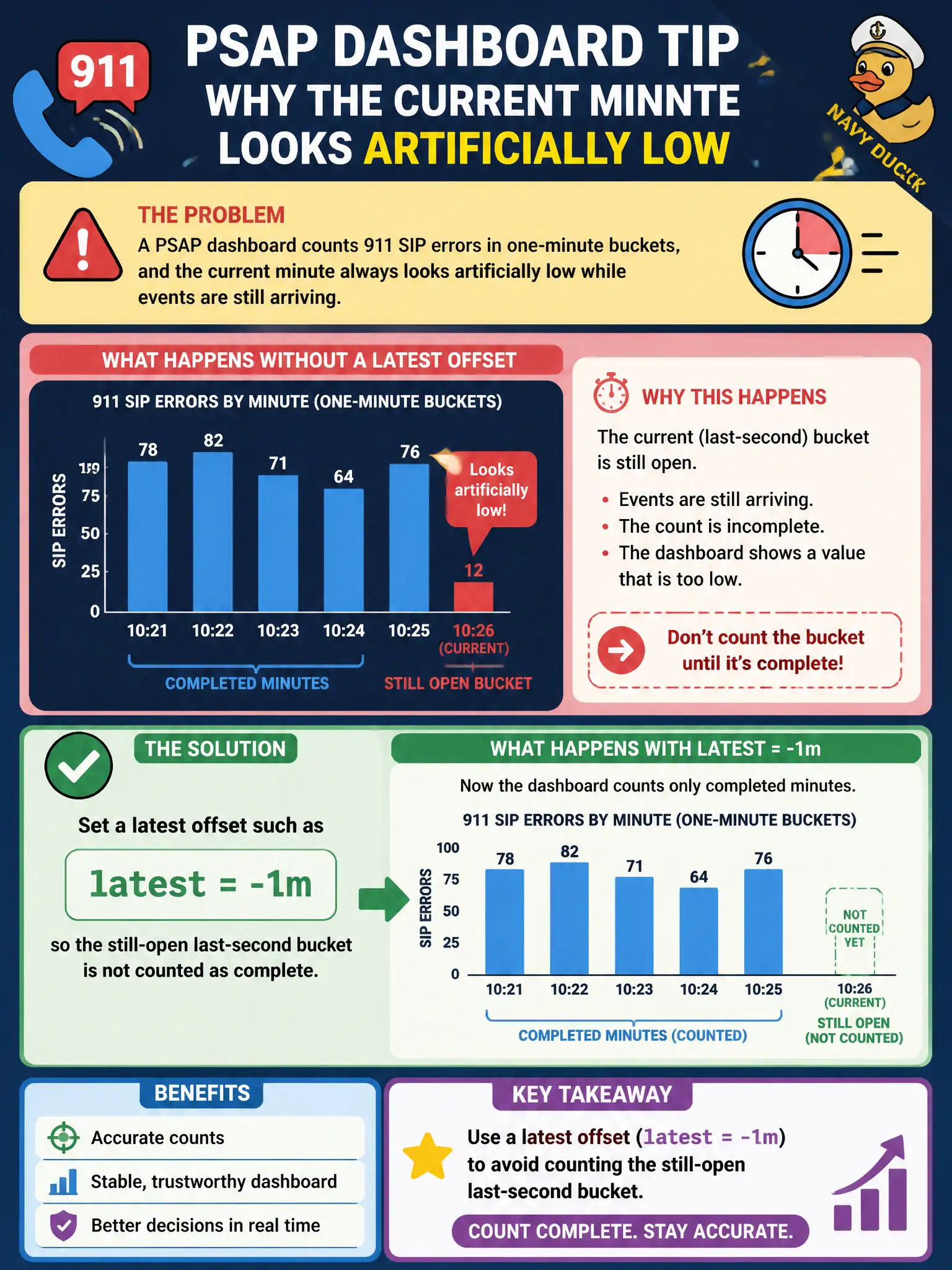
The last minute on a live 911 chart is a bucket that is still being filled, so counting it as done makes every current bar look low. Nudge latest back about a minute so the dashboard only scores closed buckets. Scanning all time or changing sourcetype to metrics does not close that bucket.
Full Explanation
Live dashboards that count 911 SIP errors in one-minute buckets often under-report the still-open current minute because events are still arriving. Setting a latest offset such as latest=-1m excludes the incomplete bucket so the PSAP chart only scores closed minutes. Dropping the earliest bound to backfill from all-time 911 data does not close the open bucket and explodes historical scope. Switching to index=* with no time picker increases cost without fixing incompleteness. Converting the SIP sourcetype to metrics is unrelated to whether the current minute is finished. Exam caveat: offset size should match event lag—one minute is a common starting point, but delayed civic collectors may need a larger latest skew. Operational check: compare the current-minute bar with and without latest=-1m on the PSAP dashboard, confirm the artificial dip disappears on closed buckets, and document the offset in the dashboard's data-latency note. Document the revised approach in the civic SOC runbook so the next on-call analyst inherits the correct pattern rather than the anti-pattern. Retain Job Inspector evidence with the change ticket for municipal audit readiness. Document the revised approach in the civic SOC runbook so the next on-call analyst inherits the correct pattern rather than the anti-pattern. Retain Job Inspector evidence with the change ticket for municipal audit readiness.