
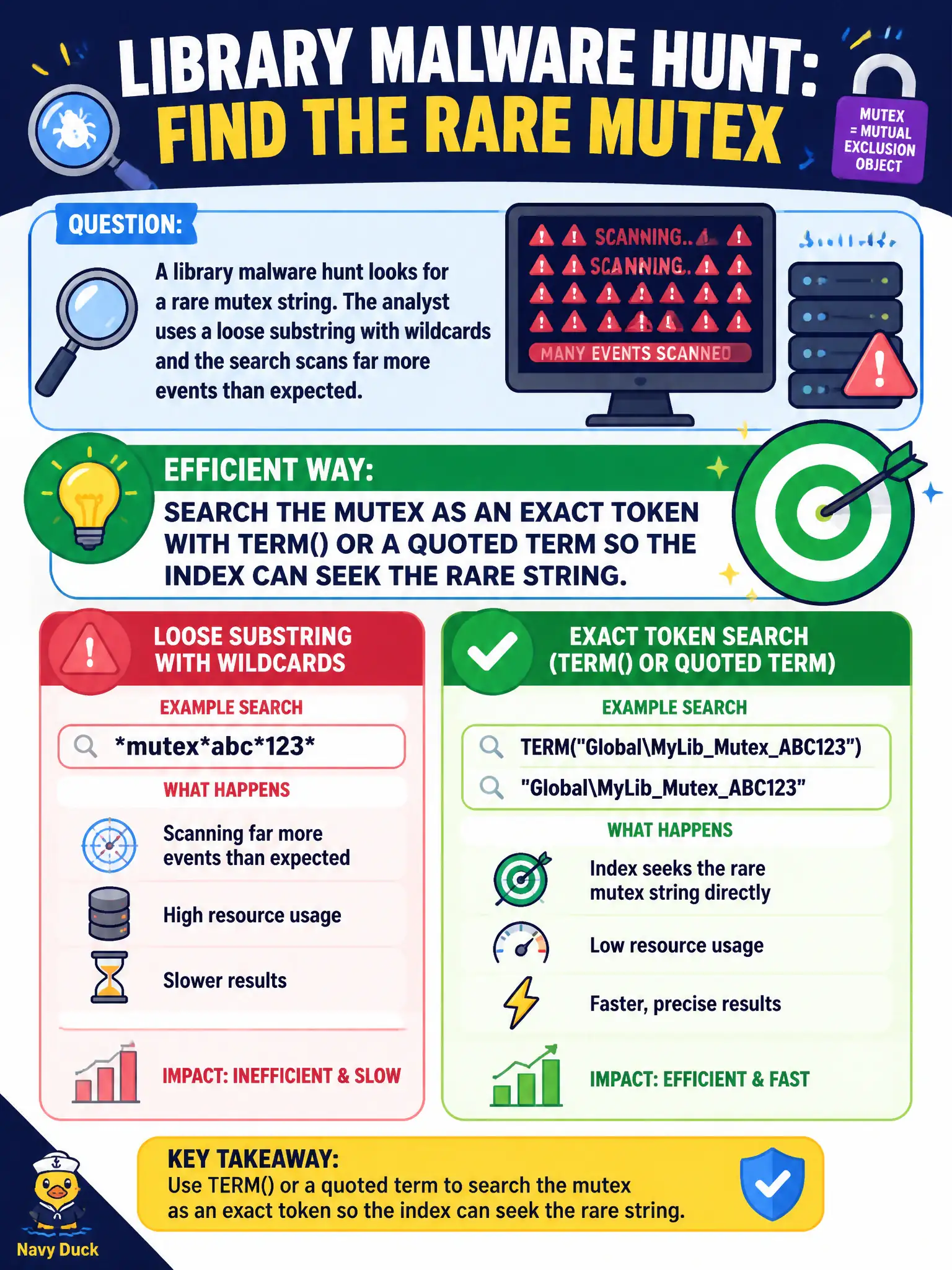
A library malware hunt looks for a rare mutex string. The analyst uses a loose substring with wildcards and the search scans far more events than expected. What is the efficient way to seek that indicator?
Select an answer to reveal the explanation.
Short Explanation
A rare mutex is a unique library catalog number — ask for that exact token. TERM() or a quoted term lets the index jump to it; wrapping it in asterisks makes the clerk read every shelf.
Full Explanation
Rare mutex strings should be sought as exact index tokens using TERM() or a quoted term so the indexer can jump to the rare library malware indicator instead of scanning with loose substring wildcards. Wrapping a mutex in leading and trailing wildcards prevents efficient seeks and forces broader scans than the rare string warrants. transaction across all library endpoints before visually scanning for the mutex is an efficiency and process failure. Verbose rex on index=* is not required for substring matching and explodes cost across unrelated civic data. Exact-token hunting is how analysts find sparse host artifacts without turning the search head into a full-corpus grepping engine. Exam caveat: TERM() and quoted terms still require the mutex to be tokenized as expected—punctuation and case rules can matter—so validate tokenization on a known sample event. Operational check: run the library mutex hunt with TERM() or a quoted exact string on a tight index and time window, confirm hits on a known sample, and remove leading/trailing wildcard forms from the shared hunt library. Document the revised SPL in the civic SOC runbook so the next on-call analyst inherits the efficient pattern rather than the anti-pattern.