
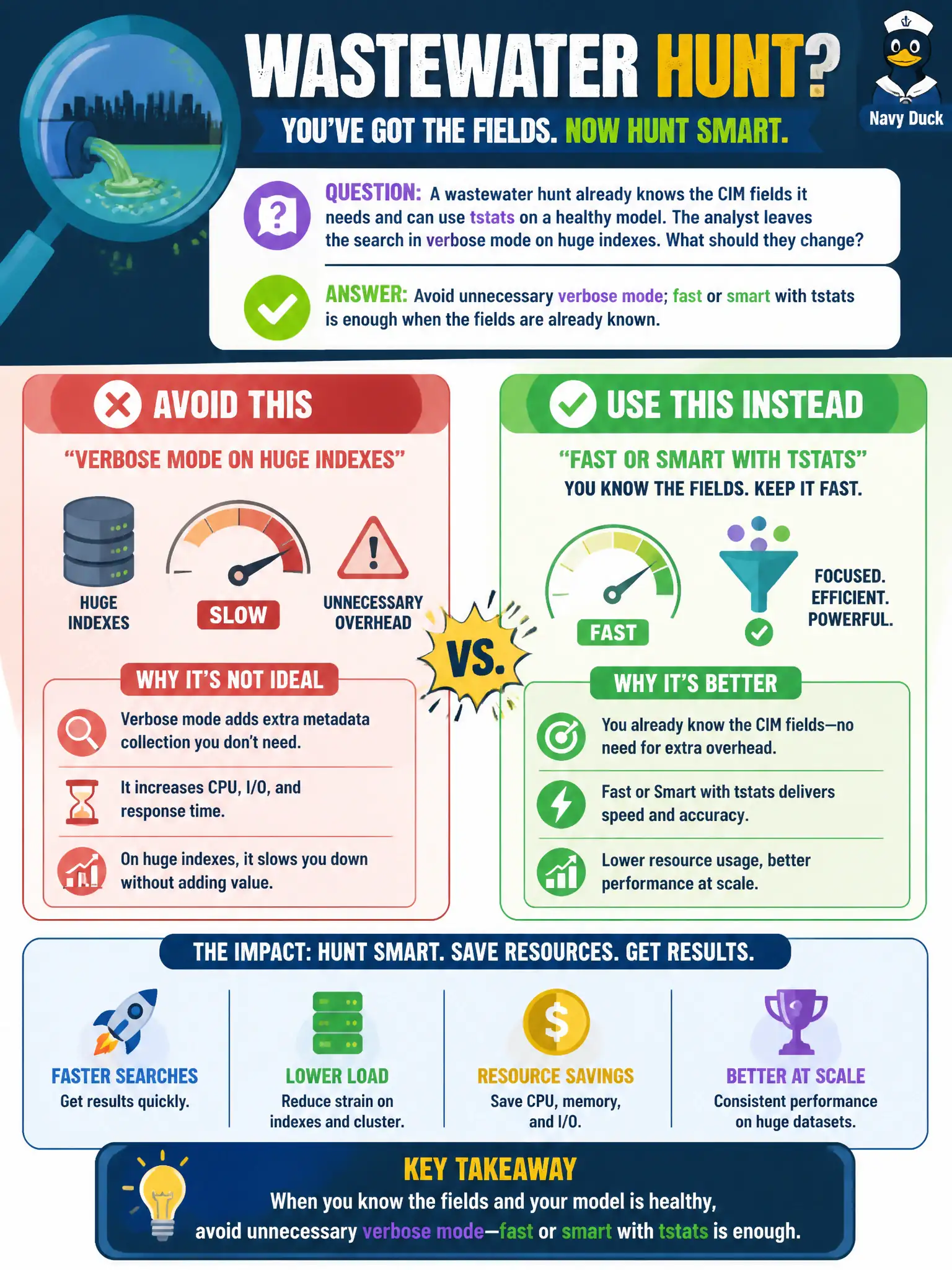
A wastewater hunt already knows the CIM fields it needs and can use tstats on a healthy model. The analyst leaves the search in verbose mode on huge indexes. What should they change?
Select an answer to reveal the explanation.
Short Explanation
Verbose mode pulls every field out of the haystack just in case. On a huge wastewater index, when the CIM fields are already known, that is wasted work. Fast or smart plus tstats is enough.
Full Explanation
Verbose search mode extracts all possible fields and is the most expensive mode. When a wastewater hunt already knows its CIM fields and can use tstats on a healthy accelerated model, fast or smart mode is sufficient and avoids extracting unused fields across huge OT indexes. Verbose is not required for tstats to read accelerated summaries, and combining verbose with All Time or index= multiplies cost on historian and SCADA data. Adding index= in verbose mode widens the scan without helping known-field tstats hunts. Reserve verbose for discovery when field names are unknown, not for production wastewater counts that already target CIM attributes. Exam caveat: if a needed field is missing from the model, fix mapping or acceleration rather than leaving every hunt in verbose as a workaround. Operational check: rerun the wastewater tstats hunt in smart or fast mode with the known CIM fields, confirm results match the verbose trial, and update the saved search mode so OT monitoring no longer defaults to verbose. Document the revised SPL in the civic SOC runbook so the next on-call analyst inherits the efficient pattern rather than the anti-pattern. Retain Job Inspector screenshots with the change ticket for audit.