
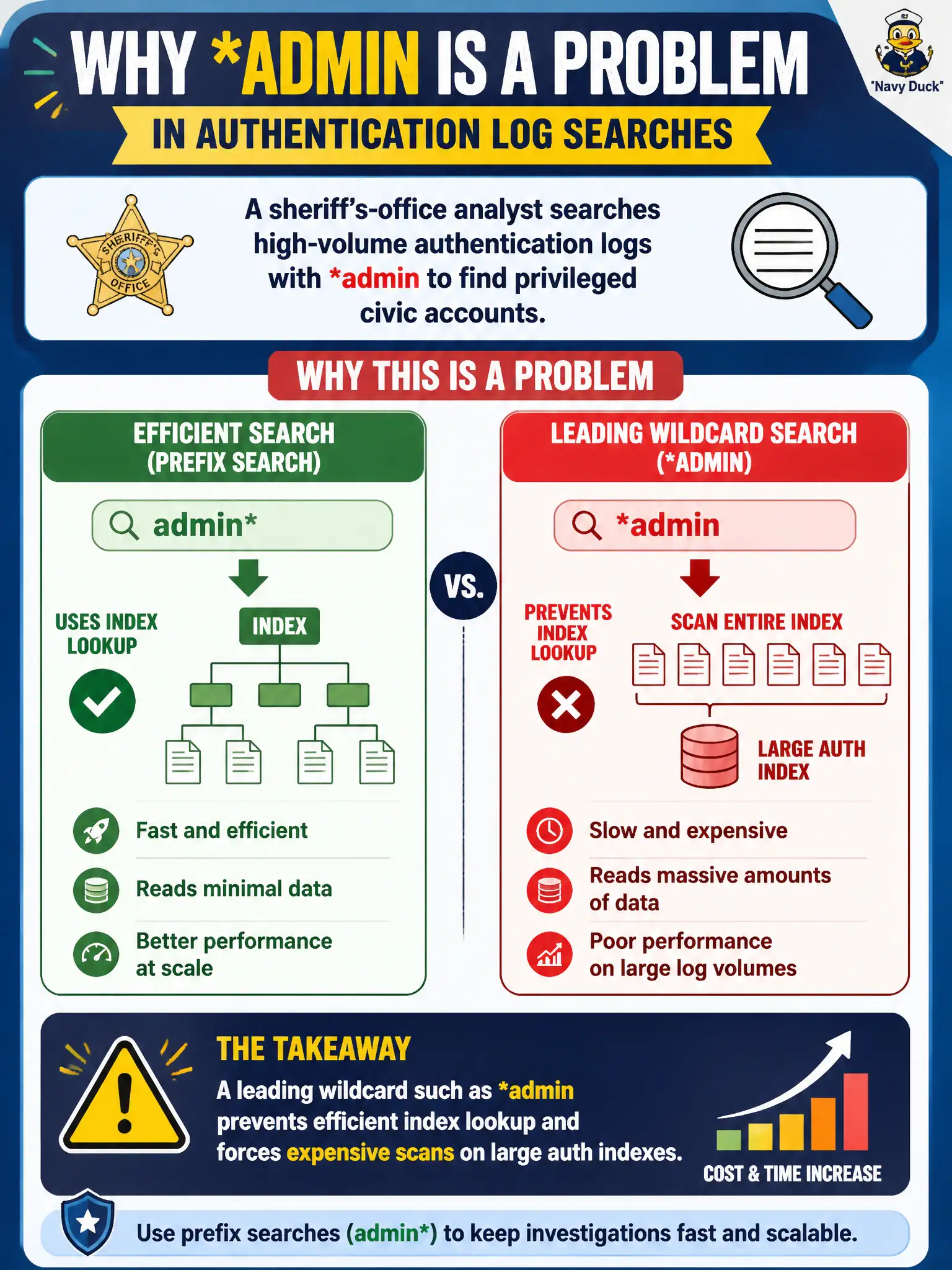
A sheriff's-office analyst searches high-volume authentication logs with *admin to find privileged civic accounts. Why is that pattern a problem?
Select an answer to reveal the explanation.
Short Explanation
A leading asterisk is like asking the records clerk to read every badge in the jail to see if it ends in admin. The index cannot jump to a term that starts with a wildcard, so high-volume auth logs get scanned the hard way.
Full Explanation
A leading wildcard such as admin prevents efficient index term lookup because the indexer cannot seek a term that begins with an unknown prefix, so high-volume sheriff's-office authentication logs are scanned the expensive way. Privileged civic account hunts should prefer anchored filters—exact user values, structured identity fields, or carefully scoped trailing patterns—that the index can use, not prefix-wildcard fishing across the entire auth corpus. Leading wildcards do not make searches faster; they disable the usual index seek path for that token. Splunk does not ignore wildcards in security indexes—the pattern still matches, just at high cost on busy jail and records systems. admin is not a CIM Authentication requirement and must not replace precise user filters in municipal hunts. Exam caveat: trailing wildcards are often cheaper than leading ones, but the best practice remains the most selective exact or field-bounded identity filter available. Operational check: compare job inspector scan metrics for user=*admin versus a precise privileged-group or exact-user filter on the same auth index and time window, then update the sheriff's hunt template to ban leading wildcards on hot identity fields.