
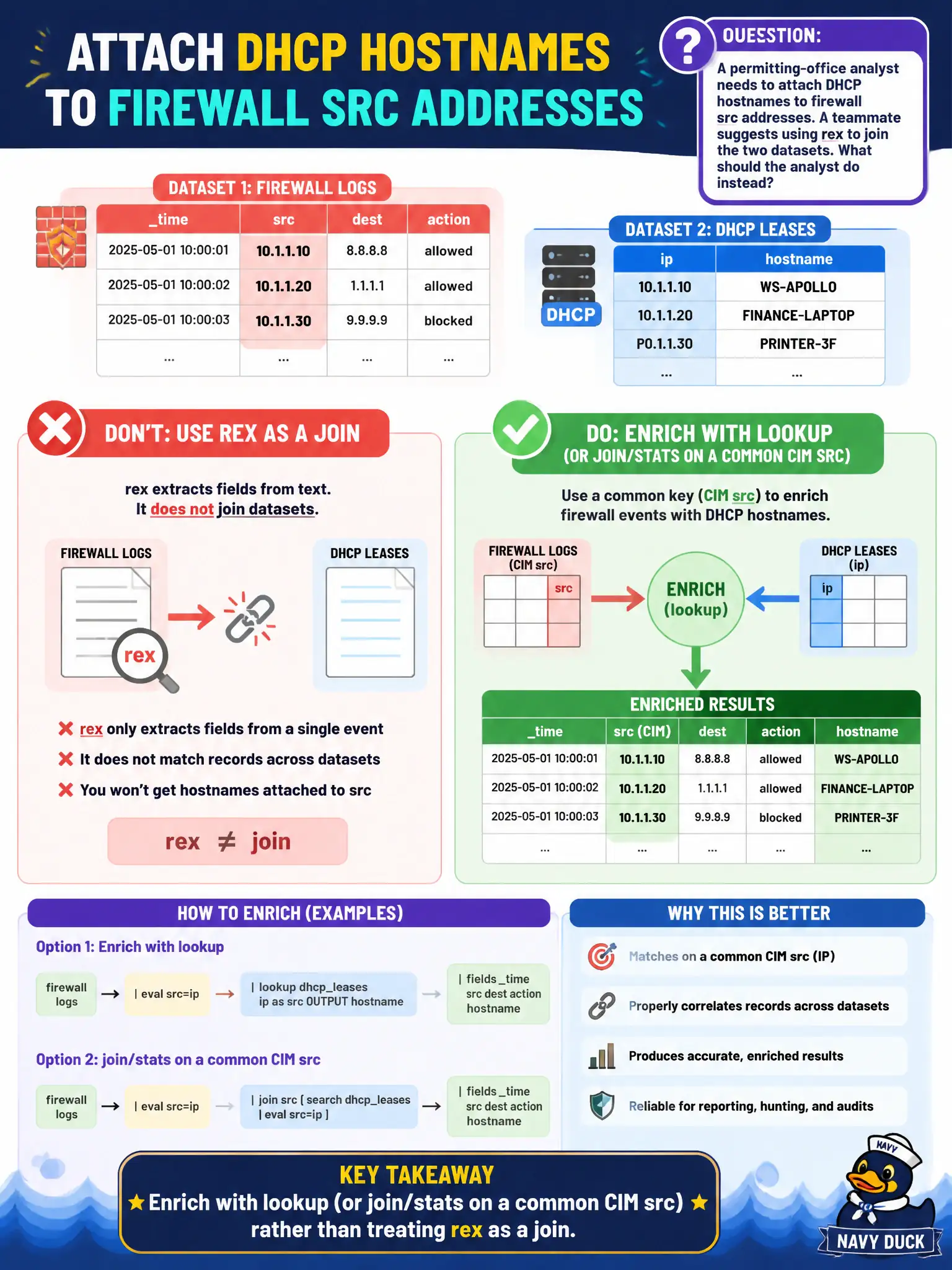
A permitting-office analyst needs to attach DHCP hostnames to firewall src addresses. A teammate suggests using rex to join the two datasets. What should the analyst do instead?
Select an answer to reveal the explanation.
Short Explanation
rex is a pair of scissors for cutting a field out of a string — it is not glue. To hang a DHCP hostname on a firewall src, use lookup, a stats/join on the shared CIM src, or the already-normalized src field — not a regex 'join'.
Full Explanation
rex extracts substrings into fields; it does not join DHCP leases to firewall sessions. A permitting-office analyst who needs hostnames on firewall src should enrich with lookup, or use join or stats on a shared CIM src, or rely on src already normalized by the add-ons—not treat regex as glue between datasets. Matching the command to the job keeps civic network hunts accurate: extract when text is buried, enrich when context lives in another table or stream. Keeping rex as the join fails conceptually because a pattern match inside one event cannot merge two indexes by itself. makeresults replacing both datasets with a dummy hostname discards the real DHCP and firewall evidence needed for the investigation. foreach on _time does not attach leases to firewall events and answers the wrong problem. Exam caveat: even with lookup or stats, the join key must be consistent—same IP formatting and a valid lease window—or hostnames attach to the wrong sessions and mislead containment. Operational check: pick a known permitting-office DHCP lease and firewall deny sharing src, enrich via lookup or stats, confirm hostname and lease fields land on the firewall row, and reject any runbook that uses rex as the join step.