
A library catalog-PC malware event exposes several hash fields named file_hash, file_hash_md5, and file_hash_sha256. How can the analyst lowercase every file_hash* field in one pass for intel matching?
Select an answer to reveal the explanation.
Short Explanation
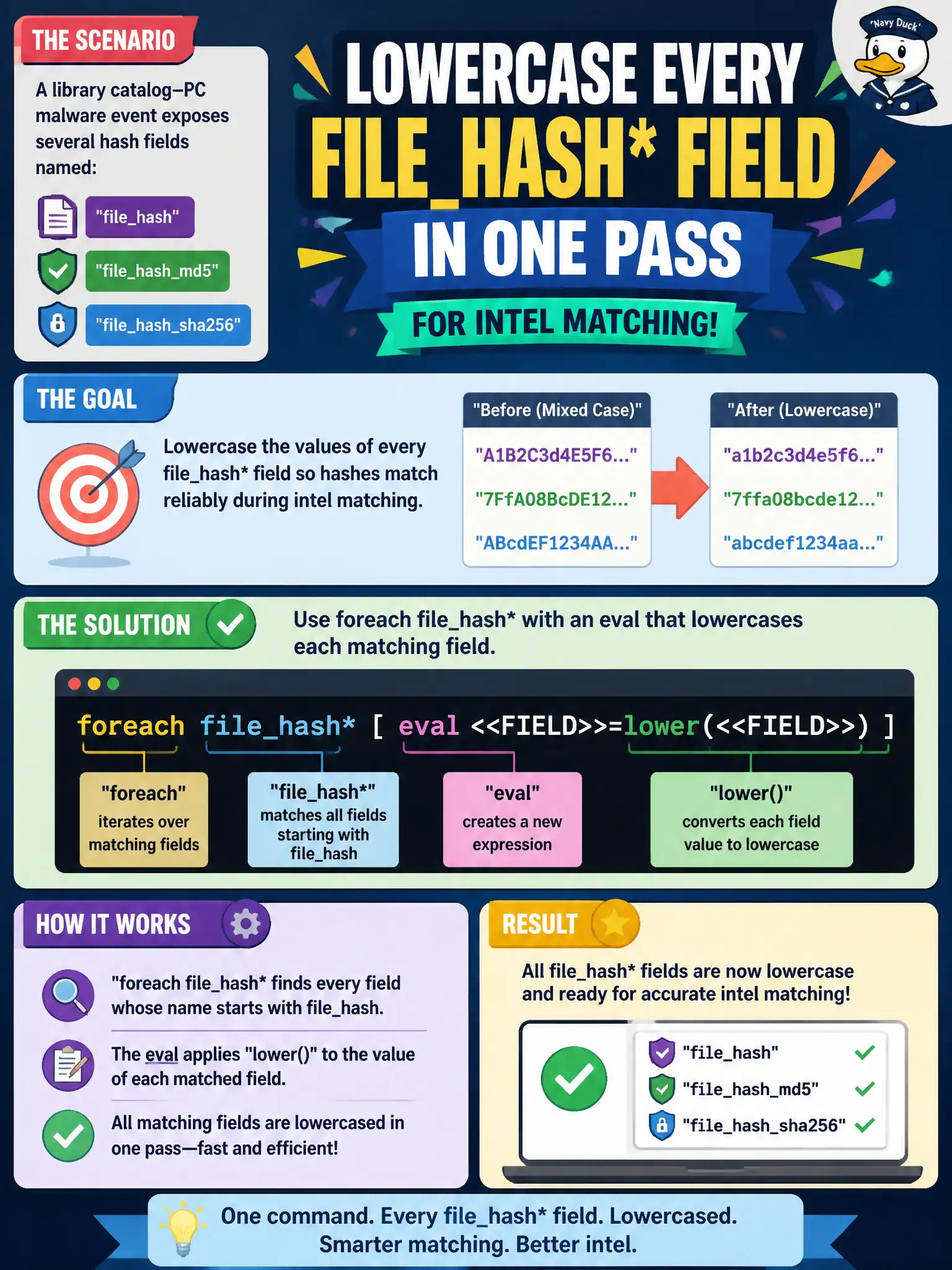
When a malware event shows up with a handful of hash fields, foreach file_hash* is the bulk stamp that lowercases every one of them. No need to name each hash by hand, and no need to pretend the data model already folded the case for you.
Full Explanation
foreach accepts wildcard field selectors, so foreach file_hash with an eval that lowercases each matching field normalizes every hash on the library catalog-PC malware event in one pass. That pattern is a security-analysis staple before intel lookup: indicators arrive under related names (file_hash, file_hash_md5, file_hash_sha256) and must share case with the ISAC or vendor table. Wildcard foreach avoids hand-listing each field and keeps the live malware event intact for subsequent enrichment. transaction keyed by file_hash groups events in time; it does not case-fold field values or prepare hashes for lookup. makeresults synthesizes new rows rather than transforming the malware event already under investigation. tstats against the Malware data model does not automatically lowercase hashes; acceleration stores summarized values as mapped, not as a case-folding service. Exam caveat: wildcards only touch fields present on the event—missing MD5/SHA256 names still need upstream extraction or TA mapping. Operational check: after foreach file_hash*, table the hash fields, confirm they are lowercase, pipe into the intel lookup, and verify a known library sample hash returns a match before relying on the hunt in production.