
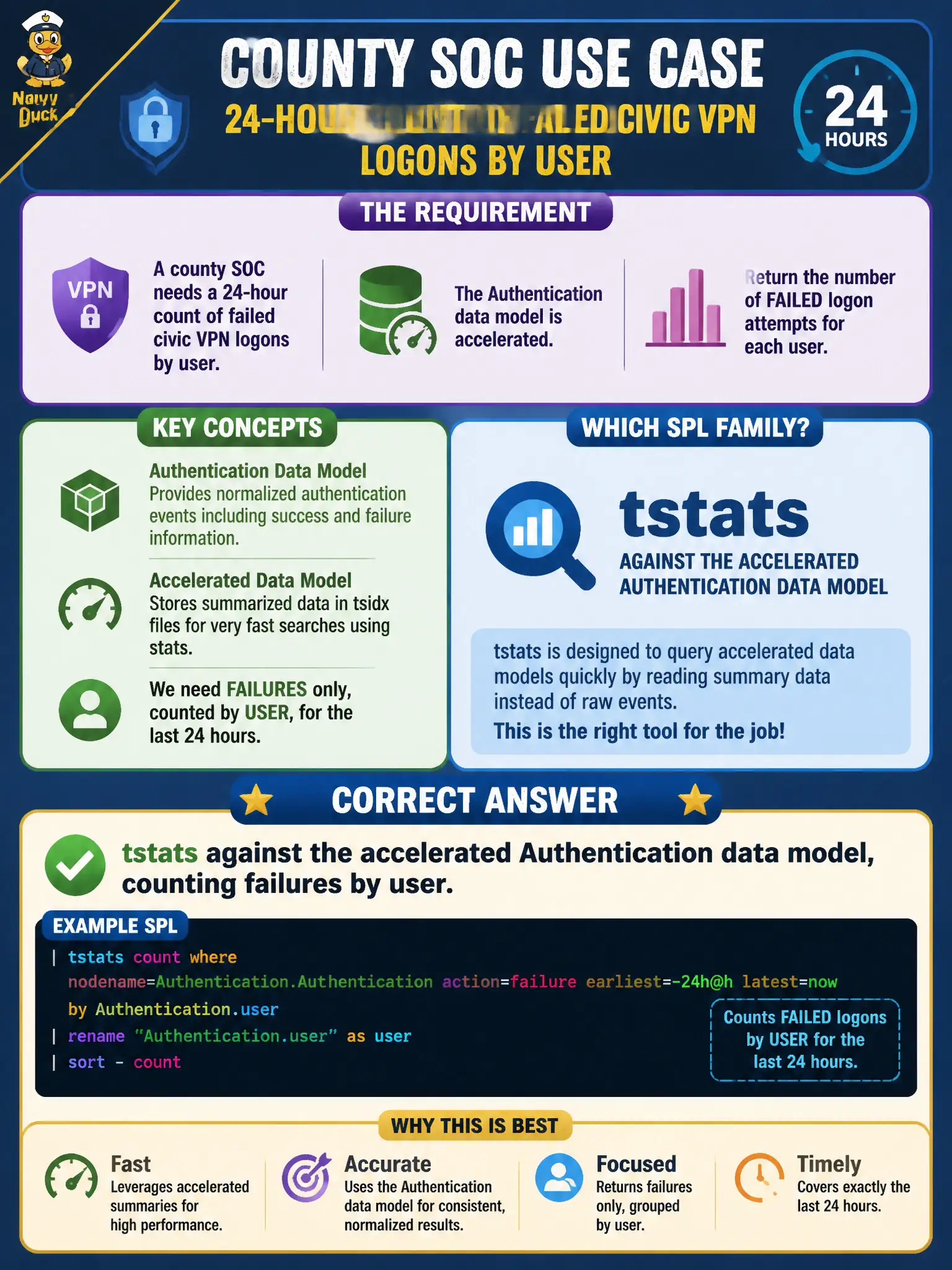
A county SOC needs a 24-hour count of failed civic VPN logons by user. The Authentication data model is accelerated. Which SPL family should the analyst use?
Select an answer to reveal the explanation.
Short Explanation
When the Authentication model is already warmed up, tstats is the express lane. A raw index=* crawl is walking every street to count one parking lot. Use the summary; that is what acceleration is for.
Full Explanation
In Splunk Enterprise Security for a municipal SOC, tstats against accelerated CIM data models is the blueprint command family for fast security aggregations such as a 24-hour count of failed civic VPN logons by user on Authentication. Because the Authentication data model is already accelerated, tstats reads summary data instead of scanning raw VPN indexes and returns counts suitable for Incident Review support and leadership metrics. Using index= sourcetype= with a leading wildcard on the username, then transaction, fails by concept because it ignores the maintained CIM model, is expensive, and misuses transaction for a simple count. Running rex against _raw for every VPN event, then makeresults to rebuild the counts, fails by concept because rex and makeresults do not replace summarized Authentication aggregates and invent or re-parse what the model already normalizes. Using foreach over unused CIM fields, then looking up a blank table to invent totals, fails by concept because foreach and empty lookups do not compute authentic failed-logon counts. Exam caveat: SPLK-5001 expects analysts to choose tstats on accelerated Authentication for civic failed-VPN aggregations rather than raw wildcard scans or synthetic commands. Operational check: run tstats on Authentication for failed VPN actions over the last 24 hours by user, compare a sample user’s count to a bounded raw search for validation, confirm acceleration is healthy, and save the search for the county SOC’s recurring VPN hygiene review.