
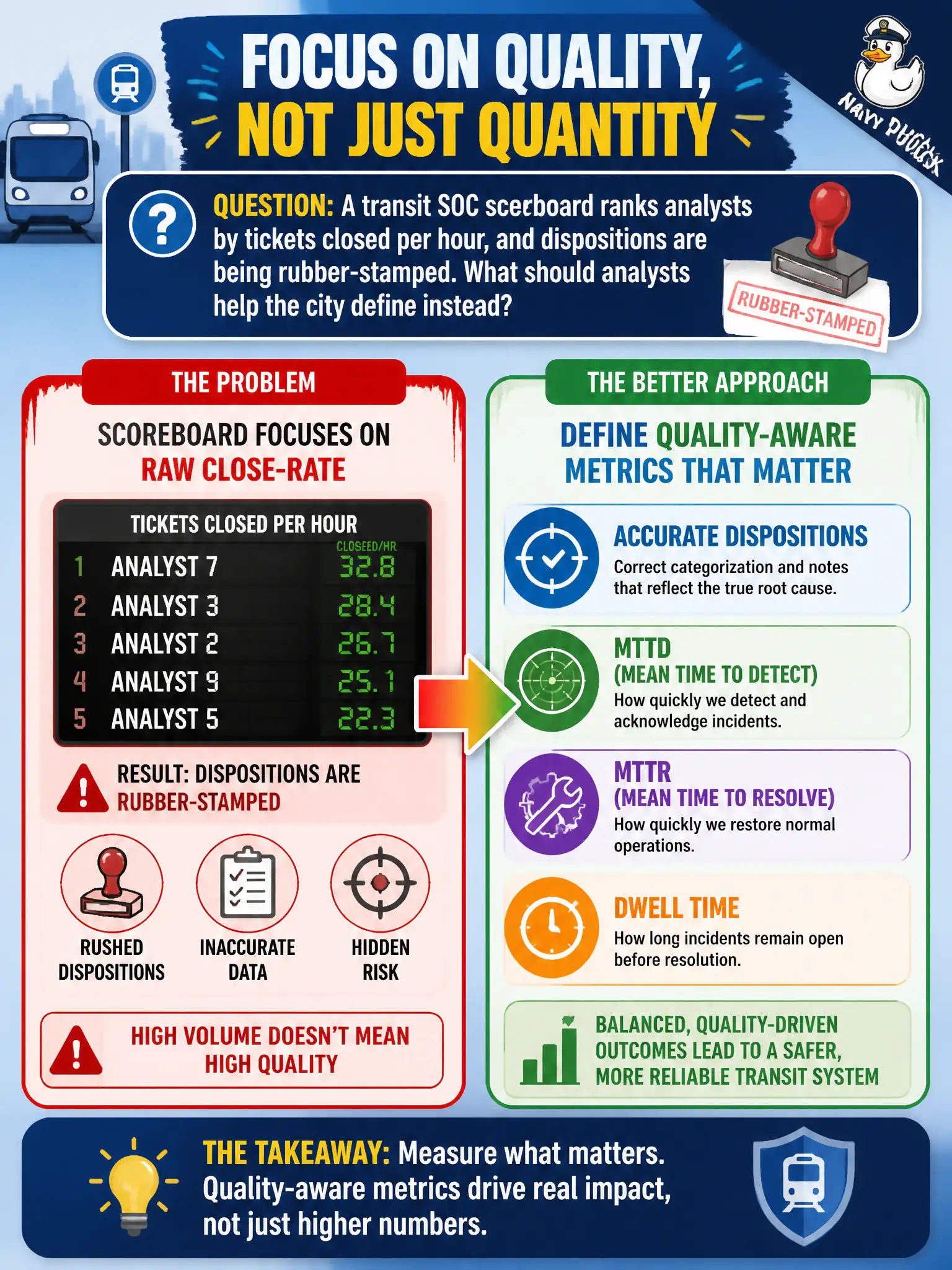
A transit SOC scoreboard ranks analysts by tickets closed per hour, and dispositions are being rubber-stamped. What should analysts help the city define instead?
Select an answer to reveal the explanation.
Short Explanation
Tickets closed per hour is a pizza-oven metric: it rewards sliding pies out whether they are cooked. Analysts should help pick clocks that measure detection, response, dwell, and honest dispositions. Rubber stamps empty the queue and poison the lesson.
Full Explanation
Analysts should help the transit city define quality-aware metrics—accurate dispositions, MTTD, MTTR, and dwell—rather than raw tickets-closed-per-hour that encourage rubber-stamping dispositions to empty the queue. A scoreboard ranked only on close rate rewards sliding notables out whether investigations are sound. Raising the close-rate target further so the queue is empty before quality is checked fails by concept because it intensifies the wrong incentive and invites premature labels. A metric that ignores disposition accuracy as long as status hits Resolved fails by concept because Resolved without a correct disposition hides false positives, true positives, and tuning needs from engineering. Requiring notables Closed without an owner so counts rise fails by concept because unowned closures destroy accountability and auditability on civic incidents. Exam caveat: SPLK-5001-aligned municipal SOCs treat disposition quality and time-based detection/response metrics as superior to pure throughput vanity scores. Operational check: replace or supplement close-rate leaderboards with disposition-accuracy sampling and MTTD/MTTR/dwell trends, and require owner plus disposition before Closed on Analyst Queue.