
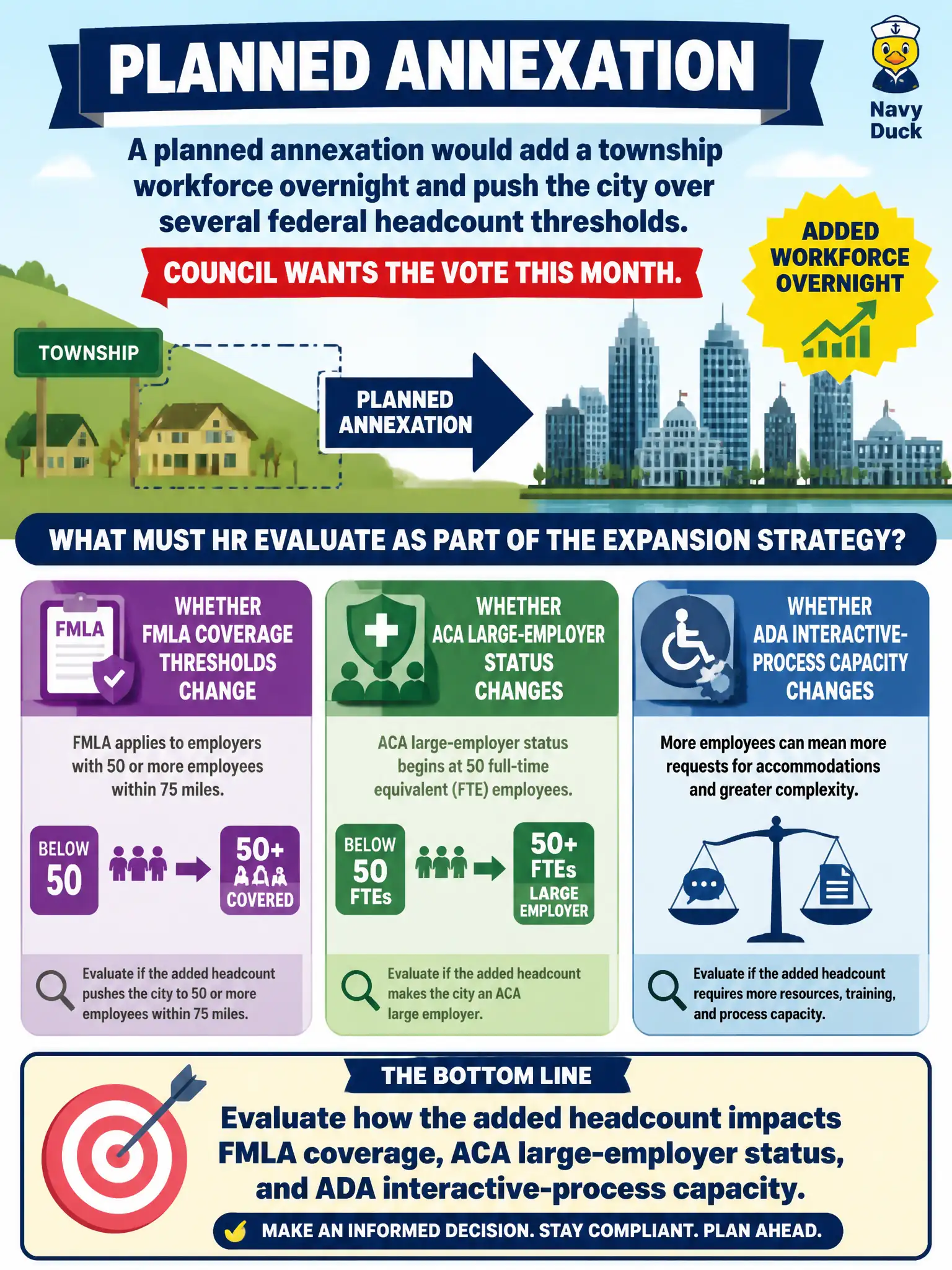
A planned annexation would add a township workforce overnight and push the city over several federal headcount thresholds. Council wants the vote this month. What must HR evaluate as part of the expansion strategy?
Select an answer to reveal the explanation.
Short Explanation
Annexation is not only a map change. It is a headcount change that can flip which federal statutes apply tomorrow morning. Check FMLA thresholds, ACA large-employer status, and ADA interactive-process capacity before the vote, not after the new employees are already on the payroll.
Full Explanation
Annexation is a headcount event as much as a map event. When a planned annexation would add a township workforce overnight and push the city over federal thresholds, HR must evaluate whether FMLA coverage thresholds, ACA large-employer status, and ADA interactive-process capacity change because of the added headcount. Crossing those lines changes leave administration, benefit offer duties, and disability-accommodation workload immediately—not on a convenient budget timetable. Strategy that ignores threshold flips leaves the city noncompliant the morning after the vote.
Evaluating only millage because 'statutes never change with annexation' is false. Delaying FMLA and ADA duties for two budget cycles after closing is not a lawful grace period the city can grant itself. Keeping new employees off official headcount to dodge thresholds is concealment, not planning.
Exam caveat: not every annexation crosses every threshold, and some duties may already apply. The concept is to model headcount-triggered federal obligations as part of expansion strategy before the vote.
Operational check: forecast post-annexation FTE and employee counts against FMLA and ACA triggers; assess ADA case volume and HR capacity; prepare policy, vendor, and training changes timed to the effective date; and put the compliance readiness statement in the council packet beside the fiscal analysis.