
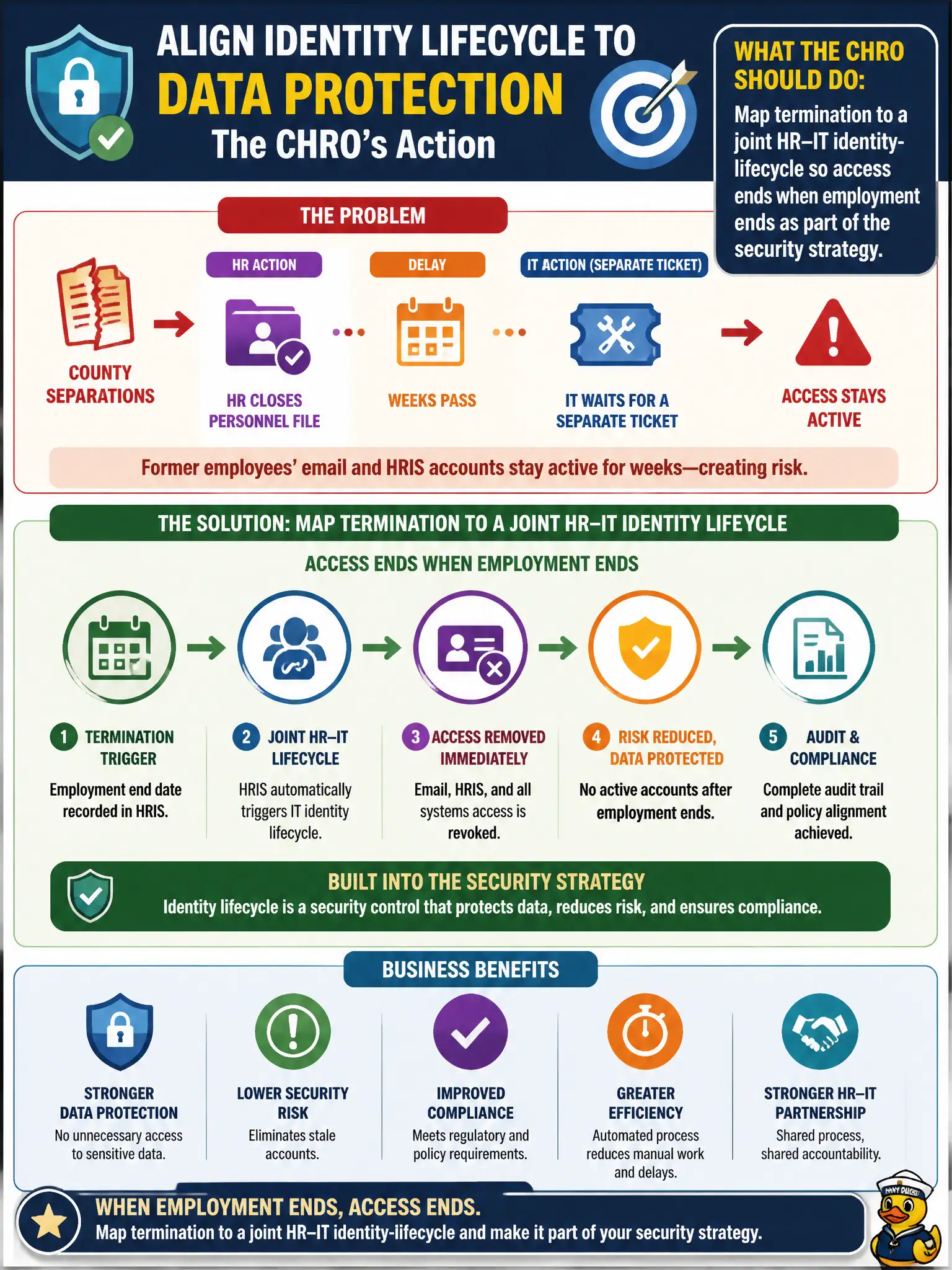
After several county separations, former employees' email and HRIS accounts stay active for weeks because HR closes the personnel file while IT waits for a separate ticket. The CHRO is aligning identity lifecycle to the data-protection strategy. What should the CHRO do?
Select an answer to reveal the explanation.
Short Explanation
Leaving a terminated badge live is like leaving the spare key under the mat after someone moves out. Closing the paper file is not the same as cutting system access. HR and IT have to share one offboarding clock so the security strategy actually fires.
Full Explanation
Access termination is an HR-security process, not an IT-only chore that starts when someone happens to open a ticket. Mapping termination to a joint HR–IT identity lifecycle so access ends when employment ends aligns offboarding to the county's data-protection strategy and closes the weeks-long residual access after separations. Accounts should die with the appointment.
Leaving deprovisioning entirely to IT with only a courtesy note when final pay issues creates a known delay gap attackers and former staff can exploit. Keeping accounts open for ninety days so alumni can retrieve personal files without help prioritizes convenience over security and records control. Requiring each departing employee to email IT a self-service disable request assumes cooperation from someone who may be disgruntled or already gone.
Exam caveat: limited, time-boxed access for benefits continuation inquiries can be designed deliberately; that is not the same as leaving full email and HRIS rights live. Operational check: trigger disablement from the HR termination event the same day, measure residual-access days, and tabletop a same-day separation for a privileged HRIS user. Document ownership so auditors can see who maintains the control.