
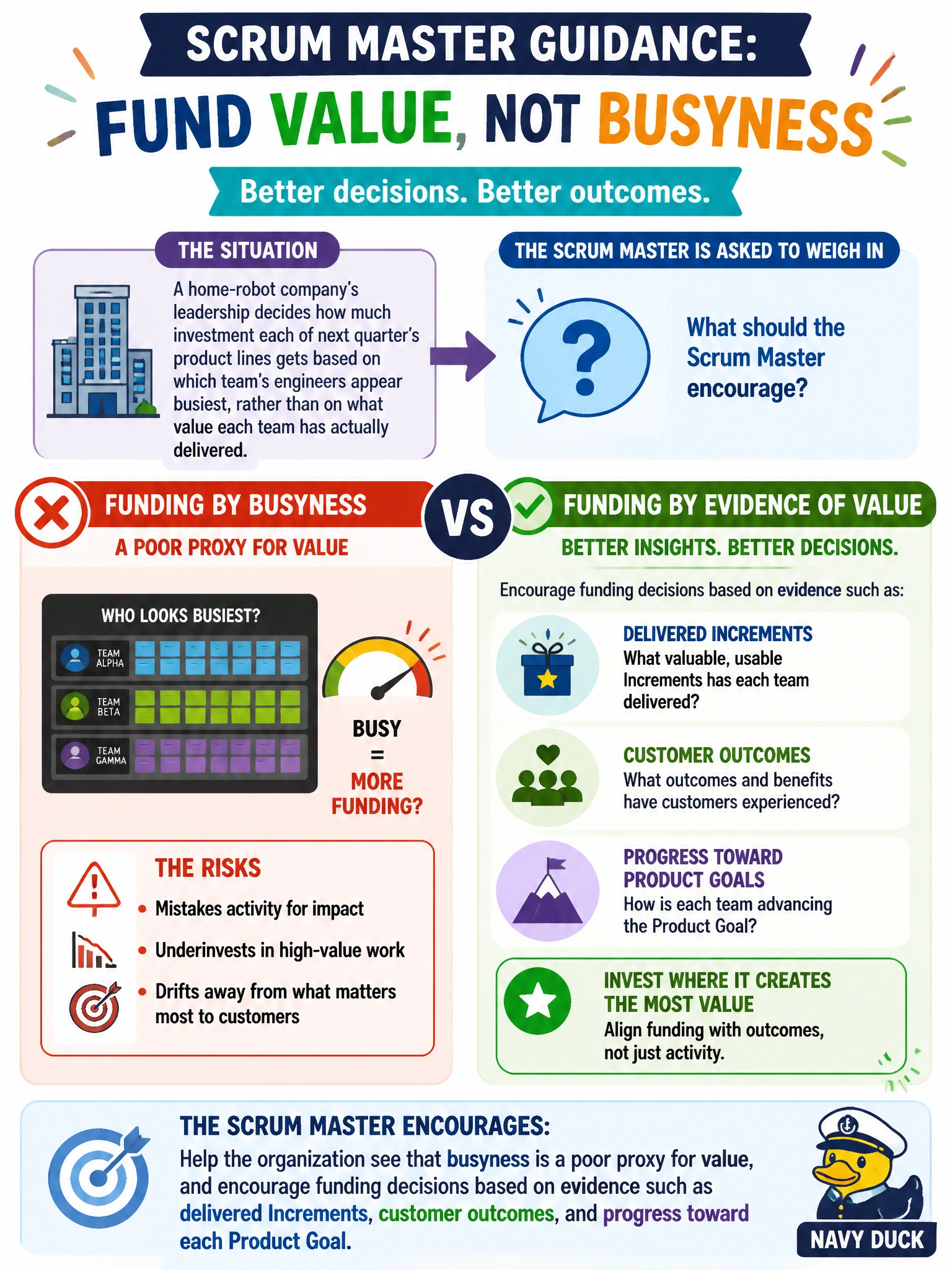
A home-robot company's leadership decides how much investment each of next quarter's product lines gets based on which team's engineers appear busiest, rather than on what value each team has actually delivered. A Scrum Master is asked to weigh in on this funding process. What should the Scrum Master encourage?
Select an answer to reveal the explanation.
Short Explanation
A team that looks slammed all quarter and a team that quietly shipped something customers actually wanted can end up funded the exact opposite way if "busy" is the metric. Busy measures effort, not outcome — and the whole point of empiricism is to make decisions off outcomes you can actually see. Pointing leadership at delivered value instead of visible motion is squarely in a Scrum Master's lane.
Full Explanation
Empiricism calls for decisions based on evidence from what's actually been delivered and observed, and utilization or apparent busyness is not that evidence — it measures how occupied people look, not whether the work produced value. A Scrum Master serving the organization helps leadership see this gap and points funding conversations toward things that can genuinely be inspected: Increments actually delivered, movement toward each Product Goal, and observable customer outcomes. Staying silent treats organizational decision-making as none of the Scrum Master's concern, but portfolio-level decisions directly shape what Scrum Teams are asked to do and are a legitimate place for the Scrum Master's service to the organization. Refining hour-logging just measures busyness more precisely without addressing that busyness was never the right signal in the first place — a more accurate measurement of the wrong thing doesn't help. Allocating funding strictly by headcount substitutes one non-value proxy for another; a larger team isn't automatically delivering more value than a smaller one. A caveat: outcome evidence is genuinely harder for leadership to gather than a utilization report, so this shift takes sustained advocacy rather than a single conversation. Concrete check: ask what evidence, if any, supported last quarter's funding split — if the answer is a utilization dashboard rather than delivered outcomes, the gap this question describes is already present.