
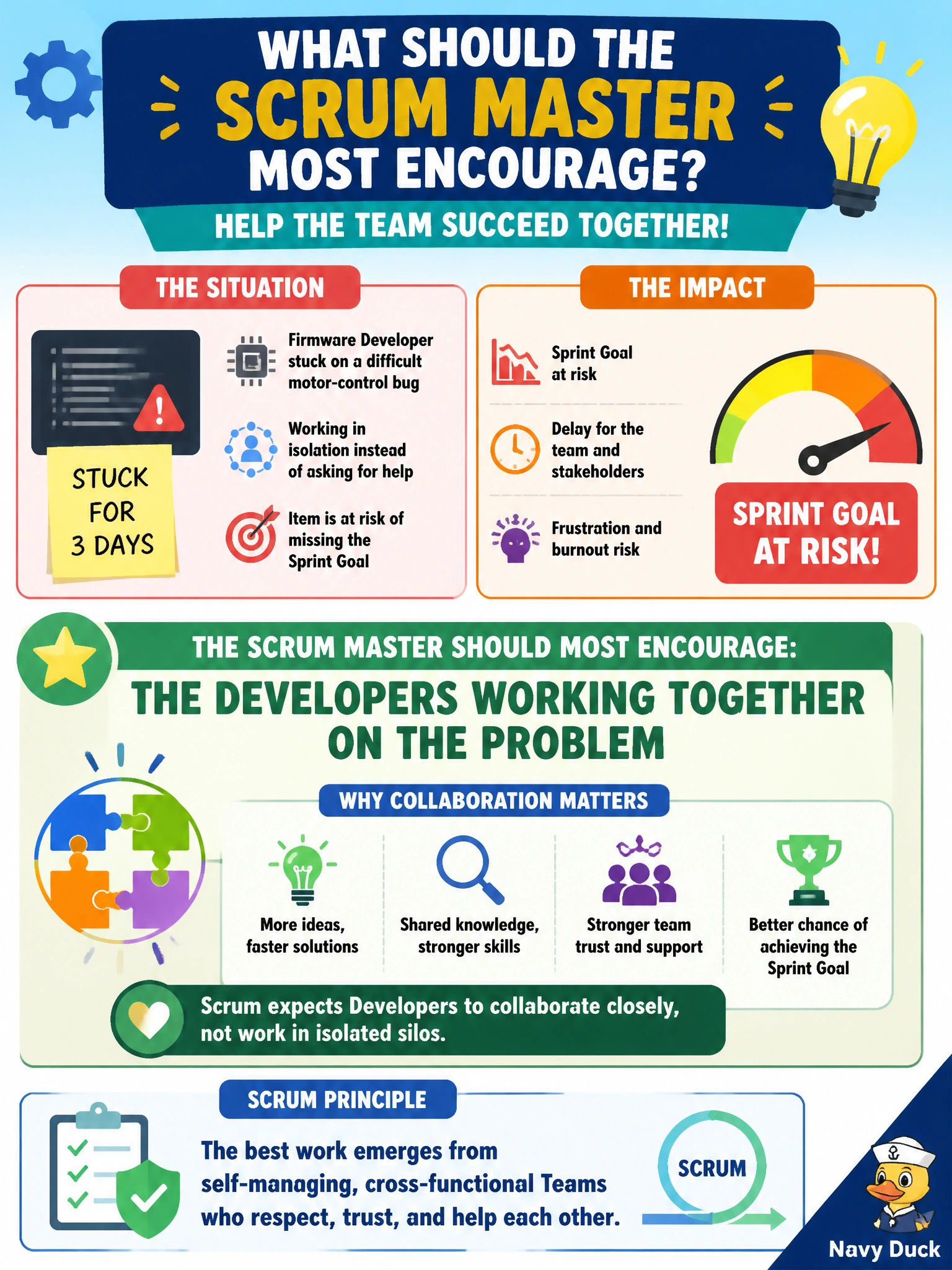
A firmware Developer has been stuck alone for three days on a difficult motor-control bug, working in isolation rather than asking teammates for help, and the item is now at risk of missing the Sprint Goal, so what should the Scrum Master most encourage?
Select an answer to reveal the explanation.
Short Explanation
One person quietly wrestling with a hard bug for three days is a lot like someone trying to move a couch alone when three other people are in the next room — the work doesn't have to be that hard. Scrum expects the Developers to work together closely as a single, cross-functional unit, so a stuck teammate pulling others in isn't a failure, it's exactly how the team is supposed to operate.
Full Explanation
Scrum does not organize the Developers as a set of individuals each privately responsible for their own tickets; it expects them to function as one cross-functional, self-managing unit that solves problems together. A Developer struggling alone for days on a difficult bug, without pulling in teammates, is working against that model rather than with it, and the Scrum Master's role here is to make that collaboration visible and normal rather than to solve the technical problem directly. Assigning the bug to a specific senior Developer reintroduces a command-and-control dynamic that undercuts self-management, since the Developers themselves decide how work gets distributed and tackled. Pulling the item from the Sprint Backlog is premature if the Sprint Goal can still be protected through collaboration, and it treats a coordination gap as if it were an unrecoverable scope problem. The Scrum Master personally diagnosing the bug also misplaces accountability, since technical work belongs to the Developers, not the Scrum Master, whose job is to facilitate and coach rather than perform the work. A simple operational check the Scrum Master can use is to notice, during the Daily Scrum, whether the same impediment is reported unresolved for multiple days in a row without any teammate volunteering to help — that pattern is a reliable signal that collaboration, not skill, is the missing ingredient.