
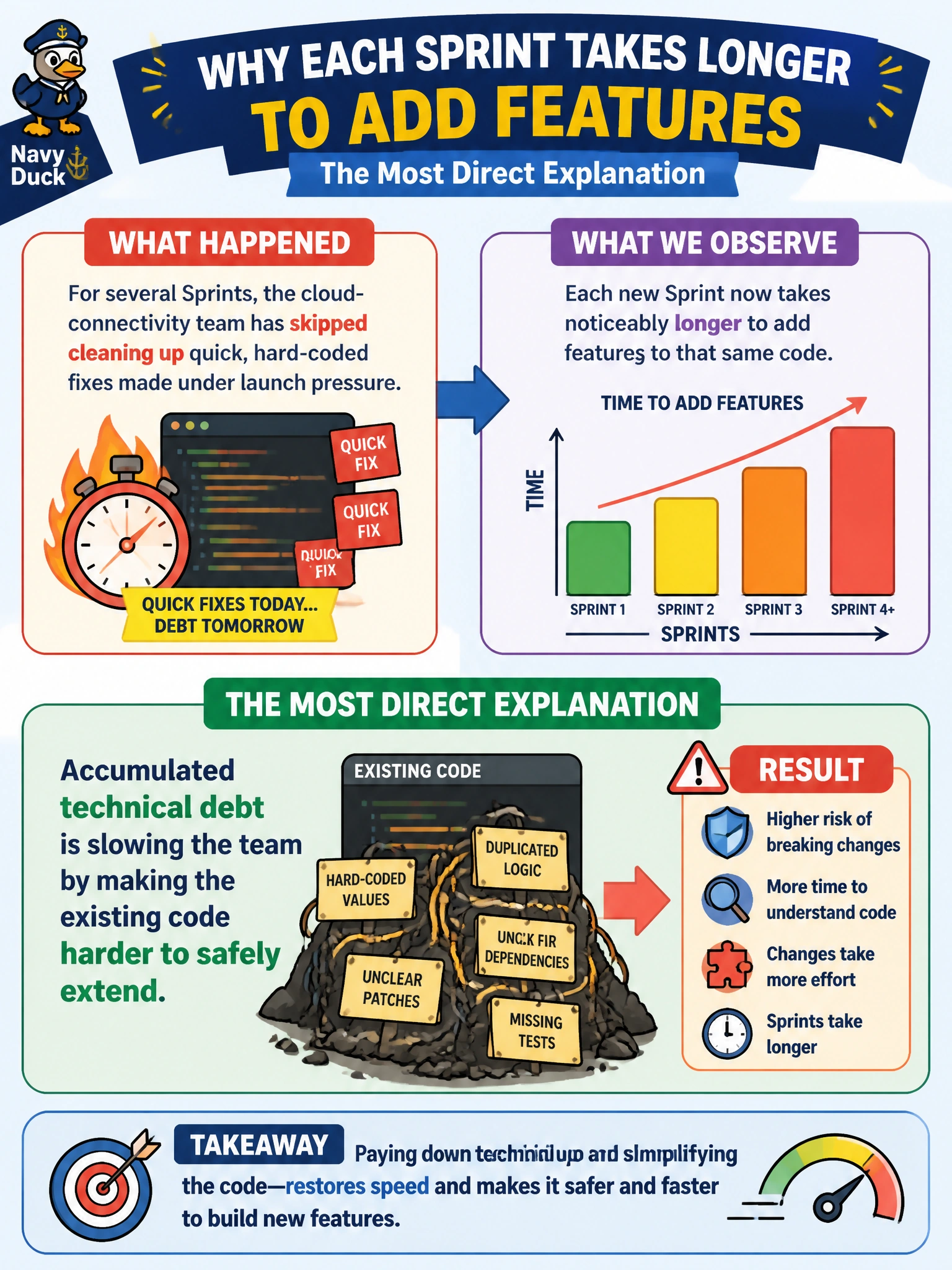
For several Sprints, the cloud-connectivity team has skipped cleaning up quick, hard-coded fixes made under launch pressure, and each new Sprint now takes noticeably longer to add features to that same code, so what is the most direct explanation?
Select an answer to reveal the explanation.
Short Explanation
Technical debt works a lot like a credit card balance: skipping the cleanup now feels free, but interest keeps compounding until every new purchase — every new feature — costs more just to make room for it. A codebase full of quick, unrefactored fixes gets slower and riskier to change, and that drag shows up as slower Sprints later, not immediately.
Full Explanation
Technical debt describes the accumulated cost of choosing an expedient shortcut over a more durable solution, and unlike financial debt it is often invisible until enough of it has piled up to visibly slow the team. Each hard-coded fix left unrefactored adds a little more fragility and coupling to the codebase, so future Product Backlog items that touch that same area take longer: Developers must first understand a messier design, work around brittle pieces, and re-test more carefully to avoid breaking something adjacent. This is exactly why a strong Definition of Done and disciplined engineering practice matter — they are what keep this debt from silently accumulating Sprint after Sprint. Adding people rarely fixes it and can even slow things further, because more Developers means more coordination inside code that is already hard to reason about; a shorter or longer Sprint length is unrelated to the root cause, and a stricter Definition of Done wouldn't have created debt, it would have prevented some of it. A useful check is to compare the effort estimates for similar-sized items across recent Sprints in that codebase — a rising trend for equivalent work is a fairly reliable signal that debt, not scope or team size, is the driver.