
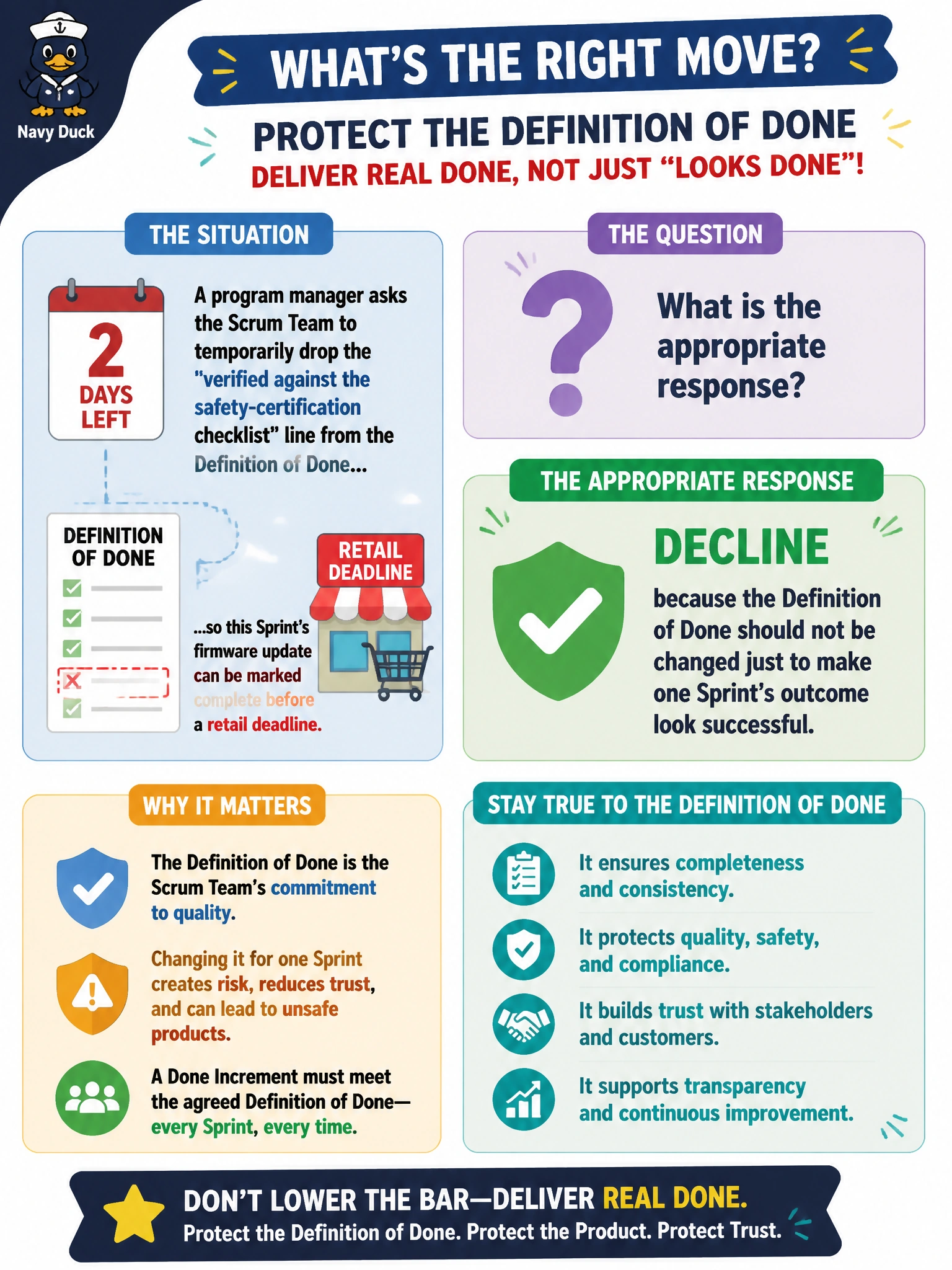
With two days left in the Sprint, a program manager asks the Scrum Team to temporarily drop the "verified against the safety-certification checklist" line from the Definition of Done so this Sprint's firmware update can be marked complete before a retail deadline, so what is the appropriate response?
Select an answer to reveal the explanation.
Short Explanation
Lowering the Definition of Done to hit a date is like moving the finish line closer because a runner is tired — the race stops meaning anything. The Definition of Done is a quality standard the whole team stands behind, not a dial to turn down under deadline pressure. If the item genuinely can't meet it, it isn't Done, and that's the honest answer, even when it's the unwelcome one.
Full Explanation
The Definition of Done exists to create a shared, objective standard of quality that does not bend to whichever Sprint happens to be under pressure. If it can be quietly relaxed whenever a deadline looms, it stops functioning as a standard at all and becomes theater — a checklist that only applies when convenient. Declining the request preserves the integrity of what "Done" means for every Increment going forward, and it keeps the transparency that empiricism depends on: stakeholders need an honest signal about what is genuinely usable, not an inflated one shaped by a retail date. A Product Owner cannot unilaterally waive the Definition of Done either, because it belongs to the whole Scrum Team and reflects the quality bar the organization has agreed to. The right move is to surface the real trade-off plainly — the certification check has not passed, so the item is not Done — and let the Product Owner decide whether to ship without that feature, delay, or accept the schedule risk with eyes open. As an operational check, ask whether the same relaxation would be acceptable in a Sprint with no external deadline at all; if not, it's a symptom of pressure, not a legitimate change to the standard.