
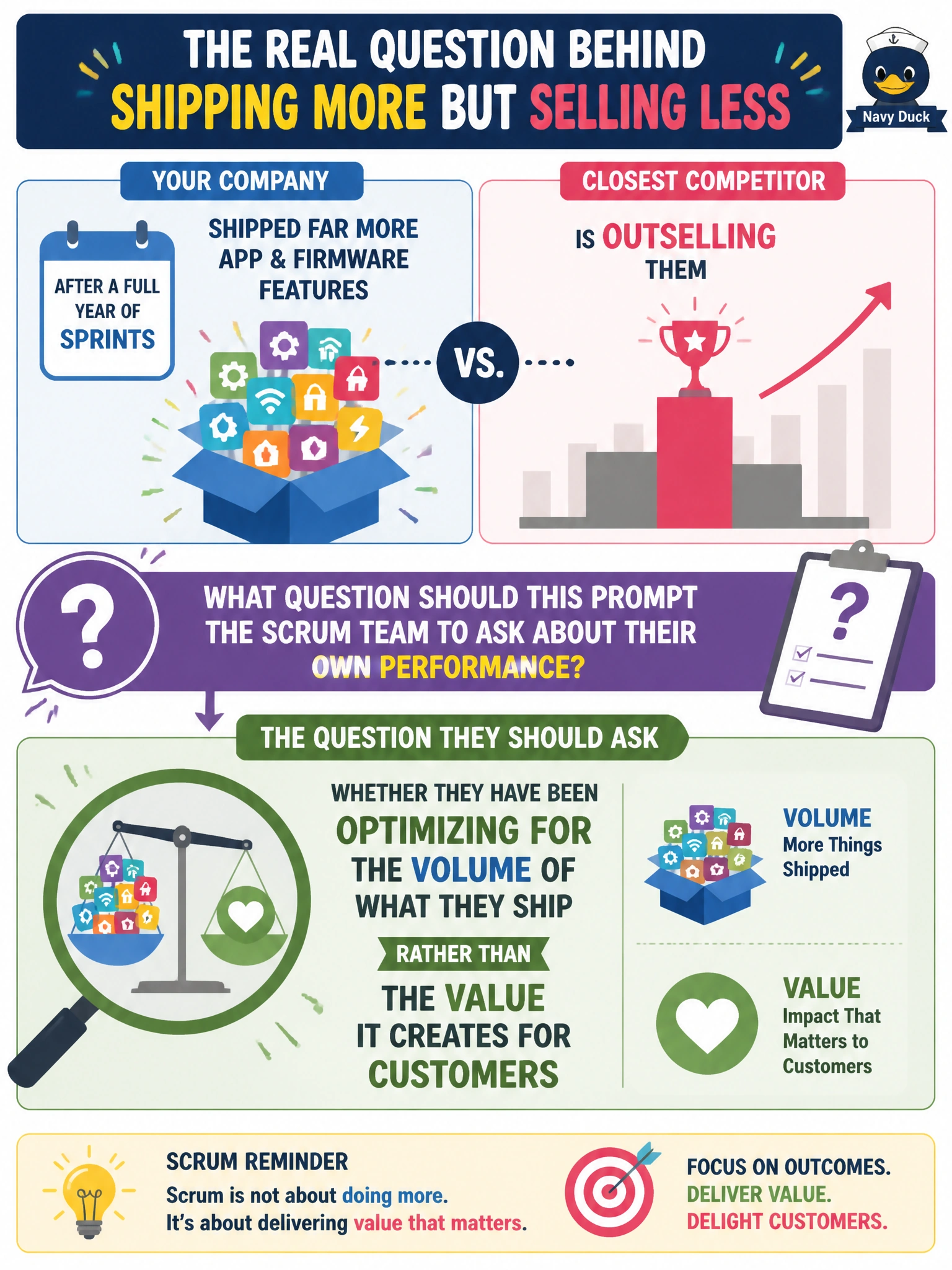
After a full year of Sprints, the home-robot company has shipped far more app and firmware features than its closest competitor, yet the competitor is outselling them. What question should this prompt the Scrum Team to ask about their own performance?
Select an answer to reveal the explanation.
Short Explanation
Out-shipping a competitor and out-selling one aren't the same contest. If more features didn't translate into more sales, it's worth asking whether the team has quietly been optimizing for how much gets built instead of how much it actually matters to customers.
Full Explanation
The mechanism ties the whole cluster together: a higher feature count is an output measure, and losing on sales despite winning on output is exactly the signal that the team may have optimized for shipping volume instead of customer value, which is what a Product Backlog is supposed to maximize. Pulling more items into each Sprint doubles down on the same output-focused instinct that produced the mismatch in the first place, rather than questioning it. Extending the Sprint length attacks cycle time and violates the fixed-timebox nature of a Sprint besides, without addressing whether the shipped work mattered. Having the Scrum Master gatekeep feature requests before the Product Backlog misassigns Product Backlog ownership, which belongs to the Product Owner, and doesn't address the underlying value question either. Caveat: outselling isn't purely a Scrum Team concern, since pricing, marketing, and distribution matter too, but the team's own contribution to value is still worth examining honestly. Operational check: pick the last five shipped features and ask, with real data if available, which of them plausibly changed a customer's decision to buy.