
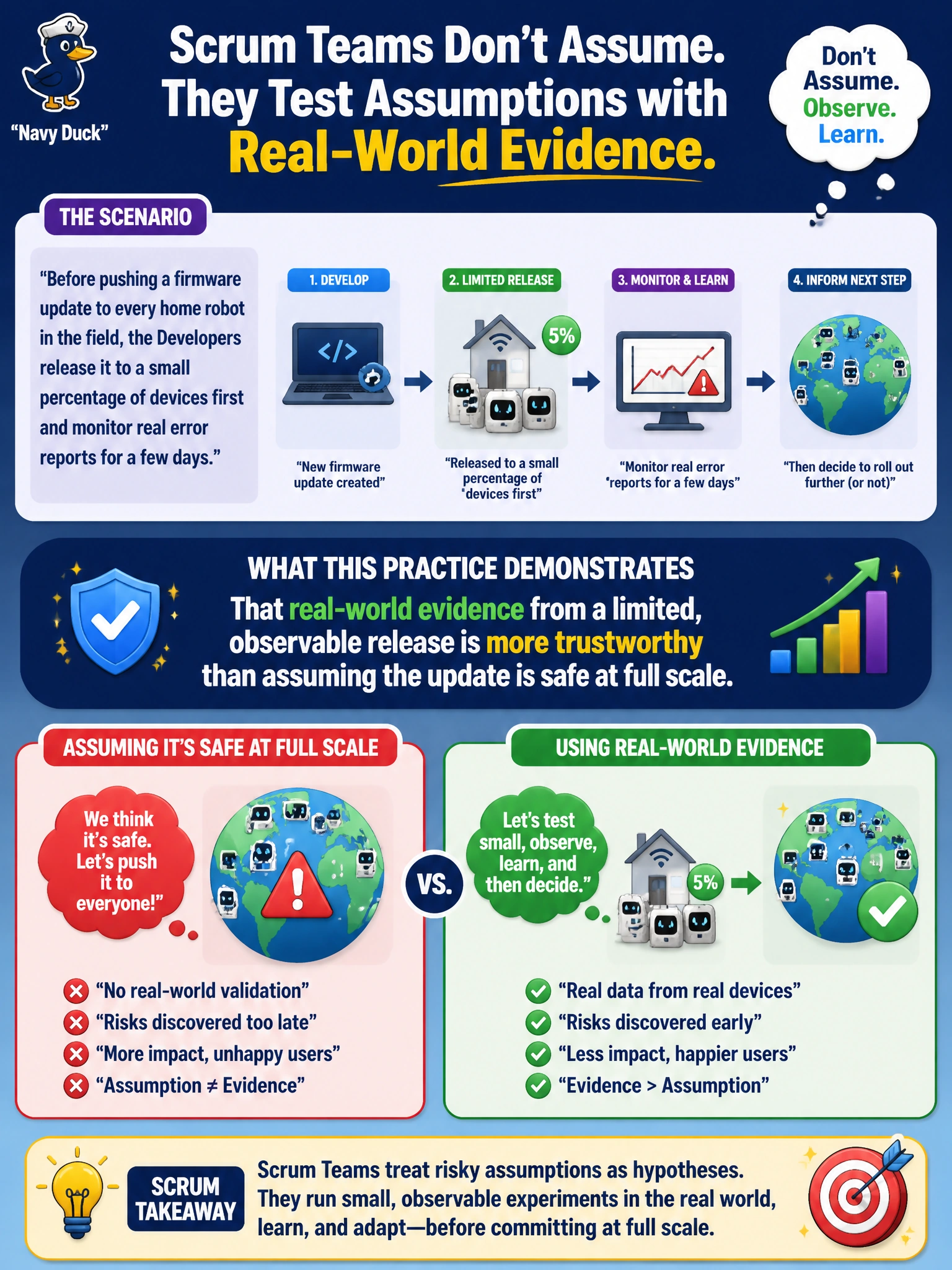
Before pushing a firmware update to every home robot in the field, the Developers release it to a small percentage of devices first and monitor real error reports for a few days. What does this practice best demonstrate about how Scrum Teams should treat risky assumptions?
Select an answer to reveal the explanation.
Short Explanation
Rolling out to a small slice first and watching what actually happens beats crossing your fingers and pushing to everyone at once. It's the same empirical instinct Scrum runs on: get real evidence in front of you before betting everything on an assumption.
Full Explanation
The mechanism is empiricism applied to operational risk: a limited release generates real, observable evidence about the update's safety before the team commits to the riskier, harder-to-reverse full-scale rollout, mirroring the same inspect-then-adapt pattern the Guide applies to product Increments generally. Lowering the Definition of Done for firmware would weaken the very safety bar that a staged rollout is trying to protect, which runs directly against the intent of the practice. Requiring personal Scrum Master approval for every push invents an approval authority not described anywhere in the Guide and misplaces accountability that belongs with the Developers and the Product Owner. Claiming firmware pushes skip Sprint Review because they happen outside the Sprint Backlog confuses a deployment mechanism with whether the work and its risk should still be inspected by the Scrum Team and stakeholders. Caveat: a small sample reduces risk but doesn't eliminate it, since rare failure modes can still hide in a limited rollout. Operational check: define in advance what error rate or signal in the limited release would stop the full rollout before it starts.