
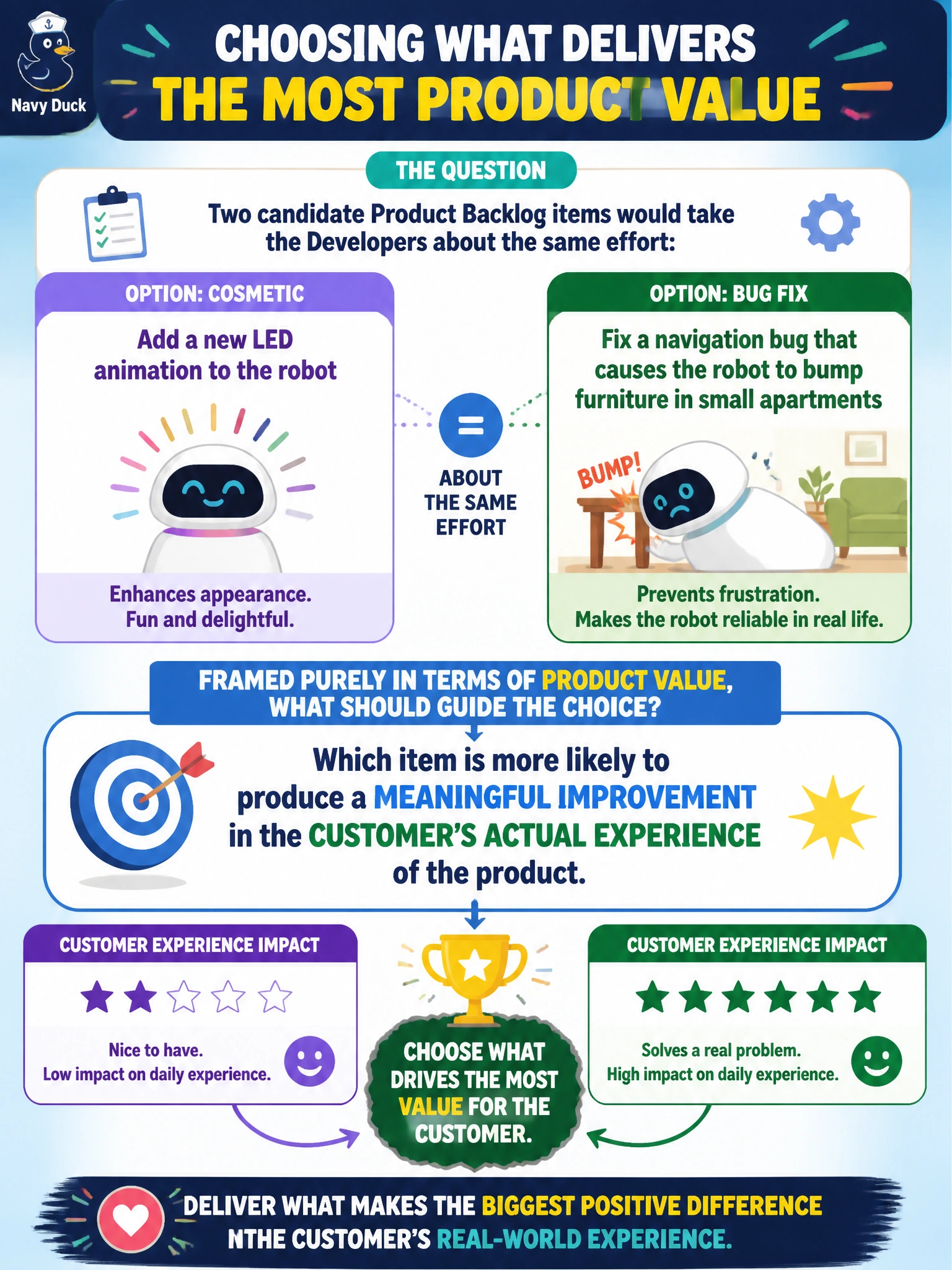
Two candidate Product Backlog items would take the Developers about the same effort: one adds a cosmetic new LED animation to the robot, and one fixes a navigation bug that causes the robot to bump furniture in small apartments. Framed purely in terms of product value, what should guide the choice?
Select an answer to reveal the explanation.
Short Explanation
A flashy demo moment and real product value aren't the same thing. If one fix stops the robot from crashing into furniture in someone's living room, that's the one actually worth the Sprint, regardless of which one looks better on stage.
Full Explanation
The mechanism is that value, the thing a Product Backlog exists to maximize, is about genuine improvement to the customer's experience of the product, not about how effort compares or how something performs in a showcase. A navigation fix that prevents real-world furniture collisions in small apartments plausibly outweighs a cosmetic animation in actual customer impact, even if both take similar effort. Choosing based on demo impressiveness optimizes for a moment at Sprint Review rather than for the product working well in someone's home, which inverts the point of the review. Choosing based on how quickly Done can be verified conflates ease of confirmation with value delivered, which are unrelated. First-requested-first-honored treats the Product Backlog as a queue rather than an ordered-by-value list, ignoring that ordering by value is the whole reason a Product Backlog is continuously reordered rather than processed in arrival order. Caveat: cosmetic work isn't automatically worthless, since it can matter for a different segment of value like desirability. Operational check: before ordering these two items, name explicitly what customer outcome each one is expected to improve.