
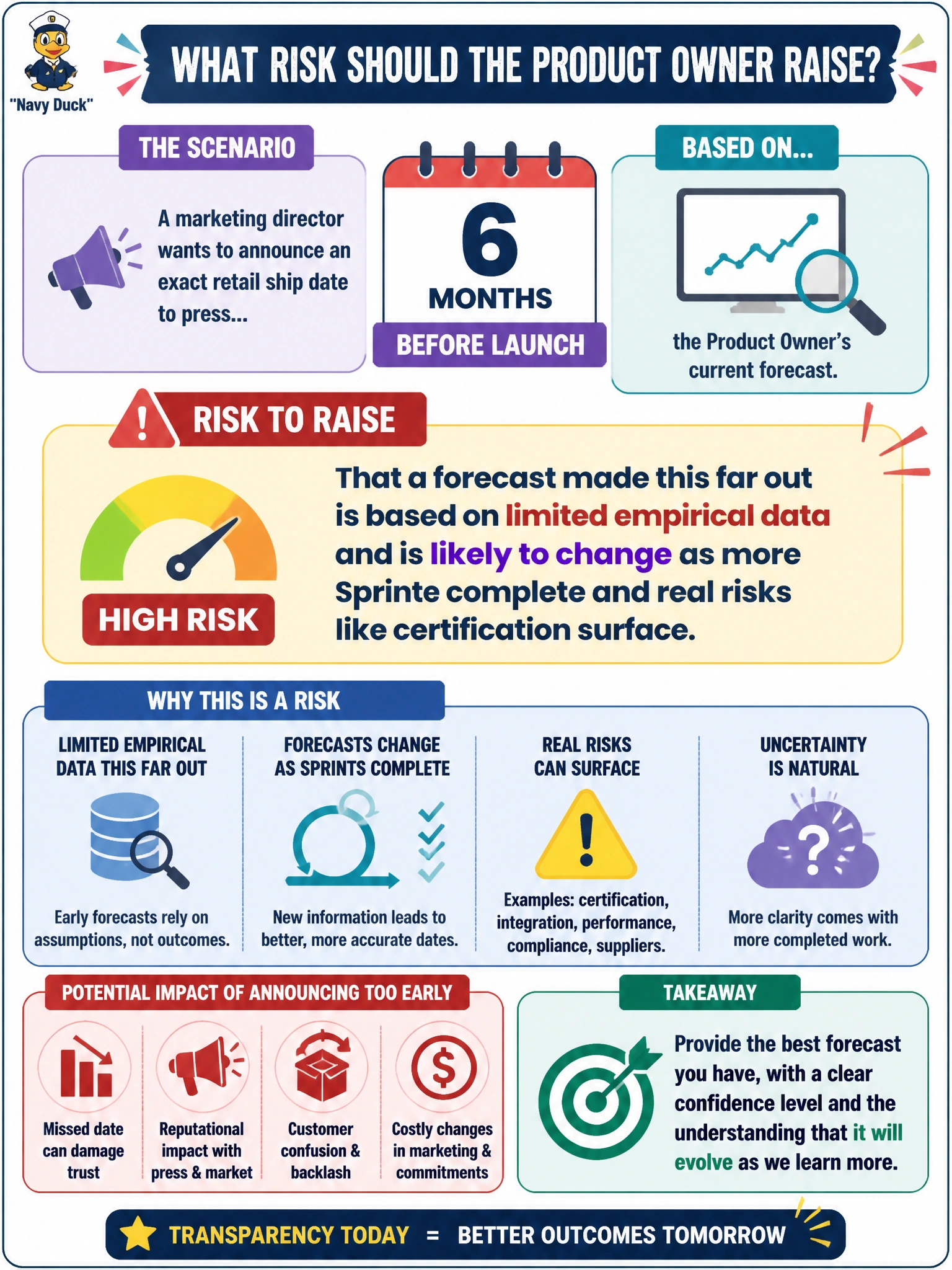
A marketing director wants to announce an exact retail ship date to press six months before launch, based on the Product Owner's current forecast. What risk should the Product Owner raise before agreeing?
Select an answer to reveal the explanation.
Short Explanation
Six months is a long runway, and a forecast that far out is built on the thinnest evidence the team will ever have. The honest move is to flag that the number will sharpen, or shift, as real Sprints and real risks like certification play out.
Full Explanation
The mechanism is that forecast confidence scales with the amount of empirical evidence behind it, and a forecast made six months out rests on comparatively little completed work, so it should be communicated as a range or a current best guess, not locked into a press announcement. Framing the concern as an accountability boundary misdirects the issue toward process ownership rather than the actual risk, which is forecast reliability. Raising overtime as the concern jumps to a labor-practice issue not implied anywhere in the scenario. Claiming a Sprint Goal six months out is already fixed is nonsensical under Scrum, since Sprint Goals are set at Sprint Planning for the Sprint directly ahead, not months in advance. Caveat: raising this risk doesn't mean refusing to give marketing any date at all, it means giving an honest, appropriately caveated one. Operational check: attach a stated confidence level or a re-forecast checkpoint to any externally shared date so it's clear the number can move.