
A regulatory safety certification the home robot's firmware must pass before retail sale has a historically unpredictable review timeline. The Product Owner is building a release plan for a fixed holiday launch window. What is the most empirically sound way to plan around this uncertainty?
Select an answer to reveal the explanation.
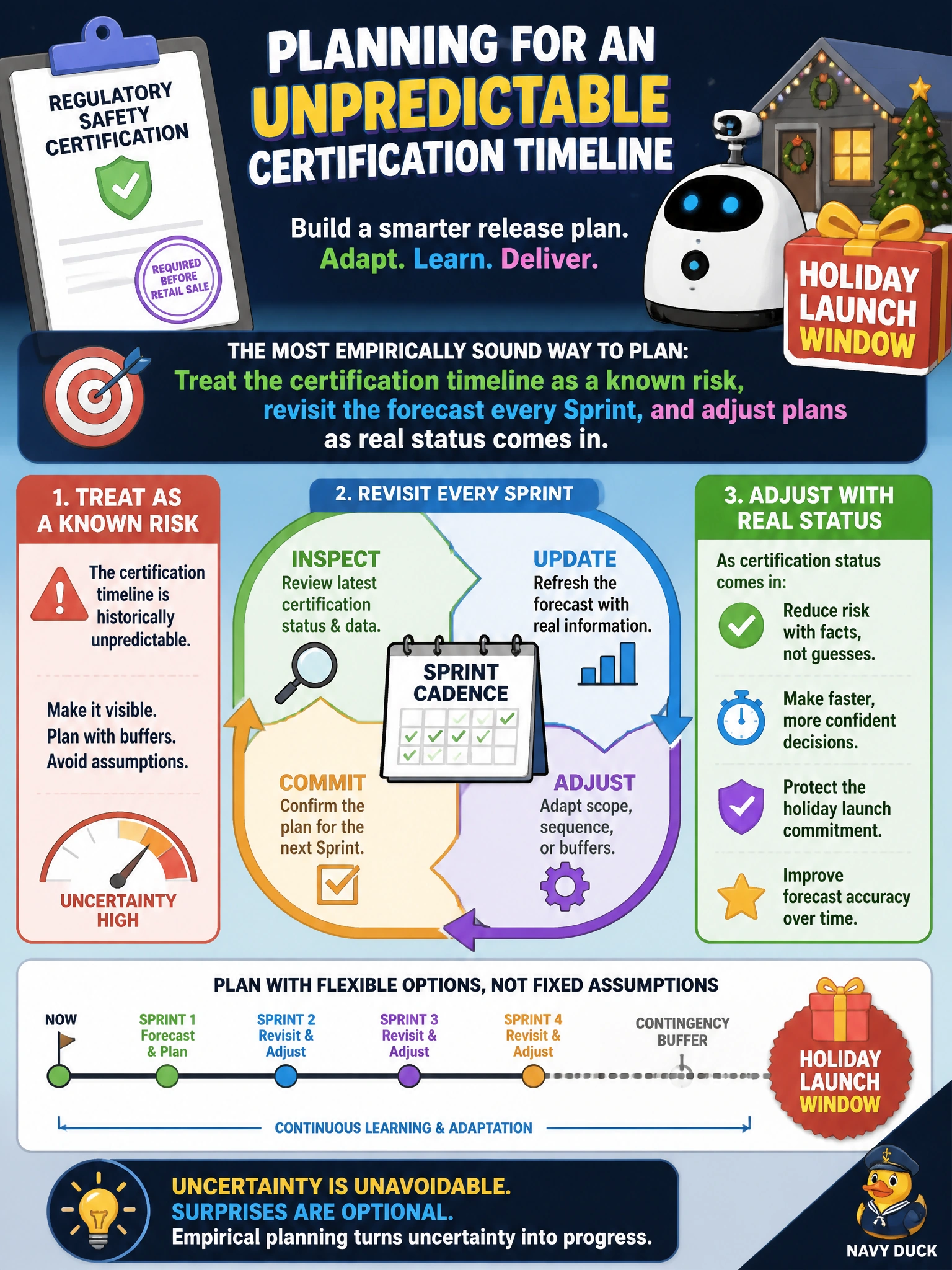
Short Explanation
You can't out-plan an unpredictable review board with a single spreadsheet made months in advance. The empirical move is to treat that uncertainty as a live risk and check in on it Sprint after Sprint, updating the plan as real information, not hope, comes in.
Full Explanation
The mechanism is applying empiricism to a known external risk: instead of freezing a release plan around an optimistic assumption, the Scrum Team inspects real certification status regularly and adapts the forecast as new facts appear, which is exactly the transparency-inspection-adaptation loop the Guide describes for handling uncertainty. Assuming a first-pass certification pass is the failure mode being tested here, since it substitutes hope for evidence and leaves no room to adapt if the review slips. Spacing Sprint Planning further apart breaks the fixed Sprint cadence for no real benefit and doesn't make the certification review any more predictable. Having the Scrum Master lobby a regulatory body confuses the Scrum Master's job of removing impediments the team can influence with authority over a third party the team has no control over. Caveat: none of this means ignoring the deadline, it means holding it loosely and communicating range, not certainty. Operational check: at every Sprint Review, report current certification status alongside the forecast so stakeholders see the plan update in real time rather than being surprised at the end.