
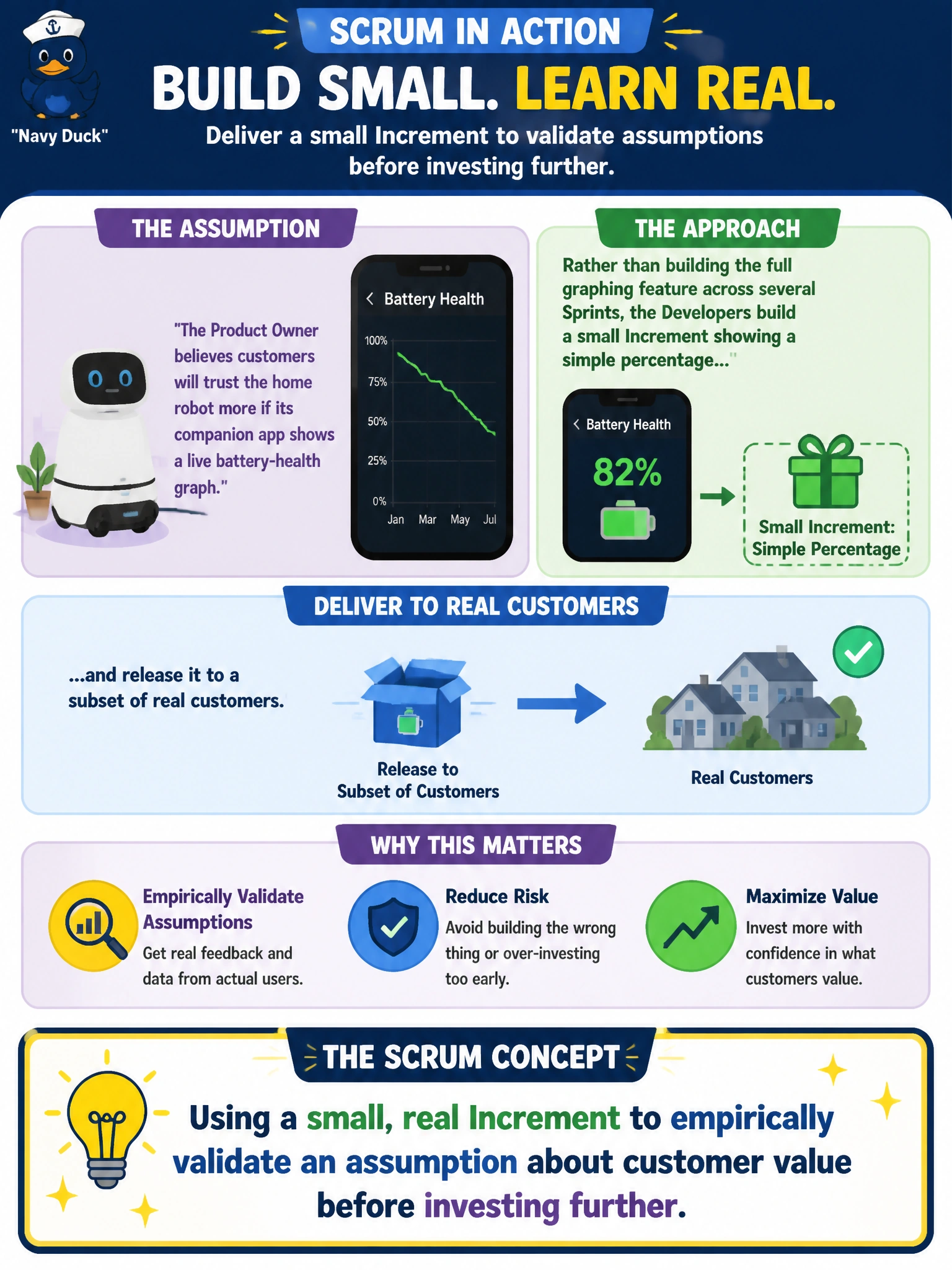
The Product Owner believes customers will trust the home robot more if its companion app shows a live battery-health graph. Rather than building the full graphing feature across several Sprints, the Developers build a small Increment showing a simple percentage and release it to a subset of real customers. What Scrum concept does this approach demonstrate?
Select an answer to reveal the explanation.
Short Explanation
Instead of guessing what customers want and building the whole thing, this team builds the smallest useful slice and lets real people tell them if the assumption holds. That's empiricism in action: inspect a real Increment, not a hunch, before deciding what to build next.
Full Explanation
The mechanism here is transparency, inspection, and adaptation applied to a value assumption rather than a technical one: a small, real Increment is exposed to actual customers so the team can inspect genuine usage data instead of speculating in a planning meeting. If the simple percentage doesn't move trust or engagement, the team adapts the Product Backlog rather than sinking more Sprints into a bigger graph nobody asked for. The delegation distractor misreads the scenario as being about who decides something technical, when it's actually about how a value hypothesis gets tested. The reordering distractor mistakes what happened here for a backlog-management action rather than an experiment. The Sprint Goal distractor invents a mid-Sprint change that isn't described at all. Caveat: this only works if the small Increment is genuinely usable and observable by real customers, not a mockup or an internal demo. Operational check: define, before releasing the slice, exactly what customer signal would count as validating or invalidating the assumption, so the next Sprint Review has something concrete to inspect.